Poles / Comparison
Pole systems vs shepherd's hooks
The hook wins on price, looks and portability. The system wins on the only thing that decides whether squirrels get your seed: height.
In Feeder Poles
Buy a pole system if you want a baffle to work, because it puts the baffle at four to five feet with the feeder above it and anchors properly. Buy a shepherd's hook if the feeder is light, the site is decorative, and you plan to exclude at the feeder with a cage rather than at the pole with a baffle.
| Pole system | Shepherd's hook | |
|---|---|---|
| Typical height | Enough for a baffle at 4 to 5 ft with the feeder above | Often 4 to 6 ft, which does not leave room for both |
| Baffle | Frequently integrated, at the right height | Rarely fits; the curve resists clamping |
| Anchoring | Auger on the systems here | Usually a spike |
| Load | Rated for multiple feeders | Designed for a hanging basket |
| Cost | Higher | Lower |
| Looks | Utilitarian | Decorative |
| Portability | Fixed once anchored | Moves in a minute |
Baffleworks is funded by affiliate commission. If you buy through a link on this page we may earn a commission at no extra cost to you, and it never decides a ranking. Full disclosure · how we pick.
Quick picks
Ranked, with the trade-off named. Tap a row for the full write-up; the price button goes straight to Amazon.
| # | Product | Best for | Price |
|---|---|---|---|
| 1 |  Ceoighe 95 in Feeder Pole with Torpedo Baffle, 4 armsA complete station in one box: five pole sections, four arms, a torpedo baffle and an auger. The geometry arrives assembled rather than assembled by you from three sellers. | A complete station, baffle included | $70.99 on Amazon |
| 2 | 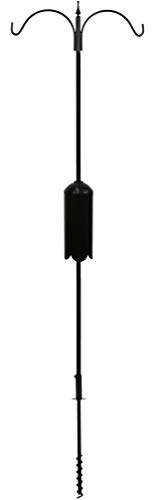 Kettle Moraine 2-Arm Pole Set with Squirrel BaffleA two-arm set that anchors with a twister ground socket rather than a stake, which is the part of a pole system that usually decides whether it is still vertical in year two. | Two feeders, nothing more | $127.00 on Amazon |
| 3 |  Girvenith Metal Caged Seed Feeder, 4 portA steel cage around an enclosed seed compartment, sized so finches and chickadees pass and larger birds do not. The cheapest honest cage on this page. | Small songbirds in a small space | $21.59 on Amazon |
#ad how we are funded · price as of October 24, 2026
The picks in full
Top pick A complete station, baffle included
Ceoighe 95 in Feeder Pole with Torpedo Baffle, 4 arms
A complete station in one box: five pole sections, four arms, a torpedo baffle and an auger. The geometry arrives assembled rather than assembled by you from three sellers.
Fits: Ground-set
Published specifications
- Total height
- 95 in (published)
- Pole diameter
- 1.5 in rust-resistant steel (published)
- Sections
- 5 (published)
- Hanging arms
- 4 horizontal arms (published)
- Baffle
- Torpedo, moves up/down and side to side (published)
- Ground anchor
- Auger stake with twist rod (published)
Trade-offs
- Baffle and auger in the box, so the clearance geometry does not depend on a second purchase
- An auger rather than a spike — the difference between a pole that stays vertical and one that leans by February
- 1.5 in steel is stiffer than the 1 in tube most kits use, which matters under four loaded feeders
- A torpedo that moves is harder to stand on than a fixed disk
- Publishes no baffle-top height, so you have to measure where the baffle lands and adjust rather than trust the box
- Publishes no load rating, unlike some competitors that state a figure in pounds
- Four arms is an invitation to hang four feeders, and four feeders is a great deal of spilled seed in one spot
- No stated setback — the 8 to 10 ft rule comes from Audubon and Cornell, not from this maker
Who it is forA first proper feeding station on open ground, where you want the pole, the baffle and the anchor to arrive together.
Skip it ifYour plot cannot give it eight to ten feet of clear air. No pole on this page fixes that — the clearance spec does, or a caged feeder does.
#ad how we are funded · price as of October 24, 2026
Where these specifications came from
No. 2 Two feeders, nothing more
Kettle Moraine 2-Arm Pole Set with Squirrel Baffle
A two-arm set that anchors with a twister ground socket rather than a stake, which is the part of a pole system that usually decides whether it is still vertical in year two.
Fits: Ground-set
Published specifications
- Height
- Approximately 85 in above ground assembled (published)
- Arms
- 2, with 12 in reach from the pole (published)
- Pole
- 1 in diameter, 3 sections (published)
- Baffle
- Squirrel baffle included (published)
- Anchor
- Twister ground socket (published)
- Material
- Black powder-coated steel (published)
- Origin
- Made in USA (published)
Trade-offs
- A threaded ground socket is published as stronger than a stake, and anchoring is where cheap poles fail
- Two arms is the honest number for most yards — enough for a seed feeder and a suet or water station
- Publishes its assembled height and its arm reach, so you can check the geometry before ordering
- Made in USA with a published material spec rather than 'heavy duty steel'
- Publishes no baffle diameter and no baffle mounting height — the two numbers that decide whether it works
- 1 in pole is thinner than the 1.25 to 1.5 in used by the heavier kits here
- Costs more than kits that include more arms, because the money is in the socket and the steel
- Two arms is a ceiling, not a starting point
Who it is forSomebody who wants two feeders done properly and permanently, and values the anchor over the arm count.
Skip it ifYou want a feeding station with four or more feeders. Buy the pole built for that rather than adding hooks to this one.
#ad how we are funded · price as of October 24, 2026
Where these specifications came from
No. 3 Small songbirds in a small space
Girvenith Metal Caged Seed Feeder, 4 port
A steel cage around an enclosed seed compartment, sized so finches and chickadees pass and larger birds do not. The cheapest honest cage on this page.
Published specifications
- Mechanism
- Fixed cage aperture
- Dimensions
- 6.25" L x 6.25" W x 10.25" H (published)
- Feeding ports
- 4 (published)
- Cage
- Durable steel exterior (published)
- Weather
- Rainproof cover; all-weather metal (published)
- Named birds
- Finches and chickadees welcomed, larger birds discouraged (published)
- Filling
- Wide-opening metal top (published)
Trade-offs
- Publishes its actual cage body dimensions, which is how you predict which birds get in
- A fixed aperture ignores weight, so it stops the chipmunk and red squirrel a weight trigger lets through
- All-metal with a rainproof cover — no plastic tube to chew or craze
- Small enough to hang almost anywhere, and cheap enough to try
- The listing publishes the cage body size but not the mesh opening, which is the number that would settle exactly which birds fit
- Excludes cardinals, jays and grosbeaks along with the squirrels — the trade, not a defect
- No published seed capacity, and a 10.25 in body will not hold much
- 'Squirrel proof' in the title is doing more work than the cage alone can — placement still matters
Who it is forA small yard with chipmunks or red squirrels, where finches and chickadees are the birds you actually want.
Skip it ifYou want cardinals. A 6.25 in cage body is the mechanism working as designed, and no setting changes it — see the cardinal page.
#ad how we are funded · price as of October 24, 2026
Where these specifications came from
The height argument, in numbers
Audubon puts the baffle four to five feet off the ground, and the feeder has to sit above it. That needs roughly six feet of usable shaft as an absolute floor, and more in practice so the feeder is not resting on the baffle.
Most decorative shepherd's hooks are four to six feet tall, because they were designed for hanging baskets. A complete pole system publishes 95 inches — close to eight feet — before the arms are counted. That is the whole comparison: one of these products has room for the geometry and the other does not.
The load argument
Woodlink's Absolute II publishes a 12 lb seed capacity. Twelve pounds of seed plus the feeder on a thin decorative rod is asking a garden ornament to do structural work. Hooks bend, and a bent hook drops the feeder to a height where none of the geometry applies any more.
If you want a large-capacity feeder, that decision has already chosen a pole for you.
Where the hook genuinely wins
- Small, light feeders. A caged feeder such as the Girvenith publishes 10.25 x 6.25 x 6.25 in — small and light enough that a hook is a coherent, sensible place for it.
- Renting, or an uncertain layout. A hook moves in a minute; an auger-anchored pole does not.
- Anywhere you cannot dig. Patios, gravel, tree roots, a septic field. A spike goes in where an auger will not.
- When the look matters. A shepherd's hook among planting reads as a garden; a four-station steel pole reads as equipment.
The hybrid answer
Keep the hook, change the feeder. If the hook is too short to baffle, put a caged feeder on it and let exclusion happen at the seed rather than on the shaft. A cage does not care how tall the hook is, and it also handles chipmunks and starlings that a weight mechanism would miss.
That is a genuinely good outcome, not a consolation prize. What does not work is a baffle on a five-foot hook — the shepherd's hook baffle page goes through why.
If the feeder in question is a camera feeder, the hook loses even harder — it puts an expensive camera at the end of a lever with no room for a baffle. The pole page for camera feeders covers what to buy instead.
If the hook wins that argument for your yard, the next question is which hook. The best heavy-duty shepherd's hooks ranks them on the three specs that decide whether a baffle can do its job: height, shaft diameter and prong count.
How we picked
- We judged poles on the geometry they produce: where the baffle sits, how high the feeder hangs, and what setback the maker states.
- We recorded published figures only — station counts, hanging heights, anchoring type, stated setbacks. Where a listing publishes nothing, we say so.
- We treated a published setback as a specification, not marketing. Squirrel Stopper prints ten feet in its own instructions, and that is a constraint on your yard before it is a feature of the pole.
- We named at least one product to skip on every page, with the reason.
- We have not installed any of these. How we pick sets out what that does and does not cover.
Everyone in this category says they tested twenty of these. We have not tested any, and we say so. What we did instead: read the manuals, compiled the published specifications, worked out the clearance geometry, and cited every source. The full method is published.
Questions people actually ask
- Can squirrels climb shepherd's hooks?
- Yes, easily. The problem is not the surface, it is the height: a hook is usually too short to place a baffle at four to five feet with the feeder still above it.
- Are pole systems worth the money?
- If you want a baffle to work, yes, because they remove the two things people get wrong: baffle height and pole strength. If you are going to exclude at the feeder instead, a hook is fine.
- How tall should a feeder pole be?
- Tall enough for the baffle top to sit at four to five feet with the feeder above it, which puts the feeder around five and a half to six and a half feet. Complete pole systems publish overall heights of roughly 85 to 95 in to allow for it.
- Can I put a baffle on a shepherd's hook at all?
- Only on a tall one, and only with a torpedo or cylindrical type sized to the shaft. Measure the shaft first — no cylinder here publishes a shaft fit, so the measurement is on you.
Sources
Read next
- The best squirrel-proof bird feeder poles
Pole systems ranked on baffle height, anchoring and the ten-foot setback one maker actually publishes.
- Squirrel baffles for shepherd's hooks
Why hooks disappoint, what fits a shaft, and when a caged feeder beats a baffle entirely.
- Caged bird feeders
Exclusion by size rather than weight: the mechanism that beats chipmunks, red squirrels and starlings.
- How high should a squirrel baffle be?
Four to five feet high, eight to ten feet clear. The sourced numbers, the arithmetic, and the popular page that gets it wrong.
- Feeder Poles
Complete pole systems and shepherd's hooks, judged on baffle height, anchoring and the setback they need.