Feeders / Cardinals
The best squirrel-proof bird feeders for cardinals
Cardinals are one of the easiest birds to attract and one of the easiest to accidentally lock out. The problem is not the bird, it is the mechanism you chose to stop squirrels.
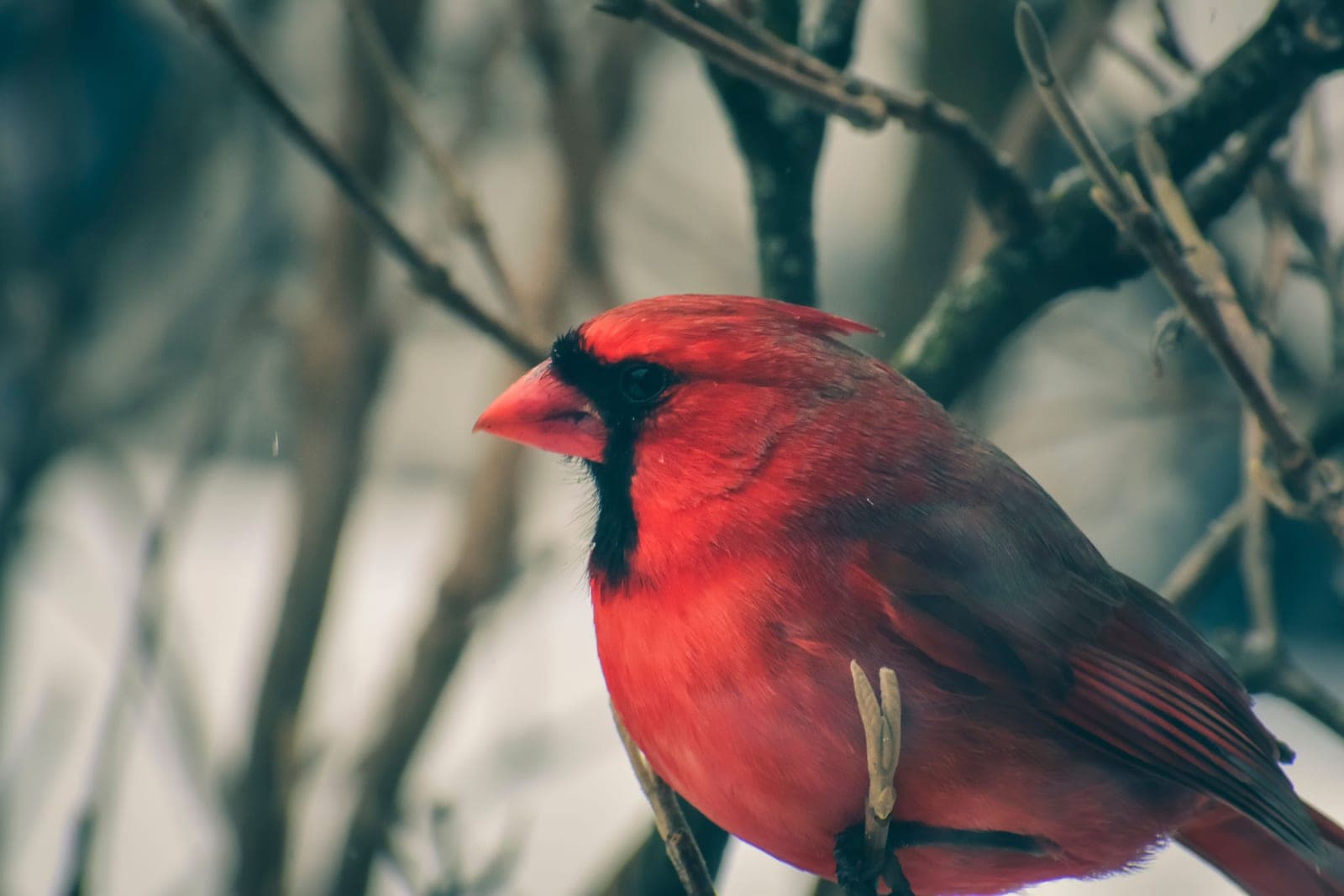
Buy a weight-activated feeder with a published cardinal ring, not a caged one. Brome's Squirrel Buster Evolution is the only model we found built around cardinals — a double cardinal ring the maker describes as extra-wide because cardinals prefer to face their food. Cages exclude by aperture, which is not a setting you can adjust.
Cardinals are, by every account, easy. Audubon calls them one of the easiest birds to attract to your feeders and says they are not picky at all. Cornell's guidance is that nearly any feeder ought to attract them. So when somebody cannot get cardinals onto a feeder, the bird is almost never the variable.
What changed is that they bought a squirrel-proof feeder. Every mechanism that keeps a squirrel out works by excluding something, and the two available mechanisms exclude in ways that can catch a large bird as collateral.
The two mechanisms, and how each one fails a cardinal
| Mechanism | How it excludes | How it can catch a cardinal | Fixable? |
|---|---|---|---|
| Weight-activated | A shroud drops under mass and closes the ports | A trigger set heavy to exclude grackles can also close on the heavier birds you wanted | Yes — it is a calibration, and the adjustable models let you back it off |
| Caged | A fixed steel aperture admits only small birds | The aperture does not care what you wanted. A cage sized to stop a chipmunk is a cage a cardinal cannot comfortably use | No — it is geometry, and there is no setting |
This is the whole decision. If cardinals matter, you are buying a weight mechanism, and the only question left is which one publishes a cardinal provision.
That distinction also explains a common and frustrating pattern: a feeder that works beautifully for chickadees and finches and never sees a cardinal. Nothing is broken. The mechanism is doing precisely what it was sold to do.
The evidence that this is a real problem
We are not going to tell you how wide a cardinal is, because we have not found a source that publishes a perch-size or body-length threshold, and inventing one would be exactly the kind of thing our editorial policy forbids.
There is better evidence available anyway, and it comes from the makers. Brome, the company that defined this category, sells a Cardinal Ring as a named product feature — and on the Evolution, a Double Cardinal Ring. Its published rationale is specific: the ring is extra-wide and easy to grip, designed especially for cardinals, since they prefer to face their food supply.
It also gives you a clean buying rule. Within one manufacturer's own range, some models get a cardinal ring and some do not. That is the maker sorting its own line for you.
What we ranked on
- A published cardinal provision. A cardinal ring, and whether it is single or double. This is the only cardinal-specific spec anyone publishes, and it separates the range cleanly.
- Mechanism type. Weight over cage, without exception, for the reason in the table above.
- Adjustability. A tunable trigger is what lets you exclude a squirrel without excluding a cardinal. A fixed trigger is a decision somebody else made for your yard.
- Capacity. Cardinals feed at dawn and dusk, so a feeder that runs dry mid-afternoon misses them entirely. Published capacities here run from 1.3 lb to 12 lb.
- Seed condition. Ventilation and water management, because damp seed empties a feeder of birds faster than any mechanism does.
Deliberately not ranked on: how cardinal-friendly a listing *says* it is. Several feeders in this category use cardinals in the marketing copy without publishing any cardinal provision at all.
Baffleworks is funded by affiliate commission. If you buy through a link on this page we may earn a commission at no extra cost to you, and it never decides a ranking. Full disclosure · how we pick.
Quick picks
Ranked, with the trade-off named. Tap a row for the full write-up; the price button goes straight to Amazon.
| # | Product | Best for | Price |
|---|---|---|---|
| 1 |  Brome Squirrel Buster EvolutionThe only feeder we found built around cardinals rather than accommodating them: a double cardinal ring Brome describes as extra-wide and easy to grip, because cardinals prefer to face their food. | Cardinals specifically | $72.51 on Amazon |
| 2 |  Brome Squirrel Buster PlusThe weight-activated shroud done properly: a squirrel's weight closes the ports, and the cardinal ring means the mechanism does not cost you the big birds. | Weight-activated, most capacity | $129.25 on Amazon |
| 3 | 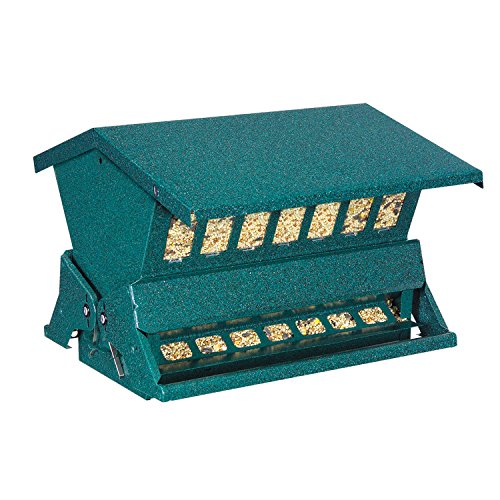 Woodlink Absolute II (7536)The big one: twelve pounds of seed, which changes refilling from a weekly job to a monthly one on most yards. | Highest capacity, double-sided | $84.00 on Amazon |
| 4 |  Brome Squirrel Buster LegacyFour removable metal perches and a chew-proof build, which is the most perch a Brome feeder publishes without going to a ring. | Removable metal perches | $66.20 on Amazon |
| 5 |  Brome Squirrel Buster ClassicThe one in the range that publishes seed ventilation and a wire mesh for shared feeding, which changes how many birds can be on it at once. | Shared feeding and seed ventilation | $78.00 on Amazon |
| 6 | 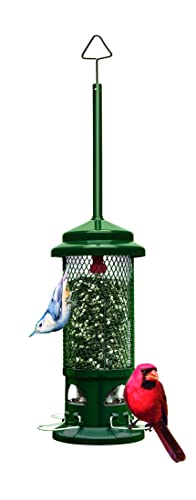 Brome Squirrel Buster StandardThe smallest Brome, with four metal perches and a 1.3 lb reservoir. The cheapest way into a mechanism that genuinely works on gray squirrels. | Small spaces and a low entry price | $59.93 on Amazon |
#ad how we are funded · price as of October 24, 2026
The picks in full
Top pick Cardinals specifically
Brome Squirrel Buster Evolution
The only feeder we found built around cardinals rather than accommodating them: a double cardinal ring Brome describes as extra-wide and easy to grip, because cardinals prefer to face their food.
Published specifications
- Cardinal provision
- Double Cardinal Ring (published)
- Brome's stated rationale
- Extra-wide, easy to grip, because cardinals prefer to face their food supply
- Seed capacity
- 1.9 lb (published)
- Mechanism
- Weight-activated shroud closes the ports
- Water management
- Built-in diverter: trough, spout and a drip edge above each port (published)
- Cleaning
- Tool-free; every component separates by hand (published)
- Recognition
- Wild Bird Feeding Institute Birding Product of the Year 2025 (per Birding Wire)
Trade-offs
- A double cardinal ring is the only purpose-built cardinal provision we found in a squirrel-proof feeder
- Brome publishes WHY the ring exists rather than just naming it, which is unusually specific for this category
- The water diverter is a genuinely uncommon spec: wet seed is what spoils a feeder between refills
- Tool-free disassembly means it will actually get cleaned, which weight-shroud feeders need
- Carries a named third-party award rather than a star rating
- 1.9 lb is a small reservoir — under half the Squirrel Buster Plus, so expect more refills
- It is the newest model here, so there is less of a track record behind it than the Plus or the Classic
- Still a weight mechanism: too light for chipmunks and red squirrels to trip, same as the rest of the line
Who it is forAnyone whose actual complaint is that cardinals will not use their squirrel-proof feeder. This is the model built for that exact problem.
Skip it ifYou refill reluctantly. At 1.9 lb this is the smallest reservoir on the page, and the Squirrel Buster Plus carries 5.1 lb with a cardinal ring of its own.
#ad how we are funded · price as of October 24, 2026
No. 2 Weight-activated, most capacity
Brome Squirrel Buster Plus
The weight-activated shroud done properly: a squirrel's weight closes the ports, and the cardinal ring means the mechanism does not cost you the big birds.
Published specifications
- Seed capacity
- 5.1 lb (published)
- Feeding ports
- 6
- Mechanism
- Weight-activated shroud, adjustable
- Included
- Cardinal ring
- Pole mounting
- Pole-mountable; pole adaptor sold separately
Trade-offs
- 5.1 lb capacity means fewer refills through a hard winter
- Adjustable weight setting, so you can shut out grackles without shutting out cardinals
- The cardinal ring is the fix for the usual complaint about shroud feeders
- The pole adaptor is a separate purchase, which is easy to miss at checkout
- A weight mechanism is a mechanism: it needs the occasional clean to keep moving freely
Who it is forThe default first purchase if you would rather solve the problem at the feeder than at the pole. It also pairs well with a baffle rather than replacing one.
Skip it ifYour problem is chipmunks or small red squirrels. A weight-activated shroud is calibrated for something heavier, and a light animal can feed under the trigger point. A caged feeder is the better answer there.
#ad how we are funded · price as of October 24, 2026
Where these specifications came from
No. 3 Highest capacity, double-sided
Woodlink Absolute II (7536)
The big one: twelve pounds of seed, which changes refilling from a weekly job to a monthly one on most yards.
Published specifications
- Model
- 7536
- Seed capacity
- 12 lb (published)
- Type
- Hopper with weight-activated perch bar
Trade-offs
- 12 lb published capacity is the largest on this page by a wide margin
- Fewer refills means fewer trips out to a pole you would rather not disturb
- Twelve pounds of seed plus the feeder is real weight on a shepherd's hook
- Seed at the bottom of a big hopper can sit long enough to spoil in humid weather
Who it is forA busy yard, or anyone who has decided that refilling twice a week is the actual problem.
Skip it ifYou are hanging this from a thin hook. Check what your hook is rated for before you put twelve pounds of seed on it — a pole system is the honest answer at this capacity.
#ad how we are funded · price as of October 24, 2026
Where these specifications came from
No. 4 Removable metal perches
Brome Squirrel Buster Legacy
Four removable metal perches and a chew-proof build, which is the most perch a Brome feeder publishes without going to a ring.
Published specifications
- Perches
- 4 metal, removable (published)
- Seed capacity
- 2.6 lb (published)
- Construction
- Chew-proof (published)
- Cleaning
- Tool-free (published)
- Cardinal ring
- Not published for this model
Trade-offs
- Removable perches are a real feature: you can take them off to discourage larger nuisance birds, or leave them on
- Metal rather than plastic perches, which is what gets chewed first on a feeder squirrels visit
- 2.6 lb sits between the Standard and the Plus, which suits most yards
- Chew-proof construction is published rather than implied
- No cardinal ring published for this model, so cardinal access is down to the standard perches
- Perches, not a ring — Brome's own product line implies that is a meaningful difference for cardinals
- Same weight-trigger limitation against chipmunks and red squirrels
Who it is forA general-purpose squirrel-proof feeder where cardinals are welcome but not the specific reason for the purchase.
Skip it ifCardinals are the whole point. Brome sells a cardinal ring on two other models and not on this one, and that is a distinction worth taking at face value.
#ad how we are funded · price as of October 24, 2026
Where these specifications came from
No. 5 Shared feeding and seed ventilation
Brome Squirrel Buster Classic
The one in the range that publishes seed ventilation and a wire mesh for shared feeding, which changes how many birds can be on it at once.
Published specifications
- Feeding ports
- 4 (published)
- Seed capacity
- 2.4 lb (published)
- Mechanism
- Weight-sensitive closure (published)
- Seed condition
- Seed ventilation (published)
- Shared feeding
- Wire mesh (published)
- Cardinal ring
- Not published for this model
Trade-offs
- Seed ventilation is a published spec and directly addresses the damp-seed problem that spoils a reservoir
- The wire mesh is described for shared feeding, so more than one bird can work it at a time
- A long-standing model with a track record behind it
- No cardinal ring published, so this is not the cardinal-first choice in Brome's own line
- A mesh surface is something a bird has to cling to rather than perch on
- 2.4 lb is mid-range capacity
Who it is forA busy feeder where several small birds feed at once and damp seed has been the recurring annoyance.
Skip it ifYou are buying for cardinals. The Evolution and the Plus are the two models Brome fits a cardinal ring to, and this is not one of them.
#ad how we are funded · price as of October 24, 2026
Where these specifications came from
No. 6 Small spaces and a low entry price
Brome Squirrel Buster Standard
The smallest Brome, with four metal perches and a 1.3 lb reservoir. The cheapest way into a mechanism that genuinely works on gray squirrels.
Published specifications
- Perches
- 4 metal (published)
- Seed capacity
- 1.3 lb (published)
- Mechanism
- Weight-activated shroud
- Cardinal ring
- Not published for this model
Trade-offs
- Lowest price of entry to a weight mechanism from the brand that defined the category
- Metal perches even at the smallest size
- Light enough for a shepherd's hook that would bend under a large hopper
- 1.3 lb is a genuinely small reservoir and will need refilling often in a busy yard
- No cardinal ring published
- Smallest body in the range, so the least comfortable for a large bird
Who it is forA balcony, a small courtyard, or a first squirrel-proof feeder where the point is finding out whether the mechanism works for you.
Skip it ifCardinals are the target. This is the smallest feeder in the range with no cardinal provision published, which makes it the least likely of the six to satisfy them.
#ad how we are funded · price as of October 24, 2026
Where these specifications came from
What we would skip
Caged feeders, if cardinals are the point
A cage excludes by aperture, and the apertures in this category are sized for small songbirds — Girvenith publishes a 6.25 in cage body. That is not a tuning problem you can solve; it is the mechanism working exactly as designed. Caged feeders are the right answer for chipmunks and starlings and the wrong one here.
An open platform feeder as your squirrel-proof answer
Cornell notes cardinals readily use platform feeders, and they do — but a platform is the least squirrel-resistant format that exists. It is a tray of seed at a convenient height. Run one if you enjoy the visits, but do not expect it to survive a squirrel, and do not count it as your defense.
Setting an adjustable weight trigger to its heaviest position by default
On the adjustable models the trigger is not a squirrel setting, it is a which-birds setting. Wound all the way up to exclude grackles, it can start excluding the large birds you wanted. Set it as light as your actual squirrel problem allows.
Nyjer or thistle, if you are feeding for cardinals
Audubon is direct about this: your best bet is black oil sunflower, then striped sunflower, then sunflower chips. Nyjer is a finch seed. The feeder mechanism gets the blame for a lot of empty-looking cardinal feeders that are simply filled with the wrong thing.
Get the seed right before you blame the feeder
This is the cheapest fix on the page and it is regularly the actual problem. Audubon's ordering is explicit: your best bet is black oil sunflower seeds, and after black oil sunflower, their next-favorite feeder fare is striped sunflower seeds, followed by sunflower chips. Cardinals will also take peanuts, cracked corn and suet.
Cornell adds safflower to the list, which is worth knowing for a second reason: safflower is markedly less attractive to squirrels than sunflower. Filling a cardinal feeder with safflower reduces the pressure on the mechanism at the same time as feeding the bird you wanted. It is the closest thing to a free win in this whole category.
If the feeder is full of nyjer, no mechanism on this page will produce a cardinal.
Placement matters here too, for a different reason
The usual clearance rules apply — baffle top at four to five feet, about ten feet of clear air, per Audubon and the Alabama Cooperative Extension System. Those exist to stop squirrels and they are covered in full in the clearance guide.
But there is a cardinal-specific consideration on top. Cardinals feed heavily at dawn and dusk, in low light, and they are a ground-and-shrub bird by habit. A feeder sited in the open with nothing nearby to retreat into is one they will use more warily than a feeder with cover within a short flight. The tension with the ten-foot rule is real and it resolves cleanly: keep the ten feet of clear air around the pole, and put the cover just outside that radius. You are trying to deny a squirrel a launch pad, not deny a bird an escape route.
The setup we would actually buy
- A weight-activated feeder with a cardinal ring — the Evolution if cardinals are the priority, the Plus if capacity is.
- Black oil sunflower or safflower, not a mixed bag and not nyjer.
- A [baffled pole](/poles/best-squirrel-proof-bird-feeder-poles) with the baffle top at four to five feet, so the feeder's trigger can be set light. The lighter you can set it, the more comfortably the big birds feed.
- Cover just outside the ten-foot radius — a shrub or a low tree the birds can drop back into.
That last point is the one nobody mentions and it is free: a correctly baffled pole means you are not relying on the feeder mechanism to do the excluding, which means you can run the trigger at its lightest setting, which is exactly the setting cardinals want. The pole and the bird are on the same side.
For the full Brome lineup beyond the cardinal question — capacity, the adjustable trigger, the water diverter — the five-model Squirrel Buster comparison puts every published figure in one table.
Goldfinches need the opposite feeder: tiny ports, and a seed almost nothing else wants. Squirrel-proof finch feeders covers the nyjer side, including why those feeders get wrecked by animals that do not even want the seed.
Two other species pages sit either side of this one: orioles, which take nectar, jelly and fruit rather than seed, and chickadees and nuthatches, which feed by taking one seed and carrying it off rather than sitting to eat.
How we picked
- We started from a published cardinal provision. Brome fits a Cardinal Ring to two models in its range and not to the others, and we treated that distinction as meaningful rather than cosmetic.
- We recorded only published figures: capacity, port and perch counts, ring type, ventilation, cleaning method.
- We did not invent bird anatomy. Neither Audubon nor Cornell publishes a perch-size or body-length threshold for cardinals, so no claim on this page rests on one — the argument runs on the makers' own product decisions instead.
- We separated the two exclusion mechanisms, because they fail cardinals for different reasons: mass can be tuned, geometry cannot.
- We have not tested any of these. How we pick sets out what that does and does not cover.
Everyone in this category says they tested twenty of these. We have not tested any, and we say so. What we did instead: read the manuals, compiled the published specifications, worked out the clearance geometry, and cited every source. The full method is published.
Questions people actually ask
- What is the best squirrel-proof bird feeder for cardinals?
- Brome's Squirrel Buster Evolution, because it is the only model we found with a published Double Cardinal Ring — described by the maker as extra-wide and easy to grip, since cardinals prefer to face their food supply. The Squirrel Buster Plus has a single cardinal ring and far more capacity at 5.1 lb.
- Why won't cardinals use my squirrel-proof feeder?
- Usually the mechanism. A cage excludes by a fixed aperture sized for small songbirds and no setting will change that. A weight trigger set heavy to exclude grackles can also close on larger birds. Check the seed too — Audubon says black oil sunflower is your best bet, and nyjer is a finch seed.
- Will cardinals use a caged feeder?
- Awkwardly at best, and often not at all. The aperture is the mechanism, and it is sized to stop chipmunks and starlings. If cardinals matter, buy a weight-activated feeder with a cardinal ring instead.
- What is a cardinal ring?
- A wide perching ring around the base of the feeder. Brome publishes the rationale: it is extra-wide and easy to grip, designed for cardinals because they prefer to face their food supply. The Evolution has a double version; the Squirrel Buster Plus has a single one.
- What seed attracts cardinals?
- Black oil sunflower first, per Audubon, then striped sunflower, then sunflower chips. Cornell adds safflower. Safflower is worth choosing deliberately because it is also markedly less attractive to squirrels, so it reduces pressure on the feeder while feeding the bird you want.
- Do cardinals prefer platform feeders?
- Cornell notes they readily use them. The catch is that a platform is the least squirrel-resistant format there is — an open tray of seed. Enjoy one if you like, but do not count it as your squirrel defense.
- Where should I put a feeder to attract cardinals?
- Keep the standard ten feet of clear air around the pole so squirrels cannot jump to it, and site cover just outside that radius. Cardinals feed at dawn and dusk and prefer somewhere to retreat to; the two requirements do not actually conflict once you place the cover outside the launch radius.
Sources
- Audubon, How to Stop Squirrels From Raiding Your Bird Feeders
- Cornell Lab of Ornithology, How to Deal With Unwanted Yard Visitors
- Alabama Cooperative Extension System, Controlling Eastern Gray Squirrel Damage
- Audubon, How to Attract Northern Cardinals to Your Home
- Cornell Lab of Ornithology, Northern Cardinal Life History
Read next
- The best squirrel-proof bird feeders
Seven feeders ranked by mechanism and published capacity, and which animal each one actually excludes.
- Weight-activated vs caged feeders
Mass versus geometry: which mechanism stops which animal, and what each one costs you in birds.
- Weight-activated feeders
How the shroud and perch-bar mechanisms work, what the adjustment is really for, and where they stop.
- How high should a squirrel baffle be?
Four to five feet high, eight to ten feet clear. The sourced numbers, the arithmetic, and the popular page that gets it wrong.
- Squirrel-Proof Feeders
Weight-activated, caged and spinning feeders, sorted by which animal each mechanism actually keeps out.