Guides / The clearance spec
How high should a squirrel baffle be?
Two numbers decide whether your setup works, and they are the two numbers most pages in this category either omit or confuse with each other. Here they are, with their sources and the arithmetic.
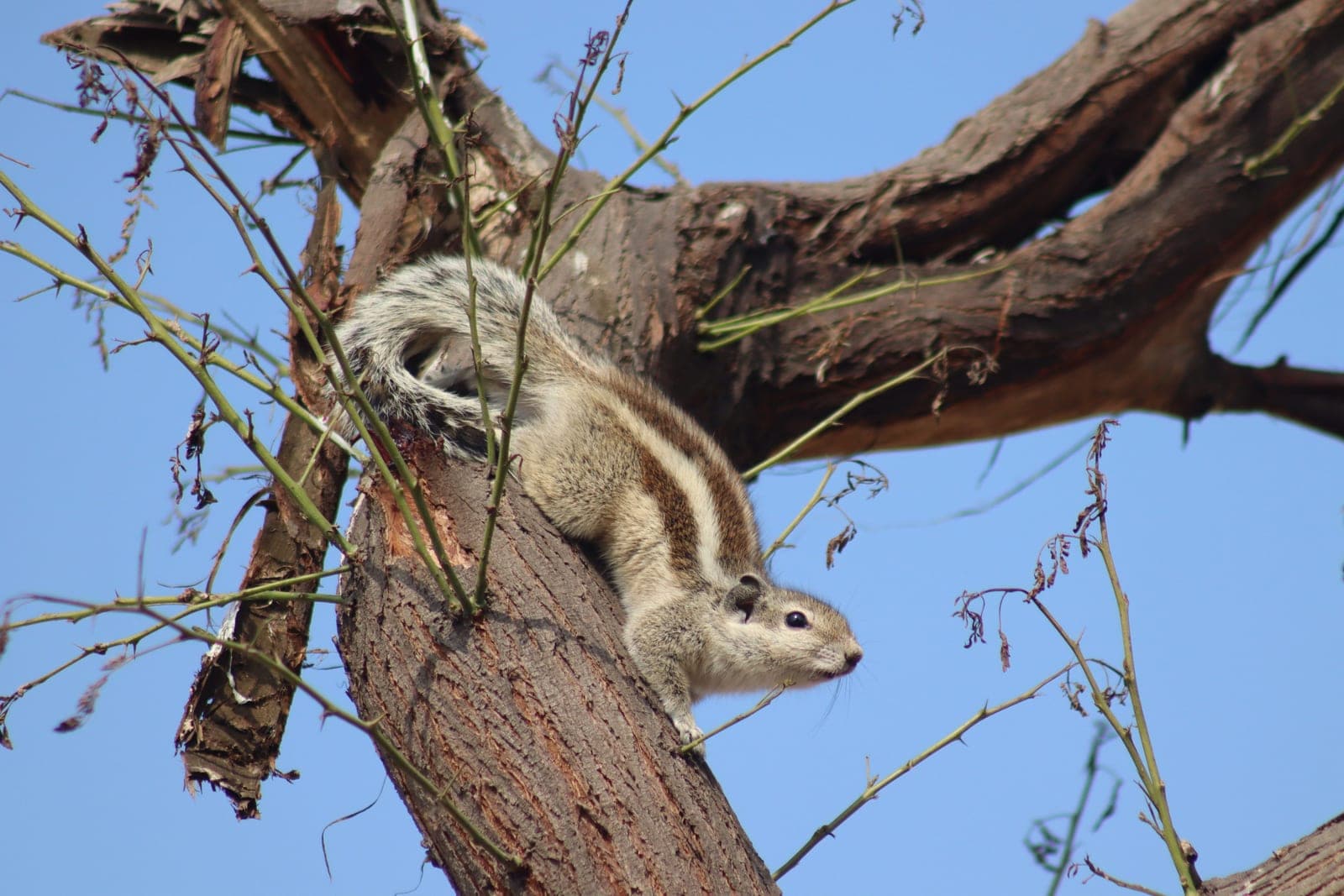
Mount the top of the baffle four to five feet off the ground, with the feeder above it, and keep the whole assembly eight to ten feet clear of anything solid. Audubon publishes both figures. They exist because a gray squirrel jumps about four feet vertically and roughly twice that horizontally.
This is the page the rest of this site is built around, so it is worth being exact. Everything below is either a published figure with a named source, or arithmetic you can check yourself in one line.
Where the numbers come from
Three independent sources, and they agree. That is unusual enough in this category to be worth laying out explicitly.
| Figure | Value | Source |
|---|---|---|
| Baffle height above ground | Between four and five feet | Audubon: the baffle needs to be between four and five feet off the ground |
| Clear air around the feeder | At least 8 to 10 feet | Audubon: place it at least 8 to 10 feet from anything solid, trees, buildings, fences, whatever |
| Distance from jumping-off points | At least 10 feet | Cornell Lab of Ornithology |
| Vertical jump | Up to 4 feet | Alabama Cooperative Extension System: squirrels are excellent jumpers and are able to jump up to 4 feet vertically |
| Horizontal jump | Twice the vertical, so about 8 feet | Alabama Cooperative Extension System: and twice that distance horizontally |
| Manufacturer setback | 10 feet from poles or walls | Squirrel Stopper, in its own pole system installation instructions |
The arithmetic, in two lines
The height. A gray squirrel jumps up to four feet vertically. If the top edge of the baffle sits at four to five feet, an animal starting from the ground cannot land on top of it. Below four feet, it can. That is the entire derivation of Audubon's figure, and it is why four feet is a floor rather than a suggestion.
The clearance. The same animal covers about eight feet horizontally. Anything solid within eight feet of the feeder is a launch platform, and a launch platform at or above feeder height puts the animal above the baffle, where the baffle is irrelevant. Audubon's 8 to 10 feet and Cornell's at-least-10-feet are the same figure with a margin on it.
Where the published advice disagrees, and who is right
A page-one result in this category publishes 6 to 10 feet as the baffle mounting height. Audubon publishes 4 to 5 feet. Those cannot both be right, and the disagreement is instructive rather than trivial.
Look at what 6 to 10 feet would mean in practice. The feeder has to hang above the baffle. Complete feeder pole systems publish overall heights of roughly 85 to 95 inches — seven to eight feet — before the arms are counted. If the baffle top is at six feet, the feeder has to be above six feet on a pole that tops out under eight. If the baffle is at ten feet, there is no consumer feeder pole on the market that can accommodate it.
In other words, 6 to 10 feet is not merely a different opinion about height. It is unbuildable on the equipment people actually own, which is a strong indication that the horizontal clearance figure has been transcribed into the vertical slot. The four-to-five-foot figure, by contrast, matches both the published jump distance and the hanging heights real pole systems are built to.
We show the disagreement rather than quietly using the number we prefer. That is what our editorial policy commits us to, and it is the clearest demonstration we can offer that we read the sources rather than paraphrasing each other.
How to measure your own yard
- Stand where the pole is (or will be) and look around at feeder height. Not at ground level — at five to six feet, which is where the animal needs to land.
- Pick out everything solid. Fence rails, deck rails, low branches, the shed roof, a wall top, a bird bath, a large planter, a stack of firewood. All of it is a launch platform.
- Pace the distance to the nearest one. A normal adult pace is roughly three feet, so three paces is about nine feet. Ten feet is about three and a half paces.
- If anything solid is inside that radius, move the pole. This is free, permanent, and does more than any product decision you will make afterwards.
- Then set the baffle top at four to five feet with the feeder above it. On a seven-foot pole that is comfortable; on a five-foot shepherd's hook it cannot be done.
The cases where the geometry cannot be met
Being honest about this matters, because a lot of yards simply cannot produce ten feet of clear air. If yours is one of them, the geometry is not available and no baffle will substitute for it. What you do instead:
- Small yard or courtyard. Exclude at the feeder rather than at the pole. A caged feeder works regardless of the approach route.
- Deck or balcony. The rail is a permanent launch point at feeder height. Deck-mounted poles covers what actually helps.
- Mature trees. A tree is the largest launch platform in most yards, and a trunk baffle only closes one of many routes. Baffles for trees.
- A hanging feeder with no pole. A spinning feeder or a seed treatment removes the reward where geometry cannot remove the access.
Product choices this geometry implies
If you have the clearance, almost anything works and you should buy on fit and durability. If you are marginal on clearance, buy for maximum overhang — a wide disk gives the most lateral protection, and Erva's SB6 publishes the largest diameter we found at 22.5 in.
If you are starting from nothing, a complete pole system arrives with the geometry mostly pre-solved: the pole, the baffle and the anchor are matched to each other. What almost no listing publishes is where the baffle top actually lands, so measure that after assembly rather than trusting the box.
Baffleworks is funded by affiliate commission. If you buy through a link on this page we may earn a commission at no extra cost to you, and it never decides a ranking. Full disclosure · how we pick.
Quick picks
Ranked, with the trade-off named. Tap a row for the full write-up; the price button goes straight to Amazon.
| # | Product | Best for | Price |
|---|---|---|---|
| 1 |  Erva SB6 Pole-Mount Disk Baffle, 22.5 inThe widest disk we found with a published diameter, which is the whole mechanism: a squirrel on the pole below has to reach past 22.5 inches of steel to get anything. | Round poles, maximum overhang | $39.99 on Amazon |
| 2 |  Ceoighe 95 in Feeder Pole with Torpedo Baffle, 4 armsA complete station in one box: five pole sections, four arms, a torpedo baffle and an auger. The geometry arrives assembled rather than assembled by you from three sellers. | A complete station, baffle included | $70.99 on Amazon |
| 3 |  Erva SB2D Cylindrical Squirrel and Raccoon Baffle, 28 x 6.25 inA cylinder rather than a disk, so it defeats the climb by length instead of width, and it is one of the few baffles whose listing names raccoons as well as squirrels. | Round poles, raccoons too | $62.99 on Amazon |
#ad how we are funded · price as of October 24, 2026
The picks in full
Top pick Round poles, maximum overhang
Erva SB6 Pole-Mount Disk Baffle, 22.5 in
The widest disk we found with a published diameter, which is the whole mechanism: a squirrel on the pole below has to reach past 22.5 inches of steel to get anything.
Fits: Round pole
Published specifications
- Diameter
- 22.5 in (published)
- Type
- Disk, pole-mount
- Material
- Powder-coated galvanized steel, solid steel collars
- Origin
- Made in USA
Trade-offs
- 22.5 in is the largest published disk diameter in this set, so it gives the most overhang past the pole
- Steel collars rather than plastic clamps, which is what usually fails first on a baffle
- Powder coat over galvanized steel, so it is not a chew or corrosion target
- Pole-mount, so it has to come off the pole to install unless your feeder arm lifts clear
- A 22.5 in disk is visually large; on a small deck or patio it dominates
Who it is forA standard round feeder pole where you want the mechanism doing the work rather than luck. Mount the top of the disk at four to five feet and give it the clearance the geometry actually needs.
Skip it ifYour feeder is on a 4x4 wooden post — this is a round-pole fitting. Use the 4x4 post baffles instead.
#ad how we are funded · price as of October 24, 2026
Where these specifications came from
No. 2 A complete station, baffle included
Ceoighe 95 in Feeder Pole with Torpedo Baffle, 4 arms
A complete station in one box: five pole sections, four arms, a torpedo baffle and an auger. The geometry arrives assembled rather than assembled by you from three sellers.
Fits: Ground-set
Published specifications
- Total height
- 95 in (published)
- Pole diameter
- 1.5 in rust-resistant steel (published)
- Sections
- 5 (published)
- Hanging arms
- 4 horizontal arms (published)
- Baffle
- Torpedo, moves up/down and side to side (published)
- Ground anchor
- Auger stake with twist rod (published)
Trade-offs
- Baffle and auger in the box, so the clearance geometry does not depend on a second purchase
- An auger rather than a spike — the difference between a pole that stays vertical and one that leans by February
- 1.5 in steel is stiffer than the 1 in tube most kits use, which matters under four loaded feeders
- A torpedo that moves is harder to stand on than a fixed disk
- Publishes no baffle-top height, so you have to measure where the baffle lands and adjust rather than trust the box
- Publishes no load rating, unlike some competitors that state a figure in pounds
- Four arms is an invitation to hang four feeders, and four feeders is a great deal of spilled seed in one spot
- No stated setback — the 8 to 10 ft rule comes from Audubon and Cornell, not from this maker
Who it is forA first proper feeding station on open ground, where you want the pole, the baffle and the anchor to arrive together.
Skip it ifYour plot cannot give it eight to ten feet of clear air. No pole on this page fixes that — the clearance spec does, or a caged feeder does.
#ad how we are funded · price as of October 24, 2026
Where these specifications came from
No. 3 Round poles, raccoons too
Erva SB2D Cylindrical Squirrel and Raccoon Baffle, 28 x 6.25 in
A cylinder rather than a disk, so it defeats the climb by length instead of width, and it is one of the few baffles whose listing names raccoons as well as squirrels.
Fits: Round pole
Published specifications
- Type
- Cylindrical / stovepipe
- Dimensions
- 28 in long x 6.25 in diameter (published)
- Named animals
- Squirrel and raccoon (published)
- Finish
- Black (published)
- Origin
- Made in USA (published)
- Pole fit
- Not published — measure your pole first
Trade-offs
- Cylinder geometry tilts and rocks under weight rather than presenting a rim to grab
- 28 in of published length is a long climb to defeat, and length is this shape's entire mechanism
- Explicitly specified for raccoons as well as squirrels, which most baffles are not
- No published pole-diameter fit, and a cylinder is fitment-critical — measure before you buy
- A cylinder hides the pole, which some people dislike visually
- Costs noticeably more than a plain disk baffle of similar overhang
Who it is forA round pole, especially one that raccoons also visit, where you would rather beat the climb by length than by overhang.
Skip it ifYour pole will not pass through a 6.25 in cylinder, or you are on a 4x4 post. Cylinders are fitment-critical in a way disks are not.
#ad how we are funded · price as of October 24, 2026
Where these specifications came from
What we did, and did not, do to write this
We read Audubon's article, the Alabama Cooperative Extension System's damage-control page, Cornell's yard-visitor guidance and the manufacturers' own installation notes, and we did the arithmetic connecting them. Every figure above is quoted or cited.
We did not test any of this. We have no test yard, no instrumented pole and no measured jump data of our own, and we are not going to imply otherwise. What we have is a set of published figures that agree with each other, an explanation of why they agree, and a named disagreement where one source departs from the rest. How we pick sets out the whole standard.
Questions people actually ask
- How high should a squirrel baffle be off the ground?
- Four to five feet to the top of the baffle, per Audubon, with the feeder above it. The figure exists because the Alabama Cooperative Extension System puts a gray squirrel's vertical jump at up to four feet.
- How far can a squirrel jump?
- The Alabama Cooperative Extension System states up to 4 feet vertically and twice that distance horizontally, so about 8 feet sideways. Those two numbers are the basis of every placement rule on this site.
- How far should a bird feeder be from a tree or fence?
- Audubon says at least 8 to 10 feet from anything solid. Cornell says at least 10 feet from jumping-off points. Squirrel Stopper prints 10 feet in its own pole instructions. Ten feet is the working figure.
- Some sites say to mount the baffle 6 to 10 feet up. Which is right?
- Four to five feet. The 6-to-10-foot figure is unbuildable on a standard feeder pole, which publishes hanging heights of six to seven feet, and it matches the horizontal clearance number rather than the vertical jump. We think the two measurements have been confused.
- What if I cannot get ten feet of clearance?
- Then the geometry is not available and a baffle will not substitute for it. Exclude at the feeder instead with a caged or spinning feeder, or use a seed treatment to remove the reward.
- Does the baffle go above or below the feeder?
- Below, on the pole. A dome above a hanging feeder is a different product solving a different problem — it blocks a drop from directly overhead rather than a climb from the ground.
Sources
Read next
- The best squirrel baffles
Seven baffles ranked by published dimensions and mount fit, with the clearance rule that decides all of it.
- Do squirrel baffles work?
Yes, within a narrow set of conditions. The four failure modes and how to diagnose yours in ten minutes.
- The best squirrel-proof bird feeder poles
Pole systems ranked on baffle height, anchoring and the ten-foot setback one maker actually publishes.
- How to squirrel-proof a feeder pole
Site, anchor, baffle, hang, manage the spill. The order is the point, and most people do it backwards.
- Squirrel Baffles
Dome, torpedo and wrap-around baffles, sorted by the mount you actually own rather than by brand.