Poles / Roundup
The best squirrel-proof bird feeder poles
A pole system is a geometry you can buy. The good ones put the baffle at the right height, anchor properly, and tell you how far from the fence to install them.
In Feeder Poles
The best squirrel-proof feeder pole is a complete system with the baffle and an auger ground anchor already in the box. Ceoighe's 95 in pole publishes five sections, four hanging arms, a torpedo baffle and an auger stake — the pole, the baffle and the anchor arrive together instead of from three sellers.
The unusual thing about this category is that the product is not really the pole. It is the set of distances the pole produces. Get those right and a plain tube feeder holds; get them wrong and the most sophisticated feeder on the market is on trial every day.
Baffleworks is funded by affiliate commission. If you buy through a link on this page we may earn a commission at no extra cost to you, and it never decides a ranking. Full disclosure · how we pick.
Quick picks
Ranked, with the trade-off named. Tap a row for the full write-up; the price button goes straight to Amazon.
| # | Product | Best for | Price |
|---|---|---|---|
| 1 |  Ceoighe 95 in Feeder Pole with Torpedo Baffle, 4 armsA complete station in one box: five pole sections, four arms, a torpedo baffle and an auger. The geometry arrives assembled rather than assembled by you from three sellers. | A complete station, baffle included | $70.99 on Amazon |
| 2 |  CimoroWin 7.9 ft Raccoon-Proof Feeder Pole, 4 armsThe one pole here whose listing names raccoons rather than only squirrels, with four 18 in arms carrying two hooks each — eight hanging points, and a published weight limit for them. | The most feeders on one pole | $105.99 on Amazon |
| 3 | 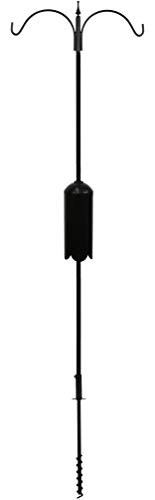 Kettle Moraine 2-Arm Pole Set with Squirrel BaffleA two-arm set that anchors with a twister ground socket rather than a stake, which is the part of a pole system that usually decides whether it is still vertical in year two. | Two feeders, nothing more | $127.00 on Amazon |
#ad how we are funded · price as of October 24, 2026
The picks in full
Top pick A complete station, baffle included
Ceoighe 95 in Feeder Pole with Torpedo Baffle, 4 arms
A complete station in one box: five pole sections, four arms, a torpedo baffle and an auger. The geometry arrives assembled rather than assembled by you from three sellers.
Fits: Ground-set
Published specifications
- Total height
- 95 in (published)
- Pole diameter
- 1.5 in rust-resistant steel (published)
- Sections
- 5 (published)
- Hanging arms
- 4 horizontal arms (published)
- Baffle
- Torpedo, moves up/down and side to side (published)
- Ground anchor
- Auger stake with twist rod (published)
Trade-offs
- Baffle and auger in the box, so the clearance geometry does not depend on a second purchase
- An auger rather than a spike — the difference between a pole that stays vertical and one that leans by February
- 1.5 in steel is stiffer than the 1 in tube most kits use, which matters under four loaded feeders
- A torpedo that moves is harder to stand on than a fixed disk
- Publishes no baffle-top height, so you have to measure where the baffle lands and adjust rather than trust the box
- Publishes no load rating, unlike some competitors that state a figure in pounds
- Four arms is an invitation to hang four feeders, and four feeders is a great deal of spilled seed in one spot
- No stated setback — the 8 to 10 ft rule comes from Audubon and Cornell, not from this maker
Who it is forA first proper feeding station on open ground, where you want the pole, the baffle and the anchor to arrive together.
Skip it ifYour plot cannot give it eight to ten feet of clear air. No pole on this page fixes that — the clearance spec does, or a caged feeder does.
#ad how we are funded · price as of October 24, 2026
Where these specifications came from
No. 2 The most feeders on one pole
CimoroWin 7.9 ft Raccoon-Proof Feeder Pole, 4 arms
The one pole here whose listing names raccoons rather than only squirrels, with four 18 in arms carrying two hooks each — eight hanging points, and a published weight limit for them.
Fits: Ground-set
Published specifications
- Total height
- 7.9 ft (published)
- Arms
- 4 arms at 18 in, 2 hooks each (published)
- Load capacity
- Up to 25 lb total (published)
- Baffle
- Wide circular baffle, published as raccoon-proof
- Material
- Reinforced steel, galvanized or zinc-plated components (published)
- Included
- Pole, 4 arms, ground stake, baffle, water tray, feeding tray (published)
Trade-offs
- Names raccoons specifically — most baffles are designed against squirrels and are untested against a heavier animal by definition
- Publishes a 25 lb capacity, which is a real number and rarer in this category than it should be
- Eight hanging points from four arms, plus trays, with no extra purchases
- 18 in arms hold feeders well clear of the pole, which matters when the baffle is doing the work
- A ground stake, not an auger — under eight loaded hanging points in wet ground that is the weaker anchor
- Publishes no baffle diameter or mounting height, so the clearance geometry has to be measured on site
- Eight hanging points concentrate a lot of spilled seed, which is what brings rats and raccoons in the first place
- 'Raccoon proof' is the maker's claim and no test is published behind it
Who it is forA yard that has already lost to a raccoon, where a second-rate baffle has been tried and beaten.
Skip it ifYou wanted one feeder. Eight hanging points and a 25 lb capacity are the wrong shape for that, and the extra seed on the ground is a real cost.
#ad how we are funded · price as of October 24, 2026
Where these specifications came from
No. 3 Two feeders, nothing more
Kettle Moraine 2-Arm Pole Set with Squirrel Baffle
A two-arm set that anchors with a twister ground socket rather than a stake, which is the part of a pole system that usually decides whether it is still vertical in year two.
Fits: Ground-set
Published specifications
- Height
- Approximately 85 in above ground assembled (published)
- Arms
- 2, with 12 in reach from the pole (published)
- Pole
- 1 in diameter, 3 sections (published)
- Baffle
- Squirrel baffle included (published)
- Anchor
- Twister ground socket (published)
- Material
- Black powder-coated steel (published)
- Origin
- Made in USA (published)
Trade-offs
- A threaded ground socket is published as stronger than a stake, and anchoring is where cheap poles fail
- Two arms is the honest number for most yards — enough for a seed feeder and a suet or water station
- Publishes its assembled height and its arm reach, so you can check the geometry before ordering
- Made in USA with a published material spec rather than 'heavy duty steel'
- Publishes no baffle diameter and no baffle mounting height — the two numbers that decide whether it works
- 1 in pole is thinner than the 1.25 to 1.5 in used by the heavier kits here
- Costs more than kits that include more arms, because the money is in the socket and the steel
- Two arms is a ceiling, not a starting point
Who it is forSomebody who wants two feeders done properly and permanently, and values the anchor over the arm count.
Skip it ifYou want a feeding station with four or more feeders. Buy the pole built for that rather than adding hooks to this one.
#ad how we are funded · price as of October 24, 2026
Where these specifications came from
What we would skip
Any pole system on a plot that cannot give it ten feet of clear air
Squirrel Stopper prints the ten-foot setback in its own installation instructions, and Cornell and Audubon independently land on the same figure. At five feet you have bought a tall pole and an ornament. On a small plot, exclude at the feeder instead with a caged feeder.
A cheap pole plus a separately-bought baffle, if you have not checked the heights
The baffle top has to land at four to five feet with the feeder above it. Assembling that from parts works, but only if you check the numbers first. Most of the failures in this category are two correct products at the wrong heights.
An eight-station system if you only wanted one feeder
Eight feeders concentrate a great deal of spilled seed in one patch of ground, and spilled seed is what brings ground feeders, rats and eventually raccoons. Buy the station count you will actually fill.
What separates a system from a stick
| Feature | Why it matters | What to look for |
|---|---|---|
| Integrated baffle | It arrives at the height the system was designed around, so nothing has to be measured | Ceoighe puts a torpedo baffle on the pole; measure where its top lands |
| Published hanging height | It tells you whether the feeder ends up above a correctly placed baffle | Ceoighe publishes 95 in overall; measure where the baffle lands |
| Ground anchor | A leaning pole is a closer pole, and a rockable pole is a climbable one | Auger, not a spike, especially in sand or loose loam |
| Stated setback | The single most useful number any maker in this category publishes | Squirrel Stopper states 10 ft from poles or walls |
Why the auger matters more than it sounds
The Ceoighe specifies an auger stake, and the Kettle Moraine set a twister ground socket driven 20 in down. The CimoroWin uses a plain ground stake, which is the weakest of the three. A spike relies on friction in the top few inches of soil; an auger or a threaded socket bites into it. Under a loaded pole in wet ground, that is the difference between a feeder that stays where you put it and one that ends the winter at ten degrees off vertical.
A leaning pole is not cosmetic. It brings the feeder measurably closer to whatever is beside it, and a pole that can be rocked gives an animal something to work with that a rigid one does not.
Station count and the seed on the ground
The CimoroWin publishes four arms with two hooks each — eight hanging points — and a 25 lb total capacity; the Ceoighe has four arms; the Kettle Moraine set has two. More is not automatically better.
Every feeder spills, and spilled seed under a pole is an unprotected ground buffet. It feeds the squirrels the baffle just excluded, and in numbers it brings rats and raccoons. Two or four stations plus a seed tray is a calmer setup than eight without one — and if raccoons do arrive, raccoon deterrents starts with food management for exactly this reason.
The raccoon question
Most baffles here are specified against squirrels only. The CimoroWin is the exception: its listing describes a wide circular baffle published as raccoon-proof, on the reasoning that a raccoon cannot grip or climb past the diameter. A baffle designed against a squirrel is untested against a heavier, longer-reaching animal by definition.
The trade is anchoring. The CimoroWin publishes a ground stake, while the Ceoighe publishes an auger — and an auger holds a loaded pole upright far better in wet ground. If raccoons are the problem, take the raccoon-rated baffle and improve the anchor yourself. If they are not, the auger is the better starting point.
If you already own a pole
Do not buy a system reflexively. If your existing pole can put a baffle top at four to five feet with the feeder above it, and it stands about ten feet from anything solid, a baffle alone is the cheaper and equally effective fix. A system is worth it when the pole itself is too short, too thin or too badly anchored to get there.
A camera feeder is the heaviest and most valuable thing you will put on a pole, and Bird Buddy sells no pole at all. The best pole for a Bird Buddy or Birdfy covers Birdfy's own baffled pole, the adapters a Bird Buddy needs, and the setback both makers ignore.
Every system here anchors with an auger or a threaded socket, and that is most of what you are paying for. The cheap squirrel-proof roundup covers the prong-based stations that cost a fraction of these, and is direct about the anchor being the compromise.
The seed on the ground is the other half of this. A baffle stops the climb and does nothing about what the birds throw down, which is why a station without a catcher feeds the squirrels it just excluded — the best seed catcher trays ranks them on the two specs that matter, diameter and drainage.
For a single feeder in a bed, a tall hook is cheaper and moves in seconds. The best heavy-duty shepherd's hooks covers that route, including the height arithmetic that rules out most decorative hooks.
How we picked
- We judged poles on the geometry they produce: where the baffle sits, how high the feeder hangs, and what setback the maker states.
- We recorded published figures only — station counts, hanging heights, anchoring type, stated setbacks. Where a listing publishes nothing, we say so.
- We treated a published setback as a specification, not marketing. Squirrel Stopper prints ten feet in its own instructions, and that is a constraint on your yard before it is a feature of the pole.
- We named at least one product to skip on every page, with the reason.
- We have not installed any of these. How we pick sets out what that does and does not cover.
Everyone in this category says they tested twenty of these. We have not tested any, and we say so. What we did instead: read the manuals, compiled the published specifications, worked out the clearance geometry, and cited every source. The full method is published.
Questions people actually ask
- What is the best squirrel-proof bird feeder pole?
- A complete system, on published figures: Ceoighe's 95 in pole ships five sections, four arms, a torpedo baffle and an auger stake. Measure where the baffle top lands after assembly — it is the one number the listing does not publish — and give the pole eight to ten feet of clear air.
- How far should a feeder pole be from a fence?
- About ten feet. Squirrel Stopper prints ten feet in its own instructions, Cornell says at least 10 ft from jumping-off points, and Audubon says 8 to 10 ft from anything solid.
- Is a pole system better than a pole plus a baffle?
- Not inherently, but it removes the two decisions people get wrong: baffle height and pole strength. If you are confident about both, a baffle on your existing pole is cheaper.
- How many feeders should one pole hold?
- As many as you will fill, and no more. Spilled seed under a pole feeds everything the baffle excluded. Two to four with a tray is a calmer setup than eight without.
- Auger or spike?
- Auger, especially in sand or loose soil. A pole that leans is a pole closer to the fence, and a pole that rocks gives an animal purchase it would not otherwise have.
Sources
Read next
- Pole systems vs shepherd's hooks
Hooks win on price and looks; systems win on the height that decides whether a baffle works at all.
- How to squirrel-proof a feeder pole
Site, anchor, baffle, hang, manage the spill. The order is the point, and most people do it backwards.
- The best squirrel baffles
Seven baffles ranked by published dimensions and mount fit, with the clearance rule that decides all of it.
- How high should a squirrel baffle be?
Four to five feet high, eight to ten feet clear. The sourced numbers, the arithmetic, and the popular page that gets it wrong.
- Feeder Poles
Complete pole systems and shepherd's hooks, judged on baffle height, anchoring and the setback they need.