Poles / Deck mounting
Deck-mounted feeder poles
A deck puts the feeder where you can see it and where a squirrel can already stand. That is the whole problem, and it is a geometry problem no bracket can solve.
In Feeder Poles
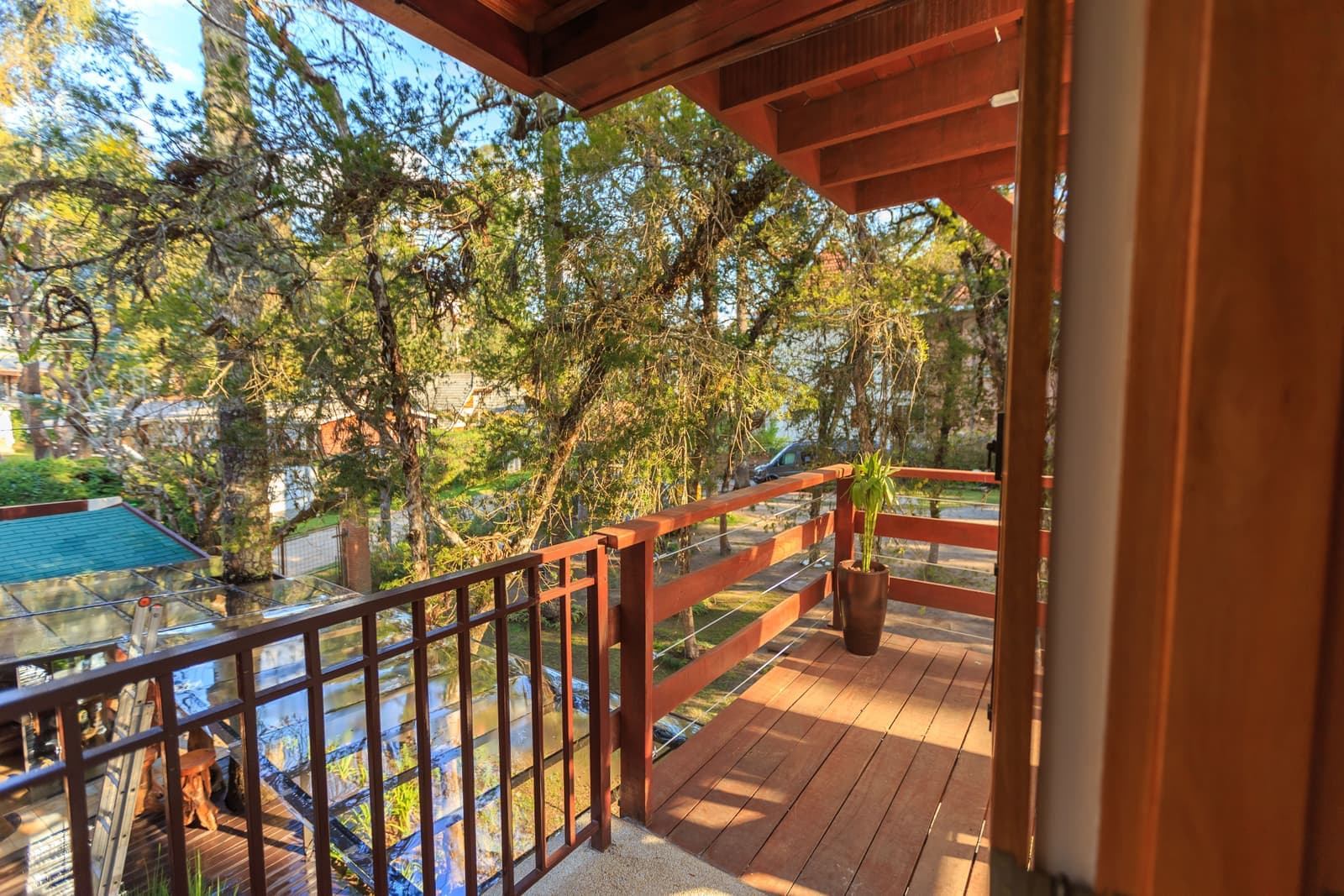
A deck rail is a solid surface at feeder height, so it functions as a permanent launch point and a pole baffle cannot help. On a deck, exclude at the feeder: a caged feeder works regardless of the approach, and a weight-activated feeder handles gray squirrels arriving from the rail.
Deck mounting is popular for an excellent reason — the feeder is at eye level from the kitchen window — and difficult for an equally clear one.
Why the geometry does not close
Audubon's rule is that the feeder should sit at least 8 to 10 feet from anything solid. A deck rail is solid, it is at feeder height, and it is roughly zero feet away. The Alabama Cooperative Extension System puts a gray squirrel's horizontal jump at roughly eight feet, and on a deck the animal does not need to jump at all.
So a baffle on a deck-mounted pole is protecting against a climb that never has to happen. This is not a criticism of deck brackets, which are well made and do exactly what they claim. It is a statement about what the physical situation permits.
What does work on a deck
- A caged feeder. Exclusion by geometry is indifferent to the approach route. This is the single most effective change for a deck feeder, and it handles chipmunks and starlings as well.
- A weight-activated feeder. Effective against gray squirrels arriving from the rail; ineffective against anything lighter. Good if gray squirrels are the specific problem.
- A seed treatment. Cole's publishes 1.5 oz per 5 lb of seed. It does not stop the visit; it removes the reason for the next one.
- Extending the mount. A bracket that carries the feeder well out past the rail buys some distance. It rarely buys eight feet, but it can buy enough that the leap becomes awkward rather than trivial.
Baffleworks is funded by affiliate commission. If you buy through a link on this page we may earn a commission at no extra cost to you, and it never decides a ranking. Full disclosure · how we pick.
Quick picks
Ranked, with the trade-off named. Tap a row for the full write-up; the price button goes straight to Amazon.
| # | Product | Best for | Price |
|---|---|---|---|
| 1 |  Girvenith Metal Caged Seed Feeder, 4 portA steel cage around an enclosed seed compartment, sized so finches and chickadees pass and larger birds do not. The cheapest honest cage on this page. | Small songbirds in a small space | $21.59 on Amazon |
| 2 |  Woodlink WLCAGE2 Designer Caged 4-Port Tube FeederA cage around a tube, which excludes by aperture rather than by weight — so it stops the chipmunk and the red squirrel a weight trigger ignores, and stops the cardinal too. | Small songbirds only | $71.48 on Amazon |
| 3 |  Brome Squirrel Buster PlusThe weight-activated shroud done properly: a squirrel's weight closes the ports, and the cardinal ring means the mechanism does not cost you the big birds. | Weight-activated, most capacity | $129.25 on Amazon |
| 4 |  Cole's Flaming Squirrel Seed Sauce, 16 ozCapsaicin on the seed: mammals taste it, birds do not. It is the one seed treatment here with a published mixing ratio, which is the difference between a method and a hope. | Treating seed you already own | $23.40 on Amazon |
#ad how we are funded · price as of October 24, 2026
The picks in full
Top pick Small songbirds in a small space
Girvenith Metal Caged Seed Feeder, 4 port
A steel cage around an enclosed seed compartment, sized so finches and chickadees pass and larger birds do not. The cheapest honest cage on this page.
Published specifications
- Mechanism
- Fixed cage aperture
- Dimensions
- 6.25" L x 6.25" W x 10.25" H (published)
- Feeding ports
- 4 (published)
- Cage
- Durable steel exterior (published)
- Weather
- Rainproof cover; all-weather metal (published)
- Named birds
- Finches and chickadees welcomed, larger birds discouraged (published)
- Filling
- Wide-opening metal top (published)
Trade-offs
- Publishes its actual cage body dimensions, which is how you predict which birds get in
- A fixed aperture ignores weight, so it stops the chipmunk and red squirrel a weight trigger lets through
- All-metal with a rainproof cover — no plastic tube to chew or craze
- Small enough to hang almost anywhere, and cheap enough to try
- The listing publishes the cage body size but not the mesh opening, which is the number that would settle exactly which birds fit
- Excludes cardinals, jays and grosbeaks along with the squirrels — the trade, not a defect
- No published seed capacity, and a 10.25 in body will not hold much
- 'Squirrel proof' in the title is doing more work than the cage alone can — placement still matters
Who it is forA small yard with chipmunks or red squirrels, where finches and chickadees are the birds you actually want.
Skip it ifYou want cardinals. A 6.25 in cage body is the mechanism working as designed, and no setting changes it — see the cardinal page.
#ad how we are funded · price as of October 24, 2026
Where these specifications came from
No. 2 Small songbirds only
Woodlink WLCAGE2 Designer Caged 4-Port Tube Feeder
A cage around a tube, which excludes by aperture rather than by weight — so it stops the chipmunk and the red squirrel a weight trigger ignores, and stops the cardinal too.
Published specifications
- Mechanism
- Fixed cage aperture
- Feeding ports
- 4 (published)
- Cage material
- Metal, bronze finish (published)
- Tube material
- Recycled plastic (published)
- Cleaning
- Published as easy to fill and clean
Trade-offs
- A fixed aperture does not care how heavy the animal is, so it excludes chipmunks and red squirrels as well as grays
- Metal cage rather than a coated wire basket
- The tube is recycled plastic, which is unusual honesty about material in this category
- Nothing to calibrate and nothing to wear out
- The cage excludes cardinals, jays and grosbeaks along with the squirrels — that is the trade, not a defect
- The listing publishes no cage aperture in inches, which is the one number that would let you predict exactly which birds get in
- No published seed capacity
- Plastic tube inside a metal cage: the cage protects it, but only while the cage is intact
Who it is forA yard where chipmunks or red squirrels are the problem and you are content with finches, chickadees and titmice.
Skip it ifYou want cardinals. A cage cannot be adjusted and this one publishes no aperture — the cardinal page covers why a weight trigger is the right mechanism instead.
#ad how we are funded · price as of October 24, 2026
Where these specifications came from
No. 3 Weight-activated, most capacity
Brome Squirrel Buster Plus
The weight-activated shroud done properly: a squirrel's weight closes the ports, and the cardinal ring means the mechanism does not cost you the big birds.
Published specifications
- Seed capacity
- 5.1 lb (published)
- Feeding ports
- 6
- Mechanism
- Weight-activated shroud, adjustable
- Included
- Cardinal ring
- Pole mounting
- Pole-mountable; pole adaptor sold separately
Trade-offs
- 5.1 lb capacity means fewer refills through a hard winter
- Adjustable weight setting, so you can shut out grackles without shutting out cardinals
- The cardinal ring is the fix for the usual complaint about shroud feeders
- The pole adaptor is a separate purchase, which is easy to miss at checkout
- A weight mechanism is a mechanism: it needs the occasional clean to keep moving freely
Who it is forThe default first purchase if you would rather solve the problem at the feeder than at the pole. It also pairs well with a baffle rather than replacing one.
Skip it ifYour problem is chipmunks or small red squirrels. A weight-activated shroud is calibrated for something heavier, and a light animal can feed under the trigger point. A caged feeder is the better answer there.
#ad how we are funded · price as of October 24, 2026
Where these specifications came from
No. 4 Treating seed you already own
Cole's Flaming Squirrel Seed Sauce, 16 oz
Capsaicin on the seed: mammals taste it, birds do not. It is the one seed treatment here with a published mixing ratio, which is the difference between a method and a hope.
Published specifications
- Size
- 16 oz (published)
- Mixing ratio
- 1.5 oz (3 tbsp) per 5 lb of seed (published)
- Ingredients
- All-natural, 100% food grade
- Stated basis
- Hot to mammals, not to birds
- Part number
- FS16
Trade-offs
- Published mixing ratio, so the dose is repeatable rather than improvised
- Treats seed you have already bought instead of replacing your feeder
- Works on the feeders a baffle cannot protect, like a hanging tube on a branch
- Handling capsaicin concentrate means gloves and care, especially around your eyes
- It treats the seed, not the raid: a squirrel will still chew a plastic feeder to find out
Who it is forA hanging feeder with no pole to baffle, or a stubborn site where the geometry cannot be fixed.
Skip it ifYou can fix the geometry instead. A treatment is a workaround; the clearance is the fix.
#ad how we are funded · price as of October 24, 2026
Where these specifications came from
What we would skip
A pole baffle on a deck-rail mount
The rail itself is a launch point at feeder height, and the deck boards are another. A baffle below the feeder blocks a climb that the animal does not need to make.
The mess problem is worse on a deck
Seed hulls, droppings and damp fat on decking are unpleasant in a way they are not on a lawn. Two practical moves: hang the feeder so the spill zone is beyond the boards where possible, and use a tray. A tray on a deck is not optional maintenance, it is what makes the whole arrangement liveable.
It also matters for wildlife management. Seed accumulating on a deck attracts exactly the animals you would least like on a deck, and food on a structure is the standard route by which raccoons decide your house is worth investigating.
The alternative worth considering
If any part of the yard sits about ten feet clear of the deck, the fence and the trees, a pole system there with a baffle at four to five feet will outperform anything mounted on the rail. You lose the eye-level view and gain a setup that works without a mechanism.
A reasonable compromise many people land on: a caged feeder on the deck for watching, and a proper pole further out for volume.
On a balcony or a window with no room for a rail mount, the remaining option is the glass itself. Window and balcony feeders covers when that genuinely works and when it is a snack shelf.
How we picked
- We judged poles on the geometry they produce: where the baffle sits, how high the feeder hangs, and what setback the maker states.
- We recorded published figures only — station counts, hanging heights, anchoring type, stated setbacks. Where a listing publishes nothing, we say so.
- We treated a published setback as a specification, not marketing. Squirrel Stopper prints ten feet in its own instructions, and that is a constraint on your yard before it is a feature of the pole.
- We named at least one product to skip on every page, with the reason.
- We have not installed any of these. How we pick sets out what that does and does not cover.
Everyone in this category says they tested twenty of these. We have not tested any, and we say so. What we did instead: read the manuals, compiled the published specifications, worked out the clearance geometry, and cited every source. The full method is published.
Questions people actually ask
- Can you squirrel-proof a deck-mounted bird feeder?
- Not with a baffle. The rail is a launch point at feeder height, so the climb a baffle blocks never has to happen. Exclude at the feeder instead, with a cage or a weight mechanism.
- What is the best bird feeder for a deck railing?
- A caged one, because it works regardless of how the animal arrived. If gray squirrels are the only problem and you want cardinals, a weight-activated feeder with a cardinal ring is the alternative.
- Will a longer deck bracket help?
- A little. Distance is the mechanism, so buying two or three feet of it makes the leap awkward. It rarely buys the eight to ten feet the sources call for.
- How do I stop the mess on the decking?
- Use a tray and site the feeder so the spill zone is beyond the boards if you can. Accumulated seed on a deck is also how raccoons come to treat the structure as worth investigating.
Sources
Read next
- Caged bird feeders
Exclusion by size rather than weight: the mechanism that beats chipmunks, red squirrels and starlings.
- The best squirrel-proof bird feeder poles
Pole systems ranked on baffle height, anchoring and the ten-foot setback one maker actually publishes.
- How high should a squirrel baffle be?
Four to five feet high, eight to ten feet clear. The sourced numbers, the arithmetic, and the popular page that gets it wrong.
- Raccoon deterrents
Food management first, then a baffle that actually names raccoons, then a sprinkler on the route.
- Feeder Poles
Complete pole systems and shepherd's hooks, judged on baffle height, anchoring and the setback they need.