Deer / Roundup
The best deer repellents
A repellent is a coating on a growing plant. It works while it is there, which is until it rains or the plant puts out new leaves. Buy the format you will actually keep reapplying.
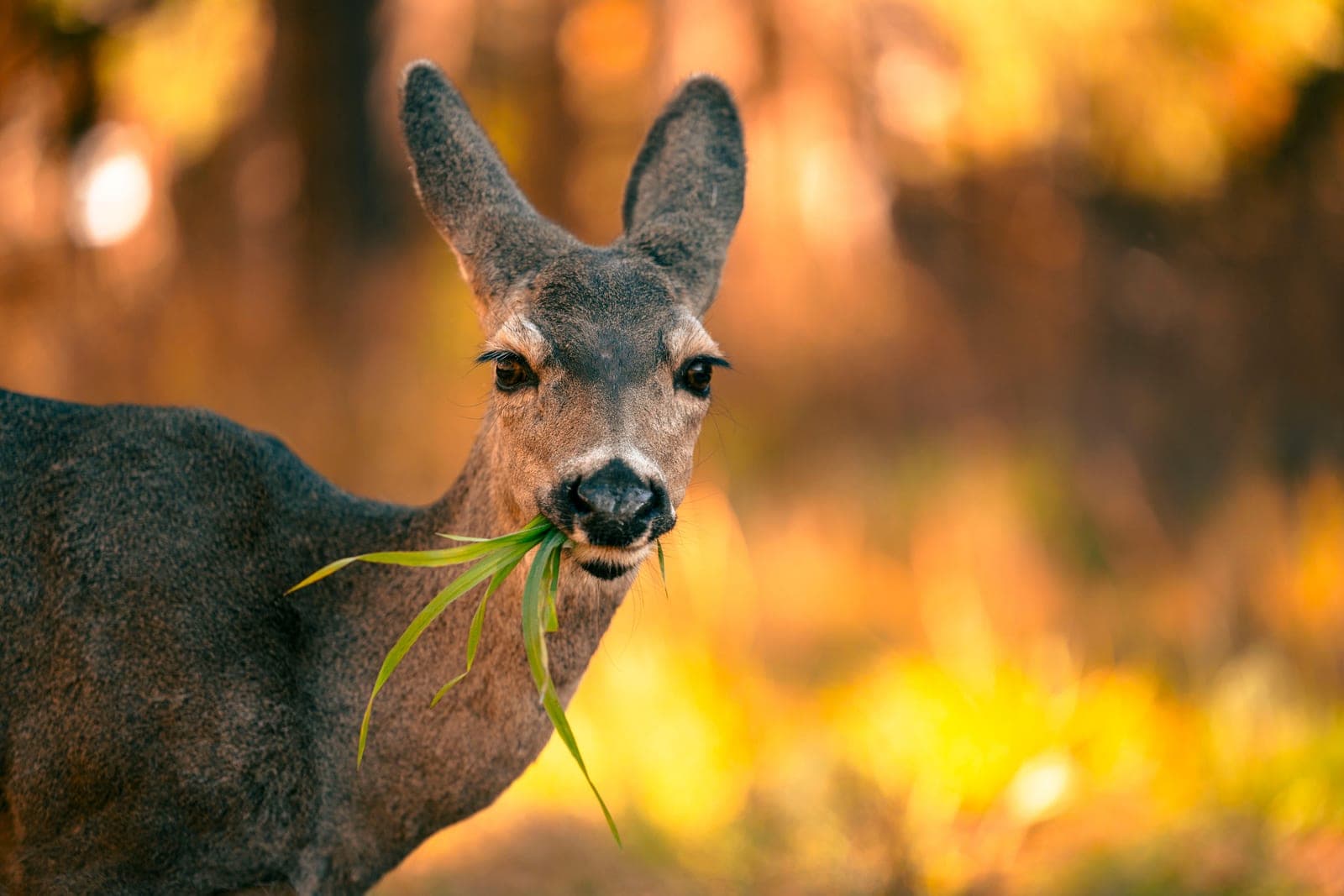
The best deer repellent is the one you will reapply, which means the cheapest per treated area. Plantskydd's 2.2 lb powder concentrate publishes a yield of 2.5 gallons, making it the best value here; rotate it with Bobbex, which uses a different base, so habituation has less to work with.
Two things are true at once about repellents, and most buying guides pick only one. They genuinely reduce browse on treated foliage. And they are not the method that solves a deer problem — that is fencing, and extension services say so plainly.
Baffleworks is funded by affiliate commission. If you buy through a link on this page we may earn a commission at no extra cost to you, and it never decides a ranking. Full disclosure · how we pick.
Quick picks
Ranked, with the trade-off named. Tap a row for the full write-up; the price button goes straight to Amazon.
| # | Product | Best for | Price |
|---|---|---|---|
| 1 |  Plantskydd Powder Concentrate, 2.2 lb2.2 lb of powder makes 2.5 gallons, which is the format that makes a repellent program affordable instead of theoretical. | Best cost per treated area | $65.47 on Amazon |
| 2 |  Bobbex Concentrated Deer Repellent, 32 ozA concentrate rather than a ready-to-use bottle, which is the right format if you are going to spray often enough for a repellent to work at all. | Rotation partner, concentrate | $25.60 on Amazon |
| 3 |  Plantskydd Ready-to-Use Liquid, 1.3 galReady-to-use and covering the widest published species list here: deer, rabbits, elk, moose, voles, squirrels and chipmunks from one bottle. | No mixing, widest species list | $80.18 on Amazon |
| 4 | 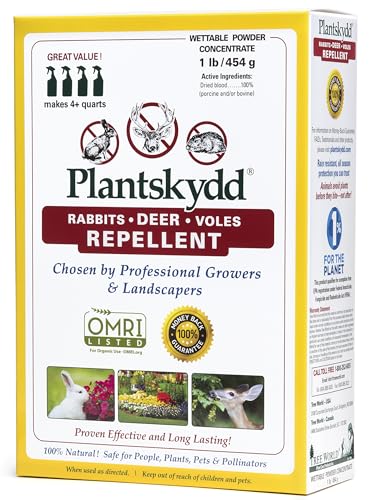 Plantskydd Wettable Powder, 1 lbOne pound makes one gallon: the small box, for finding out whether a repellent program is something you will actually keep up. | Trying it without committing | $41.00 on Amazon |
| 5 |  Bobbex-R Rabbit, Squirrel and Chipmunk Repellent, 32 ozFormulated for the small raiders rather than for deer, which matters because the animal eating your bulbs is usually not the animal eating your hostas. | Rabbits and chipmunks specifically | $27.95 on Amazon |
#ad how we are funded · price as of October 24, 2026
The picks in full
Top pick Best cost per treated area
Plantskydd Powder Concentrate, 2.2 lb
2.2 lb of powder makes 2.5 gallons, which is the format that makes a repellent program affordable instead of theoretical.
Published specifications
- Size
- 2.2 lb powder concentrate (published)
- Yield
- Makes 2.5 gal of liquid (published)
- Targets
- Deer, rabbit, voles
- Active base
- Dried blood meal
- Part number
- PSP-R2
Trade-offs
- Published yield, so cost per gallon is arithmetic rather than a guess
- Powder stores far better than mixed liquid between seasons
- The cheapest way here to cover a large garden repeatedly
- You have to mix it, and mixing is the step people skip
- Blood meal has a smell on application; downwind of a patio it is noticeable
Who it is forA large garden on a real reapplication schedule, especially through the spring browse season.
Skip it ifYou will not mix it. An unmixed concentrate protects nothing, and the ready-to-use is better value than a bag in the shed.
#ad how we are funded · price as of October 24, 2026
Where these specifications came from
No. 2 Rotation partner, concentrate
Bobbex Concentrated Deer Repellent, 32 oz
A concentrate rather than a ready-to-use bottle, which is the right format if you are going to spray often enough for a repellent to work at all.
Published specifications
- Size
- 32 oz concentrate (published)
- Targets
- Deer, elk, moose
- Form
- Dilute and spray
- Part number
- B550100
Trade-offs
- Concentrate is far cheaper per treated square foot than ready-to-use
- A different active profile from Plantskydd, which is what makes rotation possible
- Repellents are a reapplication commitment: rain, new growth and habituation all reset them
- Mixing and spraying is a job, and the ones that stop working are usually the ones that stopped being sprayed
Who it is forOrnamental beds and shrubs where fencing is not acceptable, used on a schedule rather than in a panic.
Skip it ifYou want to solve this once. Extension services are consistent that a fence is the exclusion method and a repellent is a mitigation. Read what actually keeps deer out before you buy a spray instead of a fence.
#ad how we are funded · price as of October 24, 2026
Where these specifications came from
No. 3 No mixing, widest species list
Plantskydd Ready-to-Use Liquid, 1.3 gal
Ready-to-use and covering the widest published species list here: deer, rabbits, elk, moose, voles, squirrels and chipmunks from one bottle.
Published specifications
- Size
- 1.3 gal ready-to-use (published)
- Targets
- Deer, rabbit, elk, moose, voles, squirrels, chipmunks
- Form
- Ready-to-use liquid
- Part number
- PS-5L
Trade-offs
- No mixing, so it is the one people actually reapply on schedule
- The species list covers the garden raiders as well as the browse animals
- 1.3 gal is enough to treat a real garden rather than a planter
- Ready-to-use costs considerably more per treated area than concentrate
- It is a blood-meal-based product and it smells like one for a day or so
Who it is forA mixed garden problem — deer on the shrubs, rabbits on the greens, chipmunks in the bulbs — where you want one bottle rather than three.
Skip it ifYou are treating a large area regularly. Buy the powder concentrate and mix it; the ready-to-use maths stops working quickly at scale.
#ad how we are funded · price as of October 24, 2026
Where these specifications came from
No. 4 Trying it without committing
Plantskydd Wettable Powder, 1 lb
One pound makes one gallon: the small box, for finding out whether a repellent program is something you will actually keep up.
Published specifications
- Size
- 1 lb box (published)
- Yield
- Makes 1 gal of liquid (published)
- Targets
- Deer, rabbits, elk, moose, hares, voles, squirrels, chipmunks
- Part number
- PSP-R1
Trade-offs
- Low commitment, and the yield is published so you know what a gallon costs
- Same species coverage as the larger sizes
- One gallon does not go far on a real garden
- Worst cost per treated area of the three Plantskydd formats here
Who it is forA first trial on a few shrubs, or a small courtyard garden where a gallon is genuinely enough.
Skip it ifYou already know you will be spraying all season. Go straight to the 2.2 lb box.
#ad how we are funded · price as of October 24, 2026
Where these specifications came from
No. 5 Rabbits and chipmunks specifically
Bobbex-R Rabbit, Squirrel and Chipmunk Repellent, 32 oz
Formulated for the small raiders rather than for deer, which matters because the animal eating your bulbs is usually not the animal eating your hostas.
Published specifications
- Size
- 32 oz concentrate (published)
- Targets
- Rabbit, squirrel, chipmunk
- Form
- Dilute and spray
- Part number
- B550120
Trade-offs
- Targets the species that deer repellents are not formulated for
- Concentrate, so a season of reapplication is affordable
- Same reapplication burden as every other repellent
- It will not fix a rabbit problem that a 2 ft buried fence would fix permanently
Who it is forBulbs, seedlings and container plants that rabbits, chipmunks or squirrels are working through, where a cage would be impractical.
Skip it ifThe damage is at ground level along a boundary. Colorado State Extension is specific: two feet of wire buried 4 to 8 inches is fairly effective against rabbits, and that is a permanent fix a spray is not. See rabbit fencing.
#ad how we are funded · price as of October 24, 2026
What we would skip
A repellent as a substitute for a fence on a perimeter you could fence
Michigan State University Extension is unambiguous that exclusion is the reliable method and puts effective perimeters at 8 to 10 ft. A repellent reduces browse; a fence prevents it. Buying spray to avoid fencing is the most expensive way to keep this problem.
Ready-to-use bottles for a large garden
Cost per treated area is what determines whether you keep spraying, and ready-to-use is several times the price of concentrate. Plantskydd's 2.2 lb powder publishes a yield of 2.5 gallons; the arithmetic is not close.
One product, used forever
Deer habituate. Rotating between products with genuinely different bases — Plantskydd is blood-meal based, Bobbex is a different formulation — gives habituation less to work with. Rotating between two brands of the same chemistry does not.
Why repellents get a bad reputation
Almost never because the chemistry does not work. Three mechanical reasons, in order of importance:
- New growth is untreated growth. A coating covers the leaves that existed when you sprayed. Every leaf that opens afterwards is unprotected, and in spring that is most of the plant within a fortnight.
- Rain strips it. Some formulations bind better than others, but none is permanent. A wet spring is a spring of reapplication.
- Hungry deer eat things they dislike. A repellent shifts a preference; it does not create an inability. Under real pressure, and with nothing better nearby, deer will take treated foliage.
All three point the same way: the product that works is the one still on the plant. That makes format — and therefore cost per treated area — the decisive spec.
The format arithmetic
| Product | Published size | Published yield | Format |
|---|---|---|---|
| Plantskydd powder concentrate | 2.2 lb | Makes 2.5 gal | Mix and spray |
| Plantskydd wettable powder | 1 lb | Makes 1 gal | Mix and spray |
| Plantskydd ready-to-use | 1.3 gal | 1.3 gal as supplied | No mixing |
| Bobbex deer concentrate | 32 oz | Not published on the listing | Dilute and spray |
| Bobbex-R (rabbit, squirrel, chipmunk) | 32 oz | Not published on the listing | Dilute and spray |
Where a maker does not publish a yield, we leave the cell blank rather than estimating one.
The pattern is clear. If you are treating a real garden repeatedly, the powder concentrate is the format that makes the program affordable. If you will not mix it, buy the ready-to-use — an unmixed bag in the shed protects nothing.
Rotation, and what makes it meaningful
Rotating products only helps if the products differ. Plantskydd's listed active base is dried blood meal; Bobbex is a different formulation. Alternating those two is a genuine rotation. Alternating two blood-meal products is a change of label.
A practical pattern: one product through the spring flush when growth is fastest, the other through late summer and autumn, and a fresh application after any heavy rain regardless of the calendar.
The free half of the strategy
Plant choice costs nothing and works permanently. Colorado State University Extension publishes deer-resistant plant lists, and while nothing is deer-proof under enough pressure, moving the most-browsed species out of the front line reduces how hard everything else has to work.
Combine that with a fence on the perimeter and a repellent on the specimens outside it, and you have a strategy rather than a spray bottle. Keeping deer out of the garden puts the whole thing together, and spray vs fence vs device compares the three approaches directly.
Three pages go deeper than a ranking. The Plantskydd review holds every one of the leader's claims — duration, mechanism, OMRI listing — up to the light. Bobbex vs Liquid Fence vs Plantskydd adds Liquid Fence, a third base not on this list, and the rotation claim its maker makes. And the best deer repellent for hostas applies all of it to the plant most often sprayed.
Roses are a harder repellent target than they look, because they keep producing untreated new growth all season. Protecting roses from deer covers the reapplication schedule that actually follows from that.
How we picked
- We started from the fence height cooperative extension services publish, and measured every product against it rather than against its competitors.
- We recorded published specifications only — heights, roll lengths, breaking loads, stated life expectancies, yields and mixing ratios.
- We said plainly where a product is a compromise. Every polypropylene deer fence sold online is below the height extension services recommend, and pretending otherwise would be the easiest way to waste your money.
- We named at least one product to skip on every page, with the reason.
- We have not installed or trialed any of these. How we pick sets out what that does and does not cover.
Everyone in this category says they tested twenty of these. We have not tested any, and we say so. What we did instead: read the manuals, compiled the published specifications, worked out the clearance geometry, and cited every source. The full method is published.
Questions people actually ask
- What is the best deer repellent?
- The one you will reapply. On published figures Plantskydd's 2.2 lb powder is the best value — it states a yield of 2.5 gallons — and rotating it with Bobbex, which uses a different base, reduces habituation.
- Do deer repellents actually work?
- On treated foliage, yes. They fail mechanically rather than chemically: new growth is untreated, rain strips the coating, and hungry deer will eat things they dislike. Reapplication is the whole game.
- How often should I apply deer repellent?
- After heavy rain, and whenever there is significant new growth. In a spring flush that can be every two to three weeks. Put it on a calendar rather than reapplying when you notice damage.
- Is repellent cheaper than fencing?
- Cheaper to start and more expensive to sustain. A fence is a one-time build; a repellent is an indefinite commitment. Extension services treat fencing as the exclusion method and repellents as mitigation.
- Will deer repellent work on rabbits?
- Not necessarily — formulations differ. Bobbex-R is the version targeted at rabbits, squirrels and chipmunks, and for rabbits specifically a buried fence is the permanent answer. See rabbit fencing.
Sources
Read next
- Spray vs fence vs device
Exclusion, mitigation and startle are three different jobs. Which method does which.
- The best deer fencing
Every mesh deer fence sold online is 7.5 ft; extension services say 8 to 10. What that compromise buys.
- How to keep deer out of the garden
Fence, repel, deter, replant — in that order, with the published height that decides step one.
- Rabbit fencing
Two feet high, buried four to eight inches, one inch mesh. The one garden problem with a published answer.
- Deer Deterrence
Fencing at the height extension services publish, plus the repellents that fill the gaps around it.