Feeders / Orioles
The best oriole feeders
Orioles are the one bird on this site where squirrels are not the main threat. Everything you put out for them is sugar, and sugar brings its own visitors.
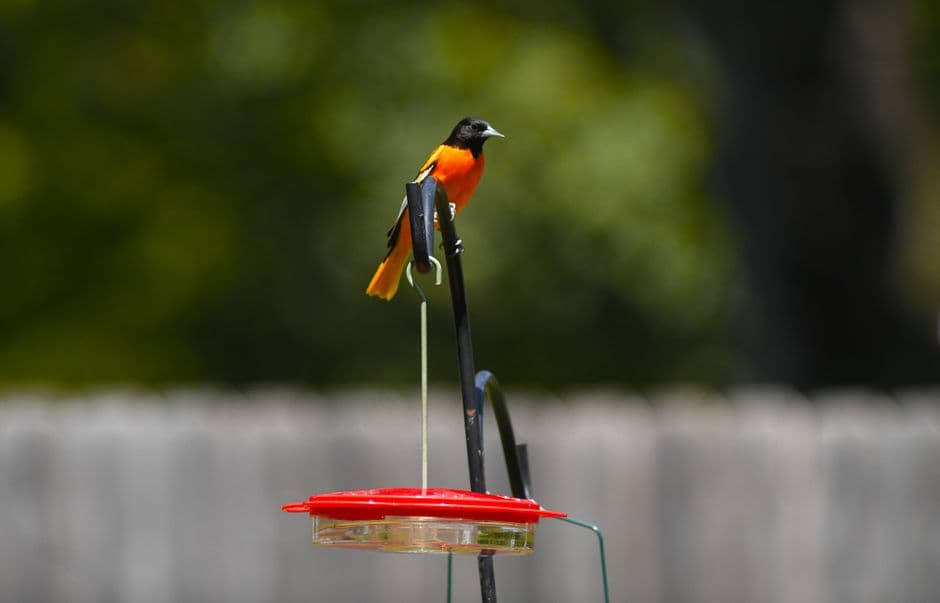
Buy the one with a published ant moat. Orioles take nectar, grape jelly and orange halves, and all three are sugar, so the animals you are actually defending against are ants and wasps rather than squirrels. A moat on the hanger stops ants completely; a cover keeps rain out of the jelly. Everything else about an oriole feeder is presentation.
This site is mostly about excluding mammals. Orioles are the exception on the shelf, and it is worth being clear about that up front rather than pretending a dome solves it.
Baffleworks is funded by affiliate commission. If you buy through a link on this page we may earn a commission at no extra cost to you, and it never decides a ranking. Full disclosure · how we pick.
Quick picks
Ranked, with the trade-off named. Tap a row for the full write-up; the price button goes straight to Amazon.
| # | Product | Best for | Price |
|---|---|---|---|
| 1 | 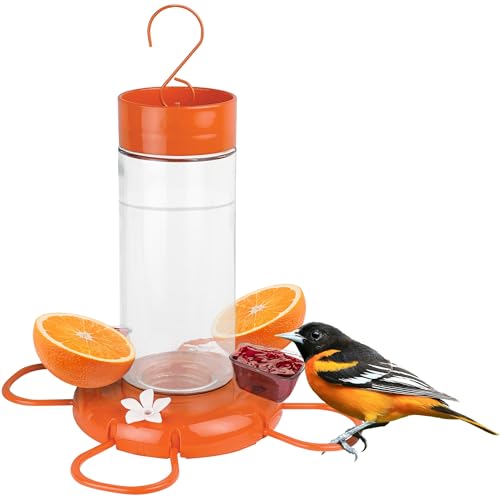 Nature's Way Glass Oriole Feeder, 30 oz, with Ant MoatNectar, jelly dishes and orange holders on one hanger, with a published ant moat and bee guards. On a sugar feeder the moat is not an accessory, it is the mechanism. | All three oriole foods with the ant defense built in | $13.95 on Amazon |
| 2 | 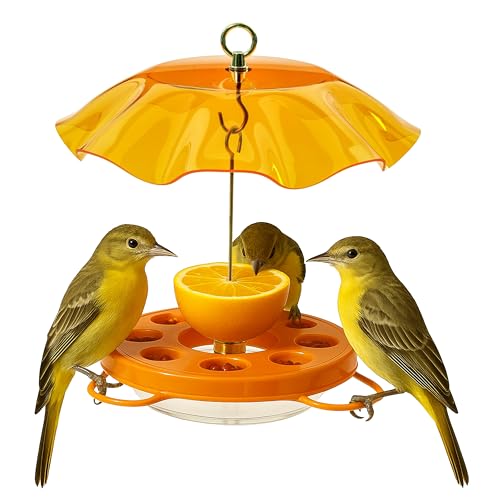 Birds Choice Oriolefest Oriole Feeder with Weatherguard, 12 ozThe Oriolefest with a dome over it. Jelly is the one feeder food rain ruins fastest, and a cover is the difference between a jelly dish and a jelly soup. | Jelly that survives a rain shower | $22.99 on Amazon |
| 3 |  Birds Choice Oriolefest Oriole Feeder for Jelly, Oranges and NectarThe uncovered Oriolefest: three foods, one hanger, under twenty dollars. The right first purchase when you are not yet sure orioles pass through your yard. | Cheapest way to find out whether you have orioles | $19.61 on Amazon |
#ad how we are funded · price as of September 27, 2026
The picks in full
Top pick All three oriole foods with the ant defense built in
Nature's Way Glass Oriole Feeder, 30 oz, with Ant Moat
Nectar, jelly dishes and orange holders on one hanger, with a published ant moat and bee guards. On a sugar feeder the moat is not an accessory, it is the mechanism.
Published specifications
- Capacity
- 30 oz (published)
- Foods
- Nectar, jelly dishes, orange fruit holders (published)
- Ports
- 4, flexible, easy to clean (published)
- Insect defense
- Ant moat and bee guards (published)
- Body
- Glass
Trade-offs
- A published ant moat and bee guards on the same feeder, which is the specific defense a sugar feeder needs
- Takes all three things orioles actually come for, so one hanger covers the whole season
- Glass rather than plastic — it does not cloud, and orioles are a spring-to-midsummer bird so UV exposure is concentrated
- 30 oz of nectar is far more than an oriole flock drinks before it spoils in heat — fill it part way
- Glass is heavier and breakable, which matters on a thin hook
- The moat only works while it has water in it, and it evaporates fastest exactly when ants are worst
Who it is forAnyone starting with orioles who would rather buy one feeder than discover which food their local birds want.
Skip it ifYou already run a hummingbird feeder with a moat and only want a jelly dish. Buy the jelly feeder and keep the moat you have.
#ad how we are funded · price as of September 27, 2026
Where these specifications came from
No. 2 Jelly that survives a rain shower
Birds Choice Oriolefest Oriole Feeder with Weatherguard, 12 oz
The Oriolefest with a dome over it. Jelly is the one feeder food rain ruins fastest, and a cover is the difference between a jelly dish and a jelly soup.
Published specifications
- Capacity
- 12 oz (published)
- Cover
- Weatherguard dome (published)
- Foods
- Jelly and nectar
- Color
- Orange (published)
Trade-offs
- The dome is the whole reason to pay more than the uncovered version — wet jelly ferments and has to be thrown out
- A cover also shades the jelly, which slows spoilage in summer heat
- Birds Choice is a long-running US feeder maker rather than a one-season listing
- 12 oz is a small reservoir, and jelly should be changed every couple of days anyway rather than stockpiled
- A dome this size shelters the dish and does nothing about a squirrel or raccoon reaching it
- Jelly attracts wasps in late summer no matter what covers it
Who it is forAn oriole feeder in a spot that gets weather, which is most spots.
Skip it ifYou are feeding nectar only. A covered jelly dish is solving a problem you do not have.
#ad how we are funded · price as of September 27, 2026
Where these specifications came from
No. 3 Cheapest way to find out whether you have orioles
Birds Choice Oriolefest Oriole Feeder for Jelly, Oranges and Nectar
The uncovered Oriolefest: three foods, one hanger, under twenty dollars. The right first purchase when you are not yet sure orioles pass through your yard.
Published specifications
- Foods
- Jelly, oranges and nectar (published)
- Cover
- None — see the Weatherguard version
- Color
- Orange (published)
- Capacity
- Not published
Trade-offs
- Covers all three oriole foods at the lowest price here, which is the honest way to test a species you may not have
- Orange is not decoration — it is the color orioles key on, and every maker uses it for that reason
- Simple dishes wash out in a sink, and jelly feeders need washing constantly
- No cover, so rain gets into the jelly and the jelly then has to go
- No published capacity
- Nothing about it addresses ants, which will find jelly within a day
Who it is forA first oriole feeder in late April, hung to find out whether the birds are there at all.
Skip it ifYou already know you have orioles. Spend the extra on the covered version or the one with the moat.
#ad how we are funded · price as of September 27, 2026
Where these specifications came from
What we would skip
An uncovered jelly dish in a wet climate
Rain turns jelly into a diluted syrup that ferments, and fermenting jelly is not something to leave out for birds. The covered version of the same feeder costs a few dollars more and removes the problem.
A large nectar reservoir filled to the top
Oriole nectar is a weaker sugar solution than hummingbird nectar and it spoils in heat just as fast. A 30 oz reservoir is a convenience for you and a liability for the birds if it sits for a week. Fill what gets drunk in a few days.
What orioles actually take
Three foods, and Project FeederWatch is specific about two of them. On fruit: "Oranges cut in half will often attract orioles which will sip the juice and eat the flesh of the orange." On nectar, the mix is not the hummingbird recipe — "A slightly more diluted mixture can be used for orioles (one part sugar to six parts water)", against one part in four for hummingbirds.
Jelly is the third, and grape is the conventional choice. Note what all three have in common: they are sugar, they are wet, and they spoil. That single fact drives every recommendation below.
| Food | Draw | Spoils | Brings |
|---|---|---|---|
| Nectar, 1:6 sugar to water | Strong | Fast in heat | Ants, wasps, hummingbirds |
| Grape jelly | Strongest | Fastest — ferments when wet | Ants, wasps, raccoons |
| Orange halves | Strong early season | Dries out, then molds | Wasps, fruit flies |
Nectar ratio quoted from Project FeederWatch. The rest is the maintenance consequence, not a published figure.
Why the ant moat is the mechanism
An ant moat is a cup above the feeder that you fill with plain water. Ants cannot cross it. There is no chemistry, no habituation and nothing to reapply — it is the most complete barrier anywhere on this site, and it works on the same day you fit it.
One of the feeders here publishes a moat and bee guards as part of the product. The other two do not, which means buying a standalone moat to hang above them. That is a few dollars and one more link in the chain, and it is the single thing most likely to decide whether you enjoy the feeder or give up on it in July.
Protecting a hummingbird feeder covers moats, bee guards and the ant problem in full — the mechanics are identical and the page applies directly to orioles.
Jelly hygiene, said plainly
Jelly is the most effective oriole food and the one most likely to go wrong. It is a sugar gel sitting in the open in spring warmth.
- Put out a spoonful or two at a time, not a full dish. It should be gone in a day or so.
- Change it rather than topping it up. Old jelly under new jelly is how mold starts.
- Keep it covered. Rain thins it, and thinned jelly ferments.
- Wash the dish every time, in hot water, not just a rinse.
- If you see mold, stop, wash everything and start again. Do not scrape and refill.
This is more upkeep than a seed feeder, and it is the honest cost of feeding orioles. Anyone not willing to wash a dish every couple of days should feed oranges instead, which fail more visibly and more slowly.
Wasps arrive later than the orioles do
Early season is easy. Late summer is when a jelly feeder becomes a wasp feeder, because wasps switch to sugar as their own food sources run out. Bee guards help at the nectar ports and do nothing for an open jelly dish.
The practical answer is seasonal: run jelly while the orioles are actively using it, and take it down when the traffic drops and the wasps take over. Orioles are a spring-to-midsummer bird in most of the country, not a year-round one like the feeder birds on the rest of this site.
Where the mammals come in
Squirrels are not indifferent to jelly, and raccoons are actively interested. A jelly feeder on a reachable hook is a target for both, and the usual answer applies: get it onto a baffled pole rather than trying to make the feeder itself defensible.
The Alabama Cooperative Extension System's jump figures apply the same way here as anywhere — a gray squirrel clears about four feet vertically and roughly eight horizontally, so a feeder within that envelope of a fence or branch is reachable regardless of what it holds. The best squirrel baffles has the hardware, and a raccoon-rated baffle is the one to buy if jelly is on the menu — see raccoon deterrents.
Timing, because it decides whether any of this works
Orioles are most findable as they arrive, and a feeder hung after they have settled into natural food often goes ignored. The convention is to put it out around the time the first migrants are reported locally and to use orange halves early, because fruit is more visible at distance than a dish of jelly.
If nothing comes in the first two weeks, that is information about your yard rather than about the feeder. Orioles are strongly tied to open woodland edges and large trees, and no feeder recruits them into a habitat they do not use.
How we picked
- We sorted by mechanism first: weight, cage or spin. Those three exclude different animals, and the choice between them is not a quality judgment.
- We used published figures only — seed capacity, port count, dimensions, mechanism. Where a maker publishes nothing, the spec row says so.
- We checked each mechanism against the animal it is calibrated for. A weight trigger tuned for a gray squirrel does not fire for a chipmunk, and we say so rather than implying it does.
- We named at least one product to skip on every page, with the reason.
- We have not tested any of these. How we pick sets out what that does and does not cover.
Everyone in this category says they tested twenty of these. We have not tested any, and we say so. What we did instead: read the manuals, compiled the published specifications, worked out the clearance geometry, and cited every source. The full method is published.
Questions people actually ask
- What is the best food for an oriole feeder?
- All three of nectar, grape jelly and orange halves work. Project FeederWatch notes that oranges cut in half attract orioles, which sip the juice and eat the flesh, and that oriole nectar is mixed more weakly than hummingbird nectar at one part sugar to six parts water.
- How do I keep ants out of an oriole feeder?
- A water-filled ant moat above the feeder. Ants cannot cross it, and it is the most complete barrier on this site — nothing to reapply and no habituation. One feeder here publishes a moat as part of the product; for the others, hang a standalone moat above it.
- How often should I change grape jelly?
- Every day or two, and change it rather than topping it up. Put out a spoonful at a time, keep it covered so rain cannot thin it, and wash the dish in hot water at each change. Fermenting or moldy jelly should be discarded and the feeder cleaned before refilling.
- Do squirrels bother oriole feeders?
- Squirrels will take jelly and raccoons are keen on it. The fix is the same as for any feeder — get it above a baffle at four to five feet with clear air around it, rather than looking for a jelly feeder that is somehow squirrel-proof.
- Why are wasps all over my oriole feeder?
- Late summer. Wasps switch to sugar as their own food runs out, and an open jelly dish is the easiest sugar in the yard. Bee guards protect nectar ports but not a jelly dish, so the practical answer is to take jelly down once oriole traffic drops.
- When should I put an oriole feeder out?
- Around the time the first local migrants are reported, and use orange halves early because fruit is more visible at distance than jelly. A feeder hung after the birds have settled onto natural food is often ignored.
Sources
Read next
- How to protect a hummingbird feeder
Ants first, bees second, rain third, squirrels a distant fourth. The water barrier you can watch working.
- The best squirrel-proof bird feeders for cardinals
Cages exclude by aperture and cannot be adjusted; weight triggers can. Which feeders publish a cardinal ring, and which quietly do not.
- Raccoon deterrents
Food management first, then a baffle that actually names raccoons, then a sprinkler on the route.
- The best squirrel baffles
Seven baffles ranked by published dimensions and mount fit, with the clearance rule that decides all of it.
- Squirrel-Proof Feeders
Weight-activated, caged and spinning feeders, sorted by which animal each mechanism actually keeps out.