Feeders / Woodpeckers
The best woodpecker feeders
There is one design that feeds woodpeckers and turns starlings away at the same time, and it works on posture rather than weight.
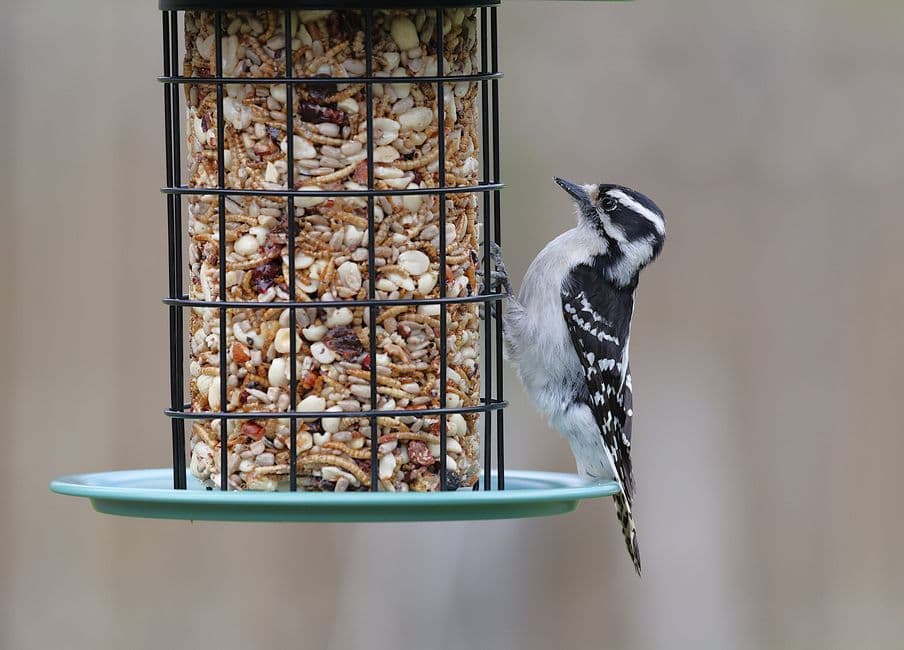
Buy an upside-down suet feeder. Project FeederWatch puts the mechanism plainly: "Cages that are only accessible at the bottom tend to be starling-resistent but allow woodpeckers, nuthatches, and chickadees to feed by clinging upside down." Woodpeckers do it without hesitating; starlings are not built for it. Add a mesh peanut feeder for the warm months when suet has to come down.
Woodpeckers are easy birds to feed and easy birds to lose. They come readily to suet, and so does every starling within half a mile. The whole problem is selectivity, and one format solves it.
Baffleworks is funded by affiliate commission. If you buy through a link on this page we may earn a commission at no extra cost to you, and it never decides a ranking. Full disclosure · how we pick.
Quick picks
Ranked, with the trade-off named. Tap a row for the full write-up; the price button goes straight to Amazon.
| # | Product | Best for | Price |
|---|---|---|---|
| 1 |  Erva SUET3S Upside-Down Suet Feeder, copper-finish roofSuet accessible only from below, with a roof over it. Woodpeckers cling and feed inverted without thinking about it; starlings largely will not, and that is the entire point of the format. | The upside-down mechanism from the maker the site trusts most on steel | $30.65 on Amazon |
| 2 | 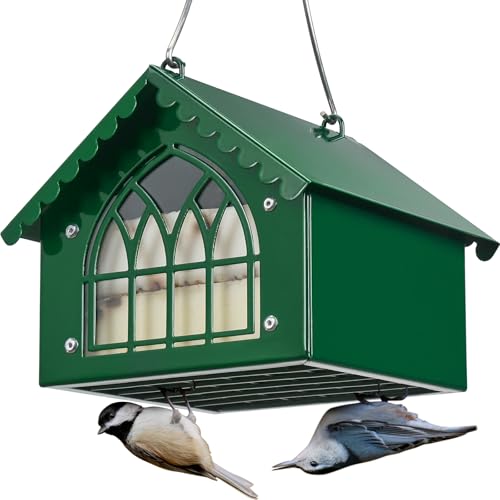 Kingsyard Metal Upside-Down Double Suet FeederMetal, inverted, and it takes two cakes instead of one. The cheapest of the three and the only one that is both metal and double. | Two cakes, metal body, lowest price | $19.99 on Amazon |
| 3 | 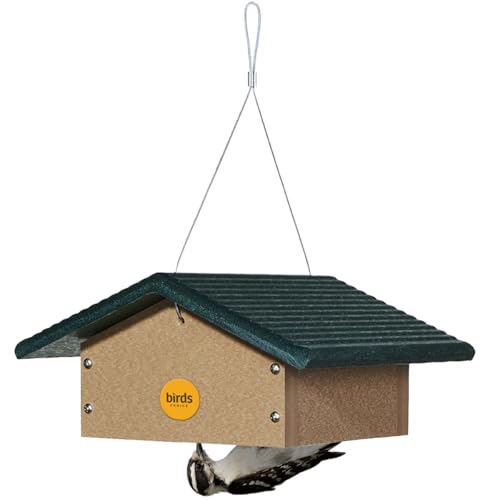 Birds Choice Upside-Down Suet Feeder, recycled plasticThe same inverted mechanism in recycled plastic lumber, which is the material that does not rot, split or need painting. A twenty-year feeder body in a category full of two-season ones. | A body that will outlast the birds using it | $34.99 on Amazon |
| 4 |  Brome Squirrel Buster Nut Feeder, 1.3 lbWeight-adjustable shroud, 1.3 lb capacity and two interchangeable meshes so you can run shelled peanuts or peanut pieces. This is the only way to put peanuts out and keep them. | Peanuts with a working weight mechanism | $74.99 on Amazon |
| 5 |  iBorn 13.5 in Metal Mesh Peanut Feeder, 2 lbA 13.5 in metal mesh tube with a published 2 lb capacity, a 17 cm roof and a tray. The mesh takes shelled peanuts or sunflower hearts and the tray stops the crumb feeding the ground. | Most capacity per dollar | $23.99 on Amazon |
#ad how we are funded · price as of September 27, 2026
The picks in full
Top pick The upside-down mechanism from the maker the site trusts most on steel
Erva SUET3S Upside-Down Suet Feeder, copper-finish roof
Suet accessible only from below, with a roof over it. Woodpeckers cling and feed inverted without thinking about it; starlings largely will not, and that is the entire point of the format.
Published specifications
- Model
- SUET3S (published)
- Access
- Upside-down — suet reached from below
- Roof
- Copper finish (published)
- Origin
- Made in USA (published)
Trade-offs
- Inverted access is a behavioral filter rather than a weight trigger, so there is nothing to calibrate and nothing to wear out
- The roof keeps rain off the cake, which is what turns suet rancid fastest
- Erva is the maker whose steel specifications this site cites on the baffle pages
- Woodpeckers find it immediately; some other clinging birds you would welcome take longer
- A single cake holder, so it empties faster than a double
- Publishes no cake size, so check your suet fits before ordering
Who it is forA suet feeder being emptied by starlings, where you want the woodpeckers to keep it.
Skip it ifStarlings are not your problem. A plain caged holder costs less and admits more of the birds you want.
#ad how we are funded · price as of September 27, 2026
Where these specifications came from
No. 2 Two cakes, metal body, lowest price
Kingsyard Metal Upside-Down Double Suet Feeder
Metal, inverted, and it takes two cakes instead of one. The cheapest of the three and the only one that is both metal and double.
Published specifications
- Access
- Upside-down — suet reached from below
- Capacity
- Double — two cakes (published)
- Body
- Metal (published)
- Cake size
- Not published
Trade-offs
- Two cakes halves the refill trips in the cold months when suet goes fastest
- Metal is the right material on the one feeder food a squirrel will carry off whole
- Cheapest entry into the inverted format by a clear margin
- Two cakes is also twice the fat sitting out, which matters in warm weather when suet spoils
- Thin metal on budget holders bends if a raccoon works at it
- Publishes no dimensions at all beyond the format
Who it is forA busy winter suet station where refilling every few days has become the chore.
Skip it ifIt is summer. Run one cake, or take the suet down entirely until it cools.
#ad how we are funded · price as of September 27, 2026
Where these specifications came from
No. 3 A body that will outlast the birds using it
Birds Choice Upside-Down Suet Feeder, recycled plastic
The same inverted mechanism in recycled plastic lumber, which is the material that does not rot, split or need painting. A twenty-year feeder body in a category full of two-season ones.
Published specifications
- Access
- Upside-down — suet reached from below
- Material
- Recycled plastic (published)
- Color
- Taupe and green (published)
- Cake size
- Not published
Trade-offs
- Recycled plastic lumber does not rot or need refinishing, unlike the cedar it imitates
- Inverted access excludes starlings while woodpeckers use it normally
- Birds Choice bodies are typically screwed rather than glued, so they come apart for cleaning
- Plastic lumber is not chew-proof — a determined squirrel gnaws the edges even if it cannot reach the cake
- Most expensive of the three upside-down holders here
- No published cake dimension
Who it is forSomebody buying a suet holder once and expecting to still own it in ten years.
Skip it ifChewing is your active problem rather than starlings. Buy the metal one.
#ad how we are funded · price as of September 27, 2026
Where these specifications came from
No. 4 Peanuts with a working weight mechanism
Brome Squirrel Buster Nut Feeder, 1.3 lb
Weight-adjustable shroud, 1.3 lb capacity and two interchangeable meshes so you can run shelled peanuts or peanut pieces. This is the only way to put peanuts out and keep them.
Published specifications
- Seed capacity
- 1.3 lb (published)
- Mechanism
- Weight-adjustable shroud
- Meshes
- 2 interchangeable (published)
- Food
- Shelled peanuts, dried fruit (published)
Trade-offs
- Peanuts are the single most attractive thing you can hang for a squirrel, so this is the one food where a weight mechanism earns its price outright
- The adjustable spring lets you tune it so woodpeckers and jays still feed while the squirrel closes it
- Two mesh sizes cover whole shelled nuts and smaller pieces without buying a second feeder
- Expensive — roughly four times a plain mesh peanut tube
- 1.3 lb is a small hopper for a food that disappears fast in a busy yard
Who it is forYou want jays, woodpeckers, nuthatches and titmice on peanuts, in a yard where an unprotected peanut feeder is emptied the same day.
Skip it ifYour peanut feeder hangs under a baffle on a properly cleared pole already. The geometry has done the job and this mechanism is redundant.
#ad how we are funded · price as of September 27, 2026
Where these specifications came from
No. 5 Most capacity per dollar
iBorn 13.5 in Metal Mesh Peanut Feeder, 2 lb
A 13.5 in metal mesh tube with a published 2 lb capacity, a 17 cm roof and a tray. The mesh takes shelled peanuts or sunflower hearts and the tray stops the crumb feeding the ground.
Published specifications
- Length
- 13.5 in (published)
- Capacity
- 2 lb (published)
- Roof
- 17 cm (published)
- Tray
- Included (published)
Trade-offs
- 2 lb in a mesh tube is a lot of peanut for the price, and the tray is included rather than sold separately
- Metal mesh rather than plastic, which is the whole game on a feeder holding peanuts
- Takes sunflower hearts as well, so it is not a single-use purchase
- No mechanism at all — a squirrel that reaches it will cling to the mesh and eat
- A tray under peanuts needs emptying; wet peanut is the one feeder food you should not let sit
Who it is forA peanut feeder that hangs under a baffle, or on a pole with real clearance, where the geometry is already doing the excluding.
Skip it ifThe feeder hangs from a tree branch or a fence with nothing above it. Mesh plus peanuts plus reachable equals an expensive squirrel feeder.
#ad how we are funded · price as of September 27, 2026
Where these specifications came from
What we would skip
An open wire suet basket, in a yard with starlings
This is the default suet holder and it is the one starlings empty. An open cage gives them a perch and full access to the cake. The upside-down version costs about the same and turns them away by posture.
Suet of any kind in high summer
Project FeederWatch's warning is about the fat, not the feeder: "Be careful if you offer suet in hot weather; it may become rancid if it has not been specially processed." Run suet through the cold months and switch woodpeckers onto peanuts when it warms.
The inverted mechanism, and why it is different
Everything else on this site excludes by weight or by aperture. This one excludes by posture. Suet is mounted so the only access is from underneath, which means a bird has to hang head-down and hold on while it feeds.
Woodpeckers are built for exactly that — stiff tail feathers, strong feet, and a life spent clinging to vertical bark. Nuthatches go down tree trunks head-first as a matter of routine. Starlings and house sparrows perch; they can cling briefly and they will not persist at it.
The FeederWatch archive includes a reader's account of exactly this working in practice, on the sparrow side: "I did see one House Sparrow clinging to it, but sparrows are just not built for hanging upside down, so the sparrow dropped off in a few seconds and has not returned." That is the mechanism in one sentence.
Suet is the most-stolen thing you can hang
Worth repeating from the suet feeder roundup: suet is calorie-dense, it comes in one portable block, and unlike seed it can be removed in a single trip. A squirrel does not graze a cake, it carries it off.
So the upside-down format solves the bird problem and not the mammal one. Two of the holders here are metal, which stops the body being chewed; none of them stops an animal that reaches the cake. That is the mount's job.
Get the holder above a baffle with its top at four to five feet, with eight to ten feet of clear air around it per Audubon, and at least ten feet from the nearest jumping-off point per the Cornell Lab. Baffles for hanging feeders covers the dome option if the holder hangs rather than sits on a pole.
Peanuts are the other woodpecker food
This matters because suet has a season and peanuts do not. Project FeederWatch on who takes them: "Larger birds like jays may grab several peanuts at a time and fly off to hide them for later consumption. Smaller birds like chickadees, nuthatches, and titmice will have more success feeding on shelled peanuts."
Woodpeckers work a mesh peanut feeder the same way they work suet — clinging to the mesh, taking pieces. A weight-adjustable nut feeder is the version that keeps squirrels off, and a plain mesh tube is the cheaper version that assumes the pole is doing the work. Squirrel-proof peanut feeders covers that choice in full.
The label warning applies here too: "You can offer raw or roasted peanuts, but avoid salted peanuts or peanuts that have been roasted with any coatings or flavorings."
What woodpeckers need that other birds do not
- Something to brace against. They feed propped on their tail, so a holder with a tail-prop panel or a long back plate is genuinely easier for them than a bare cage.
- Vertical, not horizontal. A perch is close to irrelevant; a surface to cling to is the point.
- A roof, if the suet is exposed. Wet suet spoils faster and a cake that has been rained on repeatedly goes off.
- Height. Woodpeckers are comfortable well above head height, which conveniently suits the baffle geometry anyway.
- Patience in summer. With suet down, traffic drops. That is the food, not the feeder.
One cake or two
The double holders halve the refill trips through cold weather, which is when suet disappears fastest. They also mean twice as much rendered fat sitting out, which is the wrong direction in warm weather.
The sensible pattern is a double through winter and a single — or nothing — once it warms. None of the holders here publishes a cake dimension, so check that your suet brand fits before committing to a shape.
How we picked
- We sorted by mechanism first: weight, cage or spin. Those three exclude different animals, and the choice between them is not a quality judgment.
- We used published figures only — seed capacity, port count, dimensions, mechanism. Where a maker publishes nothing, the spec row says so.
- We checked each mechanism against the animal it is calibrated for. A weight trigger tuned for a gray squirrel does not fire for a chipmunk, and we say so rather than implying it does.
- We named at least one product to skip on every page, with the reason.
- We have not tested any of these. How we pick sets out what that does and does not cover.
Everyone in this category says they tested twenty of these. We have not tested any, and we say so. What we did instead: read the manuals, compiled the published specifications, worked out the clearance geometry, and cited every source. The full method is published.
Questions people actually ask
- What is the best feeder for woodpeckers?
- An upside-down suet feeder. Project FeederWatch notes that cages accessible only at the bottom tend to be starling-resistant while allowing woodpeckers, nuthatches and chickadees to feed clinging upside down. It is the one design that feeds the birds you want and turns away the ones you do not.
- How does an upside-down suet feeder keep starlings away?
- By posture rather than weight. Access is from underneath, so a bird has to hang head-down and hold on. Woodpeckers and nuthatches do that naturally; starlings and house sparrows perch and will not persist at it. It is a preference barrier, not a wall.
- Do woodpeckers eat peanuts?
- Yes, and peanuts cover the months when suet should come down. Project FeederWatch notes smaller birds like chickadees, nuthatches and titmice do well on shelled peanuts; woodpeckers work a mesh peanut feeder by clinging, the same way they work suet. Avoid salted or coated peanuts.
- Can I leave suet out in summer?
- Project FeederWatch's guidance is to be careful in hot weather because suet may become rancid if it has not been specially processed. The practical approach is suet through the cold months and peanuts when it warms.
- Will an upside-down feeder stop squirrels?
- No. It is aimed at birds. Suet is the most-stolen food in the yard because a whole cake can be carried off, so the holder needs to sit above a baffle at four to five feet with real clearance around it.
- Do woodpeckers need a perch?
- Not really. They feed braced on their tail against a vertical surface, so a tail-prop panel or long back plate helps far more than a perch does.
Sources
Read next
- The best squirrel-proof suet feeders
Suet has no weight trigger to tune, so the cage is the whole mechanism. Which ones, and why.
- The best squirrel-proof peanut feeders
Peanuts are the food a squirrel will work hardest for. Weight-adjustable versus caged versus plain mesh, matched to whether you want jays or chickadees.
- The best feeders for chickadees, nuthatches and titmice
Small clinging birds are the one group a cage costs you nothing with. Short perches, why small capacity is a feature, and the three published foods that work.
- Baffles for hanging feeders
A dome above a feeder blocks a drop and nothing else. How to tell whether that is your problem.
- Squirrel-Proof Feeders
Weight-activated, caged and spinning feeders, sorted by which animal each mechanism actually keeps out.