Baffles / Hanging feeders
Baffles for hanging feeders
Above a hanging feeder, a dome does one job: it stops an animal dropping straight down onto the feeder. Whether that is the job you need doing depends entirely on what is overhead.
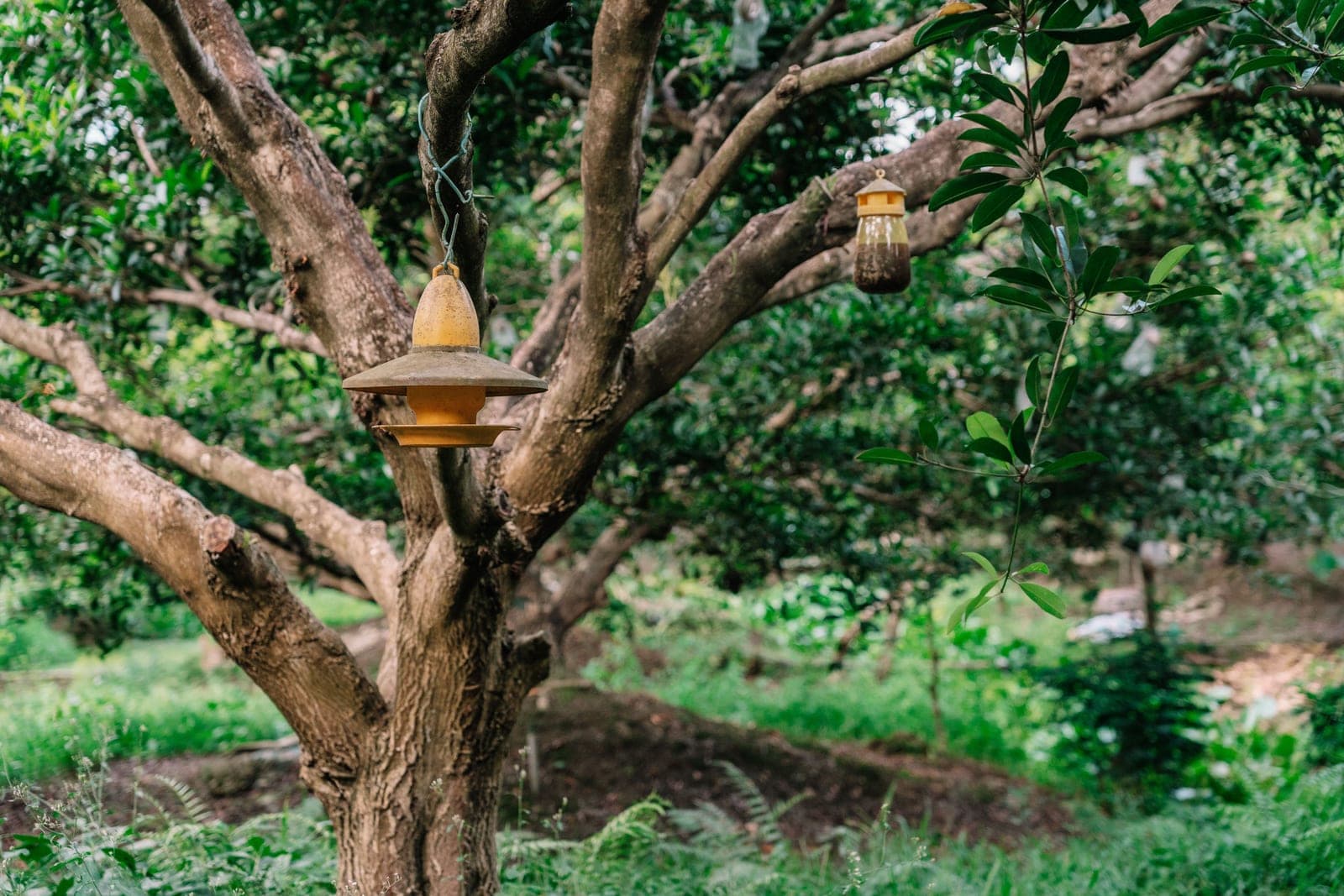
A dome baffle hung above a feeder blocks an animal dropping onto it from directly overhead. It does nothing about a sideways leap from a rail, wall or branch at feeder height. Where the approach is sideways, a caged or spinning feeder is the fix rather than a baffle.
Hanging feeders are the case where the word baffle gets used for two different products. On a pole, a baffle sits below the feeder and blocks a climb. On a hanging line, a dome sits above the feeder and blocks a drop. Same name, opposite geometry, different problem.
Work out which direction the animal arrives from
Spend five minutes watching before you spend anything. There are only three approaches:
- Down the line from above — along the branch, the wire or the eave the feeder hangs from. A dome above the feeder is exactly the right answer to this.
- Sideways at feeder height — from a fence rail, a deck rail, a wall top, a neighboring branch. A dome does nothing here. Nothing above the feeder can.
- Up from below — only possible if something is standing under the feeder, which usually means a planter, a bench or a snowdrift.
The Alabama Cooperative Extension System's figures explain why case two dominates: a gray squirrel jumps roughly eight feet horizontally. Most hanging feeders are within eight feet of something.
When a dome is the right buy
A hanging dome earns its place when the feeder hangs from a long line, well clear of everything lateral, and the only realistic approach is down the line. That is a genuine and common situation — a feeder on a wire between two poles, or on a long chain from a high eave.
Two practical notes. The dome has to be wide enough that an animal on the line above cannot simply reach around it, which is the same overhang logic as a pole disk. And it has to hang free: a dome resting on the feeder is a rain hat.
When it is not, which is more often
If the approach is sideways, change the feeder. This is the case caged feeders exist for, and the case the Yankee Flipper's spinning perch was designed around — the listing describes a rechargeable weight-activated rotating perch on a hanging feeder, which is precisely a hanging-site mechanism.
A seed treatment is the third option, and the cheapest. Cole's publishes 1.5 oz per 5 lb of seed. It does not stop the animal arriving; it removes the reason to come back.
Baffleworks is funded by affiliate commission. If you buy through a link on this page we may earn a commission at no extra cost to you, and it never decides a ranking. Full disclosure · how we pick.
Quick picks
Ranked, with the trade-off named. Tap a row for the full write-up; the price button goes straight to Amazon.
| # | Product | Best for | Price |
|---|---|---|---|
| 1 |  Girvenith Metal Caged Seed Feeder, 4 portA steel cage around an enclosed seed compartment, sized so finches and chickadees pass and larger birds do not. The cheapest honest cage on this page. | Small songbirds in a small space | $21.59 on Amazon |
| 2 |  Woodlink WLCAGE2 Designer Caged 4-Port Tube FeederA cage around a tube, which excludes by aperture rather than by weight — so it stops the chipmunk and the red squirrel a weight trigger ignores, and stops the cardinal too. | Small songbirds only | $71.48 on Amazon |
| 3 |  Droll Yankees Yankee FlipperA motorized perch that spins under a squirrel's weight. It is the only genuinely active mechanism here, and the only one that needs charging. | Hanging sites with no pole | $97.54 on Amazon |
| 4 |  Cole's Flaming Squirrel Seed Sauce, 16 ozCapsaicin on the seed: mammals taste it, birds do not. It is the one seed treatment here with a published mixing ratio, which is the difference between a method and a hope. | Treating seed you already own | $23.40 on Amazon |
#ad how we are funded · price as of October 24, 2026
The picks in full
Top pick Small songbirds in a small space
Girvenith Metal Caged Seed Feeder, 4 port
A steel cage around an enclosed seed compartment, sized so finches and chickadees pass and larger birds do not. The cheapest honest cage on this page.
Published specifications
- Mechanism
- Fixed cage aperture
- Dimensions
- 6.25" L x 6.25" W x 10.25" H (published)
- Feeding ports
- 4 (published)
- Cage
- Durable steel exterior (published)
- Weather
- Rainproof cover; all-weather metal (published)
- Named birds
- Finches and chickadees welcomed, larger birds discouraged (published)
- Filling
- Wide-opening metal top (published)
Trade-offs
- Publishes its actual cage body dimensions, which is how you predict which birds get in
- A fixed aperture ignores weight, so it stops the chipmunk and red squirrel a weight trigger lets through
- All-metal with a rainproof cover — no plastic tube to chew or craze
- Small enough to hang almost anywhere, and cheap enough to try
- The listing publishes the cage body size but not the mesh opening, which is the number that would settle exactly which birds fit
- Excludes cardinals, jays and grosbeaks along with the squirrels — the trade, not a defect
- No published seed capacity, and a 10.25 in body will not hold much
- 'Squirrel proof' in the title is doing more work than the cage alone can — placement still matters
Who it is forA small yard with chipmunks or red squirrels, where finches and chickadees are the birds you actually want.
Skip it ifYou want cardinals. A 6.25 in cage body is the mechanism working as designed, and no setting changes it — see the cardinal page.
#ad how we are funded · price as of October 24, 2026
Where these specifications came from
No. 2 Small songbirds only
Woodlink WLCAGE2 Designer Caged 4-Port Tube Feeder
A cage around a tube, which excludes by aperture rather than by weight — so it stops the chipmunk and the red squirrel a weight trigger ignores, and stops the cardinal too.
Published specifications
- Mechanism
- Fixed cage aperture
- Feeding ports
- 4 (published)
- Cage material
- Metal, bronze finish (published)
- Tube material
- Recycled plastic (published)
- Cleaning
- Published as easy to fill and clean
Trade-offs
- A fixed aperture does not care how heavy the animal is, so it excludes chipmunks and red squirrels as well as grays
- Metal cage rather than a coated wire basket
- The tube is recycled plastic, which is unusual honesty about material in this category
- Nothing to calibrate and nothing to wear out
- The cage excludes cardinals, jays and grosbeaks along with the squirrels — that is the trade, not a defect
- The listing publishes no cage aperture in inches, which is the one number that would let you predict exactly which birds get in
- No published seed capacity
- Plastic tube inside a metal cage: the cage protects it, but only while the cage is intact
Who it is forA yard where chipmunks or red squirrels are the problem and you are content with finches, chickadees and titmice.
Skip it ifYou want cardinals. A cage cannot be adjusted and this one publishes no aperture — the cardinal page covers why a weight trigger is the right mechanism instead.
#ad how we are funded · price as of October 24, 2026
Where these specifications came from
No. 3 Hanging sites with no pole
Droll Yankees Yankee Flipper
A motorized perch that spins under a squirrel's weight. It is the only genuinely active mechanism here, and the only one that needs charging.
Published specifications
- Seed capacity
- 5 lb (published)
- Mechanism
- Weight-activated rotating perch, rechargeable
- Base
- Metal
- Tube
- UV-stabilized
- Mount
- Hanging
Trade-offs
- Works where there is no pole to baffle, which is the case a lot of readers are actually in
- Metal base and UV-stabilized tube rather than the plastic that usually goes first
- The mechanism is unambiguous: the perch turns, the squirrel leaves
- It has a battery, so it is the one feeder here that stops working if you forget about it
- Moving parts outdoors are a maintenance commitment, not a one-time purchase
Who it is forA hook, a branch or an eave where a pole baffle is not an option and you want an active deterrent rather than a passive one.
Skip it ifYou want to fit and forget. Every other feeder on this page keeps working untouched; this one does not.
#ad how we are funded · price as of October 24, 2026
Where these specifications came from
No. 4 Treating seed you already own
Cole's Flaming Squirrel Seed Sauce, 16 oz
Capsaicin on the seed: mammals taste it, birds do not. It is the one seed treatment here with a published mixing ratio, which is the difference between a method and a hope.
Published specifications
- Size
- 16 oz (published)
- Mixing ratio
- 1.5 oz (3 tbsp) per 5 lb of seed (published)
- Ingredients
- All-natural, 100% food grade
- Stated basis
- Hot to mammals, not to birds
- Part number
- FS16
Trade-offs
- Published mixing ratio, so the dose is repeatable rather than improvised
- Treats seed you have already bought instead of replacing your feeder
- Works on the feeders a baffle cannot protect, like a hanging tube on a branch
- Handling capsaicin concentrate means gloves and care, especially around your eyes
- It treats the seed, not the raid: a squirrel will still chew a plastic feeder to find out
Who it is forA hanging feeder with no pole to baffle, or a stubborn site where the geometry cannot be fixed.
Skip it ifYou can fix the geometry instead. A treatment is a workaround; the clearance is the fix.
#ad how we are funded · price as of October 24, 2026
Where these specifications came from
What we would skip
A hanging dome where the approach is sideways
A dome above the feeder only intercepts a vertical drop. If the animal is arriving from a rail, a wall or a nearby branch at feeder height, the dome is above the problem rather than in front of it.
The move that beats all of it
If any part of the yard offers about ten feet of clear air, a pole there with a baffle at four to five feet is more reliable and usually cheaper than solving this in mid-air. Cornell's ten-foot figure and Audubon's 8 to 10 feet both point at the same thing: distance is the mechanism, and everything else is compensation for not having it.
Nectar feeders are the exception to most of this: squirrels rarely raid them in a sustained way, and ants are the real problem. Protecting a hummingbird feeder covers the water-barrier fix.
How we picked
- We started from the mount, not from the brand. A baffle that does not fit a nominal 4x4 post is not a worse baffle for that reader, it is an irrelevant one.
- We recorded only published dimensions. Where a maker states a diameter or a pole fit we use it; where none is published we say so rather than measuring a photograph.
- We applied the clearance geometry from Audubon and the Alabama Cooperative Extension System to every pick, because placement decides more outcomes than product does.
- We named at least one product to skip on every page, with the reason. A roundup where nothing has a downside is an advertisement.
- We have not installed or tested any of these. How we pick sets out exactly what that does and does not cover.
Everyone in this category says they tested twenty of these. We have not tested any, and we say so. What we did instead: read the manuals, compiled the published specifications, worked out the clearance geometry, and cited every source. The full method is published.
Questions people actually ask
- Does a dome baffle above a feeder work?
- Against a drop from directly above, yes. Against a sideways leap at feeder height, no — a dome above the feeder is above the problem. Watch which direction the animal actually arrives from before buying one.
- How far above the feeder should a dome hang?
- Far enough that an animal on the line cannot reach past it to the feeder, and free enough that it still swings. A dome resting on the feeder has become a weather guard.
- What is the best feeder to hang where a baffle will not fit?
- A caged feeder, because exclusion by geometry does not depend on controlling the approach. A spinning feeder is the active alternative, at the cost of a battery to recharge.
Sources
Read next
- Squirrel baffles for trees
A trunk baffle closes one route out of many. What to do instead when the feeder has to stay in the tree.
- Spinning feeders
A motorized perch that works without geometry, and the recharging routine that comes with it.
- Caged bird feeders
Exclusion by size rather than weight: the mechanism that beats chipmunks, red squirrels and starlings.
- How to keep squirrels off bird feeders
Seven methods ranked by reliability rather than by how often they get recommended. The best one is free.
- Squirrel Baffles
Dome, torpedo and wrap-around baffles, sorted by the mount you actually own rather than by brand.