Feeders / Comparison
Squirrel Buster Plus vs Classic vs Legacy vs Standard vs Evolution
Brome's five weight-activated feeders share the mechanism that made the name. They do not share capacity, cardinal provision, weather handling or adjustability, and those four things are the entire decision.
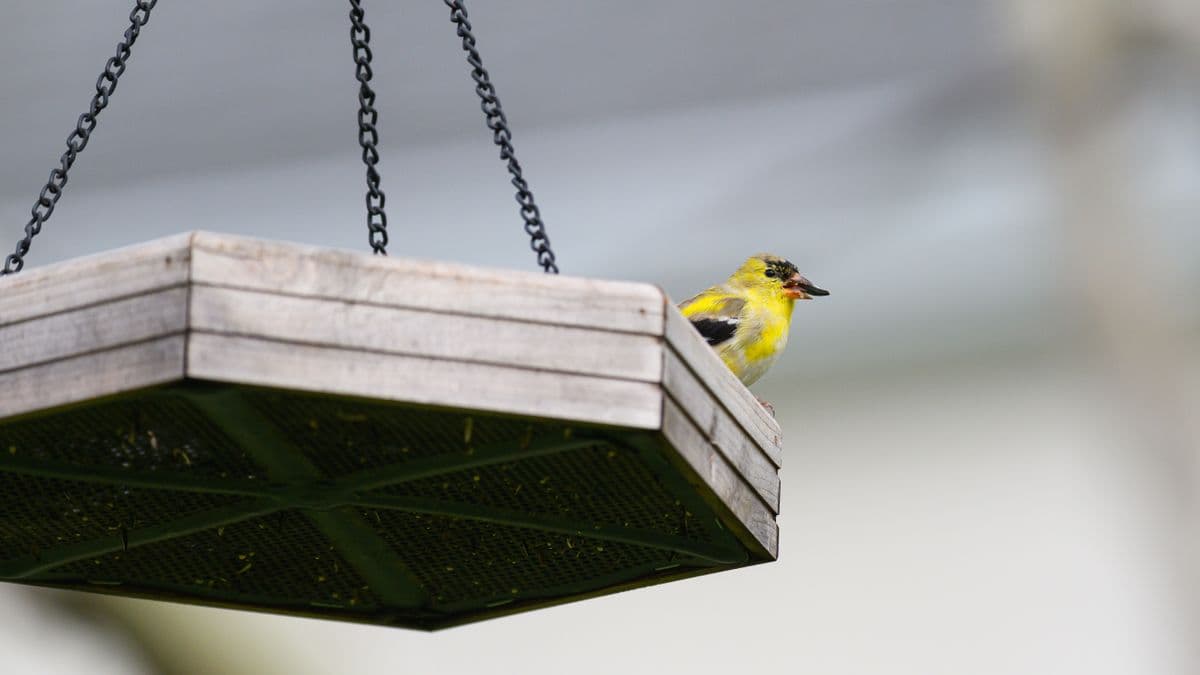
All five Squirrel Busters use the same weight-activated shroud, so none of them is more squirrel-proof than the others. The Plus is the largest at 5.1 lb with six ports, an adjustable trigger and a cardinal ring. The Evolution adds a double cardinal ring and a built-in water diverter at 1.9 lb. The Legacy publishes chew-proof construction; the Classic and Standard are the small, plain entries.
The thing they share, so you can stop worrying about it
Every feeder on this page closes its ports when something heavier than a songbird lands on the perch. Brome describes it as a weight-activated shroud on the Plus, the Standard and the Evolution, and as a weight-sensitive closure on the Classic; the Legacy's listing describes the same behavior. It is one mechanism across the line. The question 'which Squirrel Buster keeps squirrels off best' has no answer, because the published mechanism does not differ.
What the mechanism does is well understood and covered on the weight-activated feeders page: it stops the animal that lands on the feeder. It does not stop an animal reaching in from a rail beside it, and it does not stop the birds throwing seed to the ground where the squirrel eats in comfort. So the placement rules still apply — baffle top at four to five feet, eight to ten feet clear — and none of the five is exempt.
The four things that actually differ
| Plus | Evolution | Legacy | Classic | Standard | |
|---|---|---|---|---|---|
| Seed capacity | 5.1 lb | 1.9 lb | 2.6 lb | 2.4 lb | 1.3 lb |
| Ports | 6 | Shroud closes ports | 4 (perches) | 4 | 4 (perches) |
| Trigger | Adjustable | Weight-activated | Weight-activated | Weight-sensitive | Weight-activated |
| Cardinal provision | Cardinal ring | Double Cardinal Ring | Not published | Not published | Not published |
| Water handling | — | Built-in diverter: trough, spout, drip edge | — | Seed ventilation | — |
| Cleaning | — | Tool-free, every part separates by hand | Tool-free | — | — |
| Construction | — | — | Chew-proof (published) | — | — |
| Pole mount | Yes, adaptor sold separately | — | — | — | — |
A dash means the listing publishes nothing for that row. It does not mean the feature is absent — it means Brome did not say, and we will not guess.
Capacity runs from 1.3 lb on the Standard to 5.1 lb on the Plus, which is nearly four times the seed. If you refill daily that is an inconvenience; if you travel it is the whole decision.
Adjustability is published for the Plus alone. An adjustable trigger lets you tune the closing weight so that a heavier bird — a jay, a dove — can feed while a squirrel cannot. On the fixed-trigger models what closes the shroud is what Brome set at the factory. The large-bird page goes into why this matters.
Cardinal provision is where the line divides most sharply. Brome fits a cardinal ring to the Plus and a double ring to the Evolution, with a published rationale: the ring is extra-wide and easy to grip because cardinals prefer to face their food. The other three publish nothing for cardinals. The cardinal page is built on exactly this distinction.
Water handling is published only for the Evolution, which has a built-in diverter — trough, spout and a drip edge above each port — and for the Classic, which publishes seed ventilation. Wet seed clumps and molds, and a feeder that sheds rain is a feeder you clean less often. The Evolution's tool-free disassembly is the other half of that argument.
Baffleworks is funded by affiliate commission. If you buy through a link on this page we may earn a commission at no extra cost to you, and it never decides a ranking. Full disclosure · how we pick.
Quick picks
Ranked, with the trade-off named. Tap a row for the full write-up; the price button goes straight to Amazon.
| # | Product | Best for | Price |
|---|---|---|---|
| 1 |  Brome Squirrel Buster PlusThe weight-activated shroud done properly: a squirrel's weight closes the ports, and the cardinal ring means the mechanism does not cost you the big birds. | Weight-activated, most capacity | $129.04 on Amazon |
| 2 | 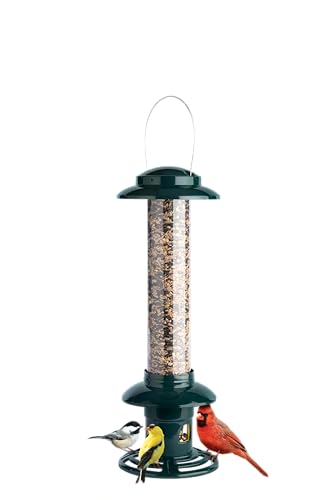 Brome Squirrel Buster EvolutionThe only feeder we found built around cardinals rather than accommodating them: a double cardinal ring Brome describes as extra-wide and easy to grip, because cardinals prefer to face their food. | Cardinals specifically | $76.45 on Amazon |
| 3 |  Brome Squirrel Buster LegacyFour removable metal perches and a chew-proof build, which is the most perch a Brome feeder publishes without going to a ring. | Removable metal perches | $54.99 on Amazon |
| 4 |  Brome Squirrel Buster ClassicThe one in the range that publishes seed ventilation and a wire mesh for shared feeding, which changes how many birds can be on it at once. | Shared feeding and seed ventilation | $79.22 on Amazon |
| 5 | 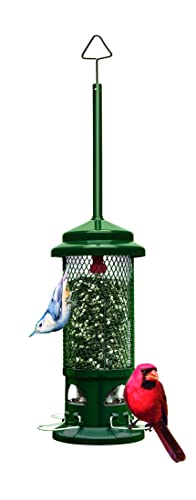 Brome Squirrel Buster StandardThe smallest Brome, with four metal perches and a 1.3 lb reservoir. The cheapest way into a mechanism that genuinely works on gray squirrels. | Small spaces and a low entry price | $56.35 on Amazon |
#ad how we are funded · price as of September 12, 2026
The picks in full
Top pick Weight-activated, most capacity
Brome Squirrel Buster Plus
The weight-activated shroud done properly: a squirrel's weight closes the ports, and the cardinal ring means the mechanism does not cost you the big birds.
Published specifications
- Seed capacity
- 5.1 lb (published)
- Feeding ports
- 6
- Mechanism
- Weight-activated shroud, adjustable
- Included
- Cardinal ring
- Pole mounting
- Pole-mountable; pole adaptor sold separately
Trade-offs
- 5.1 lb capacity means fewer refills through a hard winter
- Adjustable weight setting, so you can shut out grackles without shutting out cardinals
- The cardinal ring is the fix for the usual complaint about shroud feeders
- The pole adaptor is a separate purchase, which is easy to miss at checkout
- A weight mechanism is a mechanism: it needs the occasional clean to keep moving freely
Who it is forThe default first purchase if you would rather solve the problem at the feeder than at the pole. It also pairs well with a baffle rather than replacing one.
Skip it ifYour problem is chipmunks or small red squirrels. A weight-activated shroud is calibrated for something heavier, and a light animal can feed under the trigger point. A caged feeder is the better answer there.
#ad how we are funded · price as of September 12, 2026
Where these specifications came from
No. 2 Cardinals specifically
Brome Squirrel Buster Evolution
The only feeder we found built around cardinals rather than accommodating them: a double cardinal ring Brome describes as extra-wide and easy to grip, because cardinals prefer to face their food.
Published specifications
- Cardinal provision
- Double Cardinal Ring (published)
- Brome's stated rationale
- Extra-wide, easy to grip, because cardinals prefer to face their food supply
- Seed capacity
- 1.9 lb (published)
- Mechanism
- Weight-activated shroud closes the ports
- Water management
- Built-in diverter: trough, spout and a drip edge above each port (published)
- Cleaning
- Tool-free; every component separates by hand (published)
- Recognition
- Wild Bird Feeding Institute Birding Product of the Year 2025 (per Birding Wire)
Trade-offs
- A double cardinal ring is the only purpose-built cardinal provision we found in a squirrel-proof feeder
- Brome publishes WHY the ring exists rather than just naming it, which is unusually specific for this category
- The water diverter is a genuinely uncommon spec: wet seed is what spoils a feeder between refills
- Tool-free disassembly means it will actually get cleaned, which weight-shroud feeders need
- Carries a named third-party award rather than a star rating
- 1.9 lb is a small reservoir — under half the Squirrel Buster Plus, so expect more refills
- It is the newest model here, so there is less of a track record behind it than the Plus or the Classic
- Still a weight mechanism: too light for chipmunks and red squirrels to trip, same as the rest of the line
Who it is forAnyone whose actual complaint is that cardinals will not use their squirrel-proof feeder. This is the model built for that exact problem.
Skip it ifYou refill reluctantly. At 1.9 lb this is the smallest reservoir on the page, and the Squirrel Buster Plus carries 5.1 lb with a cardinal ring of its own.
#ad how we are funded · price as of September 12, 2026
No. 3 Removable metal perches
Brome Squirrel Buster Legacy
Four removable metal perches and a chew-proof build, which is the most perch a Brome feeder publishes without going to a ring.
Published specifications
- Perches
- 4 metal, removable (published)
- Seed capacity
- 2.6 lb (published)
- Construction
- Chew-proof (published)
- Cleaning
- Tool-free (published)
- Cardinal ring
- Not published for this model
Trade-offs
- Removable perches are a real feature: you can take them off to discourage larger nuisance birds, or leave them on
- Metal rather than plastic perches, which is what gets chewed first on a feeder squirrels visit
- 2.6 lb sits between the Standard and the Plus, which suits most yards
- Chew-proof construction is published rather than implied
- No cardinal ring published for this model, so cardinal access is down to the standard perches
- Perches, not a ring — Brome's own product line implies that is a meaningful difference for cardinals
- Same weight-trigger limitation against chipmunks and red squirrels
Who it is forA general-purpose squirrel-proof feeder where cardinals are welcome but not the specific reason for the purchase.
Skip it ifCardinals are the whole point. Brome sells a cardinal ring on two other models and not on this one, and that is a distinction worth taking at face value.
#ad how we are funded · price as of September 12, 2026
Where these specifications came from
No. 4 Shared feeding and seed ventilation
Brome Squirrel Buster Classic
The one in the range that publishes seed ventilation and a wire mesh for shared feeding, which changes how many birds can be on it at once.
Published specifications
- Feeding ports
- 4 (published)
- Seed capacity
- 2.4 lb (published)
- Mechanism
- Weight-sensitive closure (published)
- Seed condition
- Seed ventilation (published)
- Shared feeding
- Wire mesh (published)
- Cardinal ring
- Not published for this model
Trade-offs
- Seed ventilation is a published spec and directly addresses the damp-seed problem that spoils a reservoir
- The wire mesh is described for shared feeding, so more than one bird can work it at a time
- A long-standing model with a track record behind it
- No cardinal ring published, so this is not the cardinal-first choice in Brome's own line
- A mesh surface is something a bird has to cling to rather than perch on
- 2.4 lb is mid-range capacity
Who it is forA busy feeder where several small birds feed at once and damp seed has been the recurring annoyance.
Skip it ifYou are buying for cardinals. The Evolution and the Plus are the two models Brome fits a cardinal ring to, and this is not one of them.
#ad how we are funded · price as of September 12, 2026
Where these specifications came from
No. 5 Small spaces and a low entry price
Brome Squirrel Buster Standard
The smallest Brome, with four metal perches and a 1.3 lb reservoir. The cheapest way into a mechanism that genuinely works on gray squirrels.
Published specifications
- Perches
- 4 metal (published)
- Seed capacity
- 1.3 lb (published)
- Mechanism
- Weight-activated shroud
- Cardinal ring
- Not published for this model
Trade-offs
- Lowest price of entry to a weight mechanism from the brand that defined the category
- Metal perches even at the smallest size
- Light enough for a shepherd's hook that would bend under a large hopper
- 1.3 lb is a genuinely small reservoir and will need refilling often in a busy yard
- No cardinal ring published
- Smallest body in the range, so the least comfortable for a large bird
Who it is forA balcony, a small courtyard, or a first squirrel-proof feeder where the point is finding out whether the mechanism works for you.
Skip it ifCardinals are the target. This is the smallest feeder in the range with no cardinal provision published, which makes it the least likely of the six to satisfy them.
#ad how we are funded · price as of September 12, 2026
Where these specifications came from
Which one, by the problem you are solving
- Most seed, fewest refills, and the ability to let jays feed: the Plus. Largest capacity, six ports, and the only published adjustable trigger. Also the only one published as pole-mountable, with the adaptor sold separately.
- Cardinals, and a feeder that stays clean: the Evolution. Double cardinal ring, water diverter, and a Wild Bird Feeding Institute product-of-the-year recognition for 2025 reported by Birding Wire. Smaller than it looks at 1.9 lb.
- A squirrel that chews: the Legacy, the only one publishing chew-proof construction, with tool-free cleaning and 2.6 lb of capacity.
- A first Squirrel Buster on a budget of space: the Classic at 2.4 lb with seed ventilation, or the Standard at 1.3 lb if the feeder is going somewhere small.
What does not change between them
The mechanism, and therefore the animals it works on. A weight trigger set for a gray squirrel does not fire for a chipmunk, on any of the five. It does nothing about a raccoon, which is heavy enough to close the shroud and strong enough to pull the feeder down anyway — that is a baffle's job, covered in raccoon deterrents. And it does nothing about placement: the feeder still has to hang where a squirrel cannot reach the ports from anything solid.
Buy the Squirrel Buster that fits the birds you want, the refill schedule you will keep and the weather you get. Then hang it correctly. The order of those two sentences is the order that matters.
Questions people actually ask
- What is the difference between Squirrel Buster Plus and Classic?
- The Plus publishes 5.1 lb capacity, six ports, an adjustable trigger, a cardinal ring and pole-mount capability. The Classic publishes 2.4 lb, four ports, a weight-sensitive closure and seed ventilation, with no cardinal ring. The squirrel mechanism is the same.
- Is the Squirrel Buster Evolution better than the Plus?
- Different, not better. The Evolution publishes a double cardinal ring, a built-in water diverter and tool-free disassembly at 1.9 lb; the Plus publishes 5.1 lb, six ports and an adjustable trigger. Choose on cardinals and weather versus capacity and adjustability.
- Which Squirrel Buster is chew-proof?
- The Legacy is the model whose listing publishes chew-proof construction. The others do not publish a chew claim either way.
- Which Squirrel Buster is best for cardinals?
- The Plus, which publishes a cardinal ring, or the Evolution, which publishes a double cardinal ring with Brome's stated rationale that cardinals prefer to face their food. The Legacy, Classic and Standard publish nothing for cardinals.
- Does any Squirrel Buster stop chipmunks?
- No. A weight trigger calibrated for a gray squirrel does not close for a chipmunk, and Brome does not claim it does. Chipmunks are a caged feeder's job.
- Can I pole-mount a Squirrel Buster?
- The Plus publishes pole mounting with an adaptor sold separately. The other four are published as hanging feeders. A hanging feeder still needs to hang from something with a baffle on it.
Sources
Read next
- Weight-activated feeders
How the shroud and perch-bar mechanisms work, what the adjustment is really for, and where they stop.
- The best squirrel-proof bird feeders for cardinals
Cages exclude by aperture and cannot be adjusted; weight triggers can. Which feeders publish a cardinal ring, and which quietly do not.
- The best squirrel-proof feeders for large birds
Jays and doves need a ledge, not a peg. Which squirrel-proof formats accommodate large birds and which exclude them by design.
- The best squirrel-proof bird feeders
Seven feeders ranked by mechanism and published capacity, and which animal each one actually excludes.
- Squirrel-Proof Feeders
Weight-activated, caged and spinning feeders, sorted by which animal each mechanism actually keeps out.