Feeders / Small spaces
Window and balcony feeders, and when they actually work
There is no such thing as a squirrel-proof window feeder. There are windows a squirrel cannot reach, and that is a question about your building, not your feeder.
A window feeder is squirrel-proof only where nothing within jumping distance can reach it - no sill, ledge, railing, downspout or gutter. On a smooth wall above the second floor that is usually true. On a ground-floor window with a sill, it is never true, and the fix is a deck-rail or pole feeder with a baffle instead.
Everything else on this site defends a feeder with geometry: a baffle at four to five feet, clear air around it, distance from jumping-off points. A window feeder has none of those levers. It is stuck to a vertical pane at whatever height your building put it.
Baffleworks is funded by affiliate commission. If you buy through a link on this page we may earn a commission at no extra cost to you, and it never decides a ranking. Full disclosure · how we pick.
Quick picks
Ranked, with the trade-off named. Tap a row for the full write-up; the price button goes straight to Amazon.
| # | Product | Best for | Price |
|---|---|---|---|
| 1 | 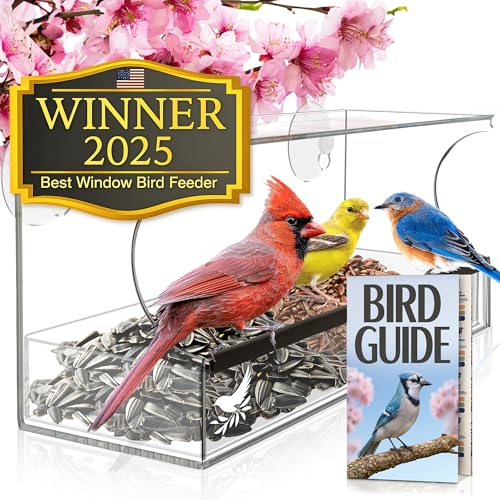 Nature's Hangout Window Bird FeederNo assembly and a suction-cup mount that is the brand's whole reputation. On a window feeder the mount is the product — every failure mode starts with it letting go. | The window feeder most likely to stay on the glass | $30.95 on Amazon |
| 2 |  Kingsyard Window Bird Feeder, 4 suction cupsFour suction cups instead of the usual two or three, at a price where finding out whether you like window feeding costs almost nothing. | Cheapest way to try the format | $14.99 on Amazon |
| 3 |  Clear Acrylic Window Feeder with RoofA roofed acrylic box on suction cups. The roof is the difference: an open window tray turns to porridge in the first rain and then grows mold against the glass. | Keeping the seed dry | $34.99 on Amazon |
#ad how we are funded · price as of September 21, 2026
The picks in full
Top pick The window feeder most likely to stay on the glass
Nature's Hangout Window Bird Feeder
No assembly and a suction-cup mount that is the brand's whole reputation. On a window feeder the mount is the product — every failure mode starts with it letting go.
Published specifications
- Mount
- Suction cups (published)
- Assembly
- None required (published)
- Body
- Clear acrylic
- Dimensions
- Not published in the listing
Trade-offs
- A window feeder sits inside the three-foot zone where a startled bird cannot build up enough speed to hurt itself on the glass
- No assembly matters more than it sounds — a feeder you can wet, press on and fill is one you will actually re-mount after cleaning
- Puts birds at reading distance, which is the only reason anyone buys this format
- Suction cups let go in cold weather and on dirty glass; this is universal to the format, not specific to this feeder
- Small hopper, so it needs filling every day or two in winter
Who it is forApartments, balconies and any window with no sill, ledge or railing a squirrel can launch from.
Skip it ifThere is a sill, a railing, a downspout or a gutter within jumping distance. Then a window feeder is a snack shelf and no suction cup will change that.
#ad how we are funded · price as of September 21, 2026
Where these specifications came from
No. 2 Cheapest way to try the format
Kingsyard Window Bird Feeder, 4 suction cups
Four suction cups instead of the usual two or three, at a price where finding out whether you like window feeding costs almost nothing.
Published specifications
- Mount
- 4 extra-strong suction cups (published)
- Body
- Clear acrylic
- Dimensions
- Not published in the listing
- Tray
- Removable
Trade-offs
- Four cups spread the load, and cup count is the one spec on a window feeder that reliably predicts whether it stays up
- Low enough cost that a failed experiment is not a real loss
- Clear body means you watch the birds rather than the back of a feeder
- Light build; a squirrel that does reach it will pull it off the glass rather than feed from it
- No published capacity
Who it is forA first window feeder, or a second window in a house that already has one working.
Skip it ifYour glass is textured, coated or permanently grimy — suction needs smooth, clean glass and no feeder brand fixes that.
#ad how we are funded · price as of September 21, 2026
Where these specifications came from
No. 3 Keeping the seed dry
Clear Acrylic Window Feeder with Roof
A roofed acrylic box on suction cups. The roof is the difference: an open window tray turns to porridge in the first rain and then grows mold against the glass.
Published specifications
- Mount
- Suction cups (published)
- Body
- Clear acrylic (published)
- Roof
- Included
- Dimensions
- Not published in the listing
Trade-offs
- A roof on a window feeder solves the format's real maintenance problem, which is wet seed against the house
- Clear on all sides, so the view works from any angle inside the room
- Deeper body than the flat-tray window feeders, so it holds seed for longer between fills
- Most expensive of the three, for a format where the mount is still the weak point
- A deeper box is heavier when full, which puts more load on the same suction cups
Who it is forA window that catches weather, or anyone who has already thrown out one sodden window tray.
Skip it ifYou want the slimmest possible profile on the glass. A roofed box stands further off the window.
#ad how we are funded · price as of September 21, 2026
Where these specifications came from
What we would skip
A window feeder above a sill, ledge or railing
This is the whole test. A squirrel that can stand within about four feet below or eight feet sideways of the feeder will reach it, and no suction cup survives that. On a windowsill, buy a weight-activated feeder on a deck rail instead.
An open-tray window feeder in a wet climate
A flat acrylic tray with no roof holds every drop of rain against the glass. The seed turns to porridge and molds within days. Buy the roofed version or expect to empty it constantly.
The only question that matters: what can it launch from?
The Alabama Cooperative Extension System puts a gray squirrel's jump at about four feet vertically and roughly eight feet horizontally. Take those two numbers to the window and answer honestly.
- A sill or ledge under the window - the feeder is reachable. Every time.
- A balcony railing, planter or air-conditioning unit nearby - reachable.
- A downspout, gutter, trellis or climbable siding within eight feet sideways - reachable.
- Flat wall, no ledge, second floor or higher - genuinely out of reach, and a window feeder works exactly as advertised.
This is not pessimism about the format. It is the difference between people who love their window feeder and people who report a squirrel pulled it off the glass in week two - and it is decided before you buy anything. Squirrel jump clearance sets out where the figures come from.
The three-foot rule is the real reason to buy one
Window feeders have a genuine advantage that has nothing to do with squirrels. Audubon's collision guidance says to "Place bird feeders directly on windows" because "Research has shown that feeders closer than three feet prevent birds from building up enough momentum to harm themselves if startled."
The dangerous distance is the middle one. A feeder hung several feet from the house draws birds toward the glass and gives them enough runway to hit it hard. On the glass or well away from it are both safer than in between.
Suction cups are the product
On a window feeder the mount is the whole thing. Every failure report starts the same way: it fell off. Cup count is the one spec that predicts whether it stays up, which is why the feeders here publish it.
- Clean the glass with rubbing alcohol, not window cleaner - residue is what kills suction.
- Wet the cups before pressing them on. Dry cups seat poorly and let go in the first cold night.
- Re-seat them when temperatures swing; cold shrinks the rubber and breaks the seal.
- Fill lightly. A brimming feeder is a heavier feeder, and weight is what the cups are fighting.
Balconies: a different problem
A balcony is usually not a squirrel problem at all above the second floor - it is a mess problem and a neighbor problem. Hulls and spilled seed land on someone else's furniture, and a ground-level seed pile is what draws rodents to the base of the building.
Two fixes: feed shelled hearts rather than seed in the shell, so there is no hull at all, and use a feeder with a tray rather than an open port. Seed catcher trays covers tray options; on a balcony they are a courtesy as much as a tactic.
If your balcony IS reachable - a ground-floor patio, a fire escape, a tree within eight feet - treat it as a yard. A weight-activated feeder on a rail mount is the honest answer, and deck-mounted poles covers that hardware.
What a window feeder will not do
It will not hold much seed, it will not suit large birds, and it will not survive a squirrel that can reach it. What it does uniquely well is put small birds at arm's length behind glass, at a distance that is measurably safer for them than the middle-ground placement most people default to.
How we picked
- We sorted by mechanism first: weight, cage or spin. Those three exclude different animals, and the choice between them is not a quality judgment.
- We used published figures only — seed capacity, port count, dimensions, mechanism. Where a maker publishes nothing, the spec row says so.
- We checked each mechanism against the animal it is calibrated for. A weight trigger tuned for a gray squirrel does not fire for a chipmunk, and we say so rather than implying it does.
- We named at least one product to skip on every page, with the reason.
- We have not tested any of these. How we pick sets out what that does and does not cover.
Everyone in this category says they tested twenty of these. We have not tested any, and we say so. What we did instead: read the manuals, compiled the published specifications, worked out the clearance geometry, and cited every source. The full method is published.
Questions people actually ask
- Are window bird feeders squirrel-proof?
- No feeder is squirrel-proof on its own, and a window feeder has no baffle. It is out of reach or it is not - decided by whether a squirrel can stand within about four feet below or eight feet sideways of it.
- Do window feeders cause birds to hit the glass?
- Correctly placed, they reduce the risk. Audubon's guidance is that feeders closer than three feet stop a startled bird building up enough momentum to hurt itself. The dangerous placement is several feet out, not on the pane.
- Why does my window feeder keep falling off?
- Almost always dirty glass or dry cups. Clean with rubbing alcohol, wet the cups before pressing, and re-seat after a cold snap. Overfilling makes it worse.
- What is the best feeder for an apartment balcony?
- Above the second floor with no climbable route, a window or rail feeder is fine and the real issues are mess and neighbors - feed shelled hearts and use a tray. On a reachable balcony, use a weight-activated feeder on a rail mount.
- Will birds use a feeder stuck to a window?
- Yes, though it takes longer than a pole feeder - often a couple of weeks. Small birds adapt to it readily; large birds mostly will not use one.
Sources
Read next
- Deck-mounted feeder poles
A deck rail is a launch pad by definition. What to do when a baffle cannot help.
- How high should a squirrel baffle be?
Four to five feet high, eight to ten feet clear. The sourced numbers, the arithmetic, and the popular page that gets it wrong.
- The best seed catcher trays
A tray's real job is denying squirrels the ground buffet, not tidiness. Ranked on diameter and drainage, with the ones that double as feeders flagged.
- Weight-activated feeders
How the shroud and perch-bar mechanisms work, what the adjustment is really for, and where they stop.
- Squirrel-Proof Feeders
Weight-activated, caged and spinning feeders, sorted by which animal each mechanism actually keeps out.