Deterrents / Review
Havahart Critter Ridder 5277, reviewed on its published specifications
The only motion sprinkler that publishes what a false trigger costs you in water. It is also the one whose maker gives two different detection ranges on the same page, and publishes no angle to aim it by.

Havahart publishes four sensitivity levels, a spray reaching up to 35 ft, roughly a 5-second burst using 2 to 3 cups of water, 2 AA batteries and eleven named species. Buy it for a long approach where reach matters more than precision. Orbit's Yard Enforcer still leads, because Havahart publishes no detection angle or coverage area - and gives two different detection ranges on its own page.
Why this unit gets its own page
This site ranks deterrent devices on what their makers publish, because a published figure is the only thing we can check without pretending to have tested anything. On that test the Critter Ridder is the Orbit's only real competitor: it is the single unit on the shelf that states how much water one activation costs you, which is the figure that tells you what a false trigger is actually worth.
It appears as a pick on the motion sprinkler roundup and the deer deterrent devices roundup. A product recommended that often should be held to its whole spec sheet, including the parts that do not flatter it and the part where the sheet contradicts itself.
Every published figure
| Specification | Havahart's published figure | What it means in a yard |
|---|---|---|
| Sensor | Infrared - detects animal heat and movement | Passive infrared, the same class of sensor as the Orbit. It reacts to a warm thing moving |
| Detection range | Two figures published: up to 100 ft in the spec table, within 60 ft in the feature text | Treat 60 ft as the working number and 100 ft as a best case. Either beats Orbit's 40 ft |
| Detection angle | Not published | The gap that matters most. You cannot plan a wedge whose width is unstated |
| Sensitivity | OFF, 1, 2, 3, 4, Sprinkler - four motion levels, least to most sensitive | A genuine advantage. A cat-sized trigger and a deer-sized one are different settings |
| Spray distance | Up to 35 ft, depending on water pressure | Same as the Orbit's published reach, and shorter than either detection figure |
| Water per activation | 2 to 3 cups per spray | Nobody else publishes this. Twenty false triggers is roughly three to four gallons |
| Burst duration | Approximately 5 seconds | Fixed, where Orbit publishes an adjustable 3 to 10 seconds |
| Coverage area | Not published | Orbit publishes up to 1,600 sq ft. Without it, you are placing the unit by eye |
| Dual function | Runs as a conventional sprinkler as well as a repellent | The Sprinkler setting on the same dial. A real feature, not a gimmick |
| Batteries | 2 AA, not included | Half the Orbit's four, and consumable either way. Check them before the season |
| Water connection | Standard garden hose connector | Hose-fed, so it freezes out in winter like every unit in this category |
| Operating pressure | Not published as a figure | Orbit publishes 20 to 100 PSI. On a well or a long hose run that number matters |
| Named species | Birds, cats, chipmunks, deer, dogs, groundhogs, opossums, rabbits, raccoons, skunks, squirrels | Eleven. Read the section below before buying it for any one of them |
The detection range contradicts itself, and that is worth saying plainly
Havahart's product page states up to 100 ft in its specification table and within 60 feet in its feature copy. Both numbers are published by the maker, on the same page, for the same device. The operating manual repeats the 100 ft figure with the qualifier that it depends on conditions.
We are not treating this as dishonesty - it reads like a spec table describing a maximum and marketing copy describing a typical case. But it is the central number in the product's pitch, and a buyer comparing it against the Orbit's single published 40 ft deserves to know that the comparison is 40 against either 60 or 100 depending on which line of Havahart's page you read. Plan on 60 ft and treat anything beyond it as a bonus.
What it does better than the Orbit
It tells you the water cost. Two to three cups per activation is the only figure of its kind in this category, and it converts an abstract worry into arithmetic. If the unit fires thirty times a night at a passing cat, that is roughly five gallons, and you can decide whether you care before you buy rather than after the water bill.
Four sensitivity levels. The Orbit's range is adjustable but its sensitivity is not stepped. A dial that distinguishes a rabbit from a deer is the difference between a device you tune and a device you keep switching off, and it is the main reason to choose this unit in a yard with several species.
Reach. On either published figure it sees further than the Orbit's 40 ft. On a long drive, a field edge or a fence line where the damage starts well away from the house, that is the thing you are buying.
Two AA batteries instead of four. A small point, and a real one over several seasons.
Baffleworks is funded by affiliate commission. If you buy through a link on this page we may earn a commission at no extra cost to you, and it never decides a ranking. Full disclosure · how we pick.
Quick picks
Ranked, with the trade-off named. Tap a row for the full write-up; the price button goes straight to Amazon.
| # | Product | Best for | Price |
|---|---|---|---|
| 1 |  Havahart Critter Ridder Motion-Activated SprinklerThe one unit on this shelf that publishes as much as Orbit does — long-range infrared detection, four sensitivity levels, and a water figure per activation that nobody else states. | An alternative to the Orbit | $49.98 on Amazon |
| 2 |  Orbit Yard Enforcer Motion-Activated Sprinkler (62100)The one deterrent device category with a mechanism you can verify from the spec sheet: infrared detection out to 40 ft, and a burst of water the animal cannot argue with. | Deer and raccoons over a wide arc | $89.74 on Amazon |
| 3 | 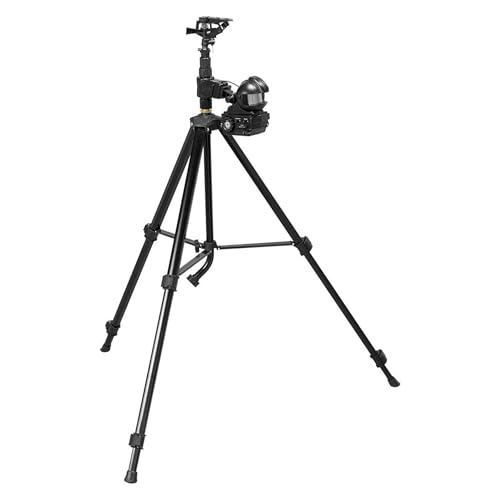 Orbit Garden Enforcer Motion-Activated Sprinkler (62120)The smaller Orbit, aimed at a bed rather than a yard. Same idea, less reach, easier to place where you actually need it. | Bed-scale coverage | $129.99 on Amazon |
#ad how we are funded · price as of October 24, 2026
The picks in full
Top pick An alternative to the Orbit
Havahart Critter Ridder Motion-Activated Sprinkler
The one unit on this shelf that publishes as much as Orbit does — long-range infrared detection, four sensitivity levels, and a water figure per activation that nobody else states.
Published specifications
- Detection
- Infrared heat and movement. Havahart publishes two figures: 'Up to 100 ft' in its spec table and 'within 60 feet' in its feature text
- Sensitivity
- OFF, 1, 2, 3, 4, Sprinkler — 4 motion levels (published)
- Spray distance
- Up to 35 ft, depending on water pressure (published)
- Water per activation
- 2 to 3 cups per spray (published)
- Burst duration
- Approximately 5 seconds (published)
- Coverage area / detection angle
- Not published
- Batteries
- 2 AA, not included (published)
- Named species
- Birds, cats, chipmunks, deer, dogs, groundhogs, opossums, rabbits, raccoons, skunks, squirrels (published)
Trade-offs
- A published water figure — 2 to 3 cups per activation — which is the number that tells you what a false trigger actually costs
- Either published detection figure, 60 ft or 100 ft, is further than the Orbit's published 40 ft
- Four sensitivity levels, so a cat-sized trigger and a deer-sized one are different settings
- Names eleven species on the spec sheet rather than claiming general animal control
- Havahart's own page gives two different detection ranges — 'Up to 100 ft' in the spec table against 'within 60 feet' in the feature text
- Publishes no detection angle, so the shape of its coverage is unknown where Orbit publishes 120 degrees
- Publishes no coverage area in square feet, which Orbit does
- Two AA batteries and the listing itself warns they self-discharge in storage — check them before the season
- Hose-fed like every unit here, so it is out of service in freezing months
Who it is forA long approach where the extra detection range earns its keep, or a yard with several species where the sensitivity levels matter.
Skip it ifYou need to plan the coverage wedge precisely. Orbit publishes the angle and the area and this does not. The full spec sheet is here.
#ad how we are funded · price as of October 24, 2026
No. 2 Deer and raccoons over a wide arc
Orbit Yard Enforcer Motion-Activated Sprinkler (62100)
The one deterrent device category with a mechanism you can verify from the spec sheet: infrared detection out to 40 ft, and a burst of water the animal cannot argue with.
Published specifications
- Detection
- Passive infrared
- Sensor range
- Up to 40 ft, adjustable (published)
- Spray duration
- Approximately 3 to 10 seconds (published)
- Modes
- Day and night detection
- Function
- Dual-purpose: deterrent and sprinkler
- Model
- 62100
Trade-offs
- Published detection range and spray duration, which almost nothing else in the deterrent aisle offers
- Water plus noise plus movement is a genuine startle, not a claimed one
- Day and night modes let you stop it firing at the postman
- It needs a hose, so its position is decided by your tap as much as by the animals
- Freezing weather takes it out of service exactly when deer browse hardest
Who it is forDeer, raccoons or cats on a defined approach — a bed, a path, a run of shrubs — during the frost-free months.
Skip it ifYour winter freezes. This is a hose-fed device, and a hose-fed device in January is a burst hose. Fence or repellent for the cold half of the year.
#ad how we are funded · price as of October 24, 2026
Where these specifications came from
No. 3 Bed-scale coverage
Orbit Garden Enforcer Motion-Activated Sprinkler (62120)
The smaller Orbit, aimed at a bed rather than a yard. Same idea, less reach, easier to place where you actually need it.
Published specifications
- Detection
- Motion activated
- Model
- 62120
- Type
- Garden-scale motion sprinkler
Trade-offs
- Sized for a bed, so it is not overkill on a small plot
- Same operating principle as the Yard Enforcer at a smaller footprint
- Orbit does not publish a detection range for this model in the listing, unlike the 62100
- Same hose dependency and same winter limitation
Who it is forOne bed, one border, or a doorway a raccoon has decided is its route.
Skip it ifYou need to cover an approach rather than a bed. Published range is the spec that matters, and only the 62100 gives you one.
#ad how we are funded · price as of October 24, 2026
Where these specifications came from
What it does worse, and why it still ranks second
The missing figures are not a rounding error - they are the two numbers you place the device with.
- No detection angle. Orbit publishes 120 degrees, which tells you the unit covers roughly a third of the compass and has to be pointed at something. Havahart publishes nothing, so the shape of the coverage is unknown until you set it up and walk it.
- No coverage area. Orbit publishes up to 1,600 sq ft. Without an equivalent you cannot tell whether one unit or two covers the problem.
- No published operating pressure. Orbit publishes 20 PSI minimum. If you are on a well, or at the end of a hundred feet of hose, that is the figure that decides whether the thing reaches 35 ft or dribbles.
- A fixed 5-second burst. Orbit's 3 to 10 seconds is adjustable. Five seconds is a reasonable default, but it is a default.
- Habituation, in common with every startle device. Animals learn. A unit that has not moved since spring is a known feature of the landscape.
- Winter. Hose-fed, so it is off when the line freezes.
So the ranking is not about which device detects further. It is about which device you can plan a placement around before you own it, and that is still the Orbit.
Eleven named species, and the three to be careful about
The spec sheet names birds, cats, chipmunks, deer, dogs, groundhogs, opossums, rabbits, raccoons, skunks and squirrels. That is more specific than the general animal control claims on most of this shelf, and we would rather have the list than not. It is still a list of claims, and for three entries the damage-management literature points the other way.
- Squirrels. ICWDM's tree-squirrel reference states that no frightening devices have been proven effective, and the sensor fan sits below the route a squirrel actually uses. The full argument is here.
- Opossums. ICWDM is categorical: no frightening devices are effective for the control of opossums, and no repellents are registered for them either. Exclusion and food management are the answer.
- Skunks. Iowa State rates scent repellents as typically not very effective on lawns and points to fencing instead, because skunks do not jump or climb. A low fence is the fix.
Where the device has a real case is the overlap between its published mechanism and animals that travel ground routes at night: deer and raccoons. That is also where the Orbit is strongest, and it is not a coincidence.
How we would set it up
- Find the route first - the gate, the gap, the corner where damage always starts. A sprinkler covers an approach, not an area.
- Set the spray limiter before the sensitivity. Decide where the water is allowed to land, especially near a path, a neighbor or a window.
- Start at sensitivity 2 and walk the route yourself to see what triggers. Climb to 3 or 4 only if it misses the animal you are after.
- Because no angle is published, walk the arc at the distance you care about and mark where it stops seeing you. That five minutes replaces the figure Havahart does not give.
- Check the reach with a manual burst. If it is well short of 35 ft, the hose run or the supply pressure is the limit, not the device.
- Move it every few weeks, and keep the food out of reach regardless. A sprinkler guarding a feeder with spilled seed underneath is guarding the wrong thing.
Who should buy it
Buy the Critter Ridder if the approach is long, if several species use it, or if you want to know the water cost of a false trigger before you commit. Buy the Orbit Yard Enforcer if you want to plan the coverage wedge on paper, which is most people most of the time. Buy the Garden Enforcer only for a bed the others would overshoot - it publishes the least of the three.
And in every case treat it as one layer. Spray against fence against device puts the three methods in order, and a device is never the one that ends the problem on its own.
How we picked
- We filtered on published mechanism first. If a maker will not state a detection range, a dose or a frequency, we cannot compare the product and we do not rank it.
- We recorded published figures only — detection ranges, spray durations, mixing ratios, stated species coverage.
- We separated startle from exclusion. A device that works by surprise decays through habituation; a barrier does not. We say which is which on every page.
- We named at least one product to skip on every page, with the reason.
- We have not tested any of these. How we pick sets out what that does and does not cover.
Everyone in this category says they tested twenty of these. We have not tested any, and we say so. What we did instead: read the manuals, compiled the published specifications, worked out the clearance geometry, and cited every source. The full method is published.
Questions people actually ask
- How far does the Havahart Critter Ridder detect?
- Havahart publishes two different figures on the same page: up to 100 ft in its specification table and within 60 feet in its feature copy. The manual repeats 100 ft with the qualifier that it depends on conditions. Plan on 60 ft as the working number. Either figure is further than Orbit's published 40 ft.
- How much water does it use?
- Havahart publishes 2 to 3 cups per activation, with a burst of approximately 5 seconds. It is the only unit in this category that publishes a water figure, which is what makes the cost of a false trigger something you can calculate rather than guess.
- What batteries does the Critter Ridder take?
- Two AA batteries, not included, per Havahart's published specification. That is half the Orbit Yard Enforcer's four.
- Havahart Critter Ridder or Orbit Yard Enforcer?
- The Havahart detects further and publishes four sensitivity levels and a water figure. The Orbit publishes a 120 degree detection angle and up to 1,600 sq ft of coverage, and the Havahart publishes neither. Those are the two numbers you aim a sprinkler with, so the Orbit is the one you can plan a placement around.
- Does it really work on all eleven species it names?
- It is a list of claims rather than evidence. For squirrels and opossums the damage-management literature states that frightening devices have not been proven effective, and for skunks Iowa State points to fencing rather than deterrents. The device has its strongest case on deer and raccoons, which travel ground routes at night.
- Can I use it as a normal sprinkler?
- Yes. The same dial has a Sprinkler setting alongside the four motion sensitivity levels, so the unit runs as a conventional sprinkler when you want it to.
- Will it work through the winter?
- No, not where the hose freezes. It connects to a standard garden hose, so it comes out of service in freezing weather - often the months with the heaviest deer browse. Plan a separate winter method.
Sources
- Havahart, Critter Ridder Motion-Activated Animal Repellent & Sprinkler 5277 (manufacturer page)
- Orbit, Yard Enforcer Motion-Activated Sprinkler 62100 (manufacturer page)
- Internet Center for Wildlife Damage Management, Tree Squirrel Damage Prevention and Control Methods
- Internet Center for Wildlife Damage Management, Opossum Damage Prevention and Control Methods
- Iowa State University Extension, Managing Skunk and Raccoon Damage to Lawns
Read next
- The best motion-activated sprinklers
The one deterrent category with published, checkable specs. Which unit states its numbers, and where to point it.
- Orbit Yard Enforcer 62100, reviewed on its published specifications
120 degrees, 40 ft, 35 ft, 1,600 sq ft, four modes. The whole published sheet for the motion sprinkler we rank first, and the places it does not reach.
- The best deer deterrent devices
Ranked on whether the maker publishes a checkable mechanism. Sprinklers do; ultrasonic and LED units do not.
- Do motion-activated sprinklers work on squirrels?
No - ICWDM states no frightening devices have been proven effective on tree squirrels. Why the mechanism misses this animal, and the geometry that does work.
- Sprinkler vs ultrasonic vs spray
One publishes a checkable mechanism, one publishes a dose, and one publishes nothing. How we sort them.
- Active Deterrents
Motion sprinklers, seed treatments and per-animal answers for raccoons, opossums and skunks, judged on whether the mechanism is published or just claimed.