Deterrents / Skunks
Skunk deterrents: a low fence works, because skunks cannot climb
The one animal on this site where a three-foot fence is a real answer. That single fact, published by Iowa State, is worth more than the entire repellent aisle.

Fence them out, low. Iowa State University Extension states that fences can help with skunks, as they do not jump or climb, and that a sturdy chicken wire or woven wire fence pinned to the ground keeps them out of feeding areas. For lawn damage, lay wire flat over the affected turf and pin it. Repellents are typically not very effective.
The one fact that makes this category easy
Almost every animal this site deals with defeats a short fence. A deer clears eight feet. A squirrel jumps eight feet sideways and climbs anything. A raccoon goes over the top, which is why Iowa State says raccoon exclusion has to cover the ground rather than ring it.
A skunk does neither. They do not jump or climb. That one published sentence turns an eight-foot problem into a three-foot one, and it is the reason this page recommends a fence first when most of the site recommends a fence last.
The requirement that replaces height is that the fence has to be pinned to the ground. A skunk is a digger, and an unpinned bottom edge is a door. The whole specification is therefore: not very tall, and tight along the soil.
First, confirm it is a skunk
Skunk and raccoon lawn damage get confused constantly, and they need different fixes - so this is worth two minutes before you buy anything. Iowa State describes the two signatures distinctly.
| Skunk | Raccoon | |
|---|---|---|
| Method | Pushes its nose into the lawn, then digs the area out with its front paws | Uses its front paws like hands to lift and flip sod pieces over |
| What you see | Many small rutted holes, which can coalesce into one large disturbed patch | Sod rolled back, sometimes as neatly as if someone meant to transplant it |
| Does a fence fix it? | Yes - they do not jump or climb | No - exclusion for raccoons has to cover the ground |
| Where to go next | This page | Raccoon deterrents |
If the sod is flipped in sheets you have a raccoon and a fence will not help. If the turf is stippled with small holes, you have a skunk and it will.
They are after grubs, and there is a published threshold
A skunk digging your lawn is not interested in the grass. It is after what is under it, and Iowa State publishes the numbers that make this tractable.
- Healthy turf tolerates a lot. As many as 20 or more grubs per square foot before the grass itself shows injury.
- Skunks and raccoons arrive much earlier. Populations only typically have to be at five or more grubs per square foot to attract them.
- So the damage is a food signal, not a turf problem. Your lawn can be perfectly healthy and still be worth digging up. This is why people treat for grubs, see no grass improvement, and conclude the treatment failed.
- If numbers are low, no treatment is necessary. Dig a square foot of sod and count before you spend anything on insecticide.
Timing is the part that catches people out, and Iowa State is specific: the most effective treatment is preventative insecticides applied from late May to early August. Curative applications work best in August and early September. And treatments after early October are not effective and are not recommended - which is exactly when the damage is most visible and people reach for the bag.
In other words, by the time you see the holes it is usually too late to treat for this season. Fence the area now; treat on the calendar next year if the damage recurs annually.
The two fences, and which one you want
There are two different jobs here and they take different hardware.
Ringing an area - a vegetable bed, a chicken run, the ground under a feeder. A three-foot woven or welded wire fence pinned tight along the soil is enough, because there is no climb to defeat. This is the cheapest effective fence anywhere on this site.
Protecting open lawn - where the digging is spread across turf you cannot sensibly ring. Here Iowa State's instruction is to lay the wire flat: put hardware cloth, chicken wire or bird netting across the damaged areas and secure it to the ground with landscape staples or bricks. The grass grows through it, and the digging becomes frustrating enough to stop being worth the effort.
For denning - under a deck, shed or porch - the job becomes the same screening work the opossum page sets out, and the published mesh, depth and skirt figures there transfer directly. Check the space is empty before you close it, and be especially careful in spring.
Baffleworks is funded by affiliate commission. If you buy through a link on this page we may earn a commission at no extra cost to you, and it never decides a ranking. Full disclosure · how we pick.
Quick picks
Ranked, with the trade-off named. Tap a row for the full write-up; the price button goes straight to Amazon.
| # | Product | Best for | Price |
|---|---|---|---|
| 1 |  SANZEUS Welded Wire Fence, 3 ft x 50 ft, 2 x 4 in, 15 gaugeHeavy-gauge welded wire at the 3 ft height wildlife agencies publish for woodchucks, in a 50 ft roll — the right raw material for a fence that has to be buried and bent. | The fence itself, at the published height | $50.99 on Amazon |
| 2 | 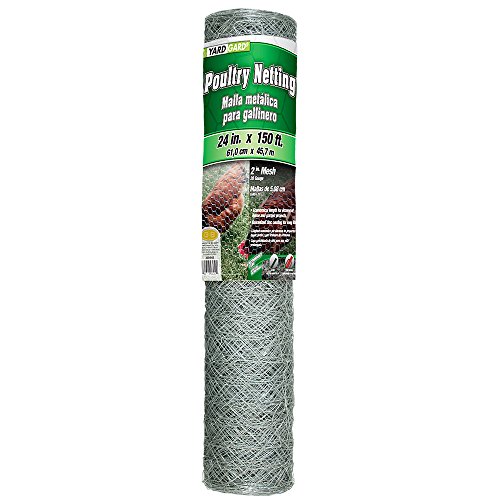 YARDGARD 2 in Poultry Netting, 24 in x 150 ft, 20 gaugeClassic hexagonal chicken wire: 2 in mesh, 20 gauge, 150 feet of it. Cheap, light, easy to cut and bend — and 2 in openings stop nothing smaller than a rabbit. | Cheap coverage over a big area | $29.99 on Amazon |
| 3 |  HOOPLE Landscape Staples, 6 in, 11 gauge, 100 packSix inches of 11 gauge galvanized wire, a hundred of them. This is the cheapest item on the page and the one most likely to decide whether the fence works. | Pinning the bottom edge, which is where fences fail | $15.99 on Amazon |
| 4 |  HUNKA Hardware Cloth, 1/2 in mesh, 36 in x 50 ft, 19 gaugeRecommended by specification rather than by brand: 1/2 in mesh, 36 in tall, galvanized. This roll meets it — any roll matching the same three numbers does the same job. | A permanent rabbit barrier | $42.99 on Amazon |
| 5 |  6 Gallon Galvanized Steel Seed Can with LidA galvanized can with a lid, which is the storage extension guidance actually names: rodents gnaw through plastic and paper, and do not gnaw through steel. | Storing seed where rodents cannot smell their way in | $28.79 on Amazon |
#ad how we are funded · price as of October 24, 2026
The picks in full
Top pick The fence itself, at the published height
SANZEUS Welded Wire Fence, 3 ft x 50 ft, 2 x 4 in, 15 gauge
Heavy-gauge welded wire at the 3 ft height wildlife agencies publish for woodchucks, in a 50 ft roll — the right raw material for a fence that has to be buried and bent.
Published specifications
- Height
- 3 ft (published)
- Roll length
- 50 ft (published)
- Mesh
- 2 x 4 in (published)
- Gauge
- 15 (published)
- Material
- Galvanized steel, welded joints (published)
- Working
- Published as cuttable and installable with T-posts
Trade-offs
- 3 ft is the height both sources on this page publish as the minimum for woodchucks
- 15 gauge is heavier wire than the 16 gauge most garden rolls use, which matters on a fence an animal climbs
- Welded rather than woven, so the joints do not slip when you bend the bottom into an L
- 2 x 4 in mesh is small enough for a groundhog and open enough to see through
- 50 ft does not go far around a vegetable plot — measure the perimeter before ordering one roll
- Galvanized bare wire is visible in a way black PVC-coated fencing is not
- Cut ends are sharp and the roll has memory; this is a gloves-and-two-people job
- It is only the wire. Posts, ties and the digging are all still ahead of you
Who it is forA vegetable garden or a run of beds that needs a permanent barrier built to the published spec rather than a temporary screen.
Skip it ifYour perimeter is long. The 100 ft roll costs less per foot and saves a join, and joins are where a burrowing animal gets in.
#ad how we are funded · price as of October 24, 2026
Where these specifications came from
No. 2 Cheap coverage over a big area
YARDGARD 2 in Poultry Netting, 24 in x 150 ft, 20 gauge
Classic hexagonal chicken wire: 2 in mesh, 20 gauge, 150 feet of it. Cheap, light, easy to cut and bend — and 2 in openings stop nothing smaller than a rabbit.
Published specifications
- Mesh
- 2 in hexagonal (published)
- Gauge
- 20 (published)
- Size
- 24 in x 150 ft (published)
- Finish
- Galvanized steel (published)
Trade-offs
- 150 feet is enough to cage a whole vegetable bed run, at a price hardware cloth cannot touch
- Light and flexible: it bends around hoops and cuts with ordinary snips
- Fine for the jobs extension guidance actually recommends 1-2 in mesh for — rabbit fencing and freestanding covers over rows
- 2 in openings pass chipmunks, mice, voles and young rats without slowing them down
- 20 gauge is thin enough that a determined squirrel can work an opening wider
Who it is forRabbit fencing, row covers and cages where the animal you are excluding is rabbit-sized or bigger.
Skip it ifYou are excluding rodents or sealing a structure. Use hardware cloth — this is the wrong material and it fails the same way every time.
#ad how we are funded · price as of October 24, 2026
Where these specifications came from
No. 3 Pinning the bottom edge, which is where fences fail
HOOPLE Landscape Staples, 6 in, 11 gauge, 100 pack
Six inches of 11 gauge galvanized wire, a hundred of them. This is the cheapest item on the page and the one most likely to decide whether the fence works.
Published specifications
- Length
- 6 in (published)
- Gauge
- 11 (published)
- Quantity
- 100 (published)
- Finish
- Galvanized (published)
Trade-offs
- 11 gauge is thick enough to drive into firm soil without folding, which 12 and 14 gauge staples do
- 100 staples at roughly one every 2 ft covers about 200 ft of bottom edge
- Galvanized, so they survive being left in wet ground season after season
- 6 in is short for loose or sandy soil, where a longer pin or a buried apron holds better
- Pinning a bottom edge is slow, unglamorous work that most people skip — which is precisely why it is on this page
- They disappear into grass, so mark the line before you mow
Who it is forEvery mesh fence, without exception. The top of a deer fence gets all the attention and the bottom is where the animals get through.
Skip it ifYou are burying an apron of wire instead, which is better and considerably more work.
#ad how we are funded · price as of October 24, 2026
Where these specifications came from
No. 4 A permanent rabbit barrier
HUNKA Hardware Cloth, 1/2 in mesh, 36 in x 50 ft, 19 gauge
Recommended by specification rather than by brand: 1/2 in mesh, 36 in tall, galvanized. This roll meets it — any roll matching the same three numbers does the same job.
Published specifications
- Mesh
- 1/2 in x 1/2 in (published); 1 in or smaller is the spec, 1/2 in excludes young rabbits
- Roll
- 36 in W x 50 ft L (published)
- Gauge
- 19, 0.91 mm wire diameter (published)
- Material
- Hot-dip galvanized over annealed wire (published)
- Height above ground
- At least 2 ft (Colorado State Extension)
- Buried depth
- 4 to 8 in (Colorado State Extension)
Trade-offs
- Extension services put chicken wire, hardware cloth or flexible netting at 2 ft high and buried 4 to 8 in as fairly effective against rabbits
- A permanent fix rather than a reapplication schedule
- Half-inch mesh also excludes young rabbits, which 2 in poultry netting does not
- Hot-dip galvanized after weaving, which is the coating that survives being buried
- Burying the bottom edge is the whole job, and it is real digging
- Galvanized wire is visible in a way black deer netting is not
- 36 in tall means you are burying roughly a third of what you paid for
- The listing warns of sharp edges at both ends — this is a gloves job, and nothing about this brand makes it better than any other roll at the same spec
Who it is forA vegetable plot or a border with a persistent rabbit problem, where you would rather dig once than spray for years.
Skip it ifDeer are the actual problem. Two feet of wire is a step-over for a deer; the height that matters there is 8 ft and up. See deer fencing.
#ad how we are funded · price as of October 24, 2026
Where these specifications came from
No. 5 Storing seed where rodents cannot smell their way in
6 Gallon Galvanized Steel Seed Can with Lid
A galvanized can with a lid, which is the storage extension guidance actually names: rodents gnaw through plastic and paper, and do not gnaw through steel.
Published specifications
- Capacity
- 6 gallon (published)
- Material
- Galvanized steel (published)
- Lid
- Included (published)
- Stated use
- Bird seed storage, rodent proof (published)
Trade-offs
- Steel is on the short list of materials rodents cannot gnaw through, alongside concrete and wire mesh
- 6 gallons takes a 15-20 lb bag of seed with the bag opened flat inside
- A lid that seats properly also keeps the seed dry, which is the other way stored seed goes bad
- A lid that merely rests on top is not enough where raccoons are active — they lift lids; a locking or strapped lid is the fix
- Galvanized steel left in the weather will eventually rust at the seams
Who it is forAnyone storing seed in a garage, shed or porch — which is the single most common reason rats appear at a feeder.
Skip it ifYou buy 5 lb bags and use them in a fortnight. The bag in a sealed bin indoors is fine.
#ad how we are funded · price as of October 24, 2026
Where these specifications came from
What we would skip
Scent repellents as the strategy
Iowa State Extension is direct: repellents are typically not very effective at preventing additional damage to lawns. It describes castor-oil products that mask the scent of grubs and coyote urine applied around a perimeter, and notes both must be reapplied often, especially after rain. Use them as a supplement if at all - the fence is the method.
Castor-oil granules bought as a skunk product
Worth knowing before you shop: the castor-oil granules and concentrates on the shelf are almost all labeled for moles, voles and gophers, not skunks. Iowa State describes the castor-oil mechanism as masking grub scent on the lawn, which is a different use than the label. We will not feature a mole product as a skunk product.
Ultrasonic and strobe devices
Same objection as everywhere else on this site: no maker publishes a frequency, a sound pressure level or a detection range, so there is nothing to compare. A skunk that is digging for grubs is working, not passing through, and a startle has to beat a food reward.
Trapping, without reading your state law first
A trapped skunk is a sprayed trap, a sprayed you, and in many states a rabies-vector species with specific legal handling. Protections and relocation rules vary. Exclusion is the position this site takes on every animal and it is least negotiable here.
Food management, briefly, because it still applies
A skunk's main draw is in the soil, which makes it different from a raccoon or an opossum. But the secondary draws are the familiar ones and they are the reason a passing animal becomes a resident: fallen birdseed, open bins, pet food left outside, and accessible compost.
A skunk cannot climb to your feeder, so unlike the raccoon case you do not need a baffle for it. What you need is for nothing to be on the ground underneath. A seed tray under the feeder and sealed seed storage handle most of it - keeping rats away from bird feeders covers the same ground-level discipline for the same reason.
The order we would do this in
- Identify the animal from the damage. Small rutted holes, skunk. Flipped sod, raccoon. Do not buy hardware until you are sure.
- Count the grubs. One square foot of lifted sod. Under five per square foot and grubs are not the draw; over five and they are.
- Clear the secondary food. Fallen seed, bins, pet bowls, compost. A week of this alone resolves a surprising number of cases.
- Fence or cover. Three-foot wire pinned to the ground to ring an area; wire laid flat and stapled down to protect open turf.
- Screen any den space under decks and sheds, after confirming it is empty.
- Put grub treatment on next year's calendar if the damage is annual - late May to early August preventative, August to early September curative, nothing after early October.
- Skip the repellent as the plan. Iowa State rates it as typically not very effective, and the products on the shelf are mostly labeled for moles.
On the smell, and on being fair to the animal
A skunk sprays when it is cornered or startled, which is an argument for fences and against devices, traps and surprises. Every method on this page works by making a place not worth visiting, and none of them involves confronting the animal.
It is also worth saying that a skunk eating grubs is doing something you would otherwise pay for. The goal here is to move the digging off the lawn you care about, not to remove an animal from the neighborhood.
How we picked
- We filtered on published mechanism first. If a maker will not state a detection range, a dose or a frequency, we cannot compare the product and we do not rank it.
- We recorded published figures only — detection ranges, spray durations, mixing ratios, stated species coverage.
- We separated startle from exclusion. A device that works by surprise decays through habituation; a barrier does not. We say which is which on every page.
- We named at least one product to skip on every page, with the reason.
- We have not tested any of these. How we pick sets out what that does and does not cover.
Everyone in this category says they tested twenty of these. We have not tested any, and we say so. What we did instead: read the manuals, compiled the published specifications, worked out the clearance geometry, and cited every source. The full method is published.
Questions people actually ask
- What is the best skunk deterrent?
- A low fence pinned to the ground. Iowa State University Extension states that fences can help with skunks as they do not jump or climb, and that a sturdy chicken wire or woven wire fence pinned to the ground helps keep them out of feeding areas. Three feet is enough because there is no climb to defeat.
- Do skunk repellents work?
- Iowa State rates them as typically not very effective at preventing additional damage to lawns. Castor-oil products can mask the scent of grubs on the turf and coyote urine can be applied around a perimeter, but both need frequent reapplication, especially after rain. Treat them as a supplement, not the plan.
- How tall does a skunk fence need to be?
- Much shorter than for most animals, because skunks do not jump or climb. Three feet of woven or welded wire is a reasonable specification. The critical requirement is not height but that the fence is pinned tight to the ground, since skunks dig.
- How do I tell skunk damage from raccoon damage?
- A skunk pushes its nose into the turf and digs with its front paws, leaving many small rutted holes that can merge into one disturbed patch. A raccoon uses its paws like hands and flips sod over in sheets. It matters because a fence stops a skunk and does not stop a raccoon.
- How do I stop skunks digging up my lawn?
- Lay hardware cloth, chicken wire or bird netting across the damaged areas and secure it to the ground with landscape staples or bricks, per Iowa State. Grass grows through it and digging stops being worth the effort. Also count grubs: five or more per square foot is what attracts them.
- Will grub control stop skunks digging?
- Only on the right schedule. Iowa State puts preventative insecticides from late May to early August and curative applications in August and early September, and states that treatments after early October are not effective and are not recommended. By the time holes appear it is usually too late for that season.
- Do I need a baffle to keep skunks off my bird feeder?
- No. A skunk cannot climb, so it is not coming up the pole. What it wants is the seed on the ground underneath, so a seed catcher tray and sealed storage do the job that a baffle does for squirrels and raccoons.
- Should I trap a skunk?
- We would not. A trapped skunk is a sprayed trap, and in many states skunks are a rabies-vector species with specific legal handling and relocation rules. Exclusion with a low pinned fence carries no such risk and does not need repeating next year.
Sources
- Iowa State University Extension, Managing Skunk and Raccoon Damage to Lawns
- Penn State Extension Master Gardener, Critter Control
- Internet Center for Wildlife Damage Management, Opossum Damage Prevention and Control Methods
- Havahart, Critter Ridder Motion-Activated Animal Repellent & Sprinkler 5277 (manufacturer page)
Read next
- Raccoon deterrents
Food management first, then a baffle that actually names raccoons, then a sprinkler on the route.
- Opossum deterrents: there is no repellent, so exclude instead
No repellent is registered and no frightening device is effective, per ICWDM. The published mesh, burial and skirt spec - and the food that brought them.
- Hardware cloth vs chicken wire
Chicken wire stops rabbits; hardware cloth stops rodents. The published extension mesh specs by animal, plus gauge, and which roll to buy for the five common garden jobs.
- How to keep rats away from bird feeders
Rats under a feeder are eating what falls, not what hangs. Catch the spill, store the seed in metal, clear the ground at dusk - and why rodenticide is the wrong tool in a yard full of birds.
- How to keep groundhogs out of the garden
A groundhog climbs and digs, so the fence has to beat both. The published 3 ft height, the outward L, the floppy top, and where two sources disagree.
- Active Deterrents
Motion sprinklers, seed treatments and per-animal answers for raccoons, opossums and skunks, judged on whether the mechanism is published or just claimed.