Guides / Deer
How to protect hydrangeas from deer
Hydrangeas are near the top of what deer actually want, and the damage that costs you is not the leaves. It is the buds that were going to be next summer's flowers.
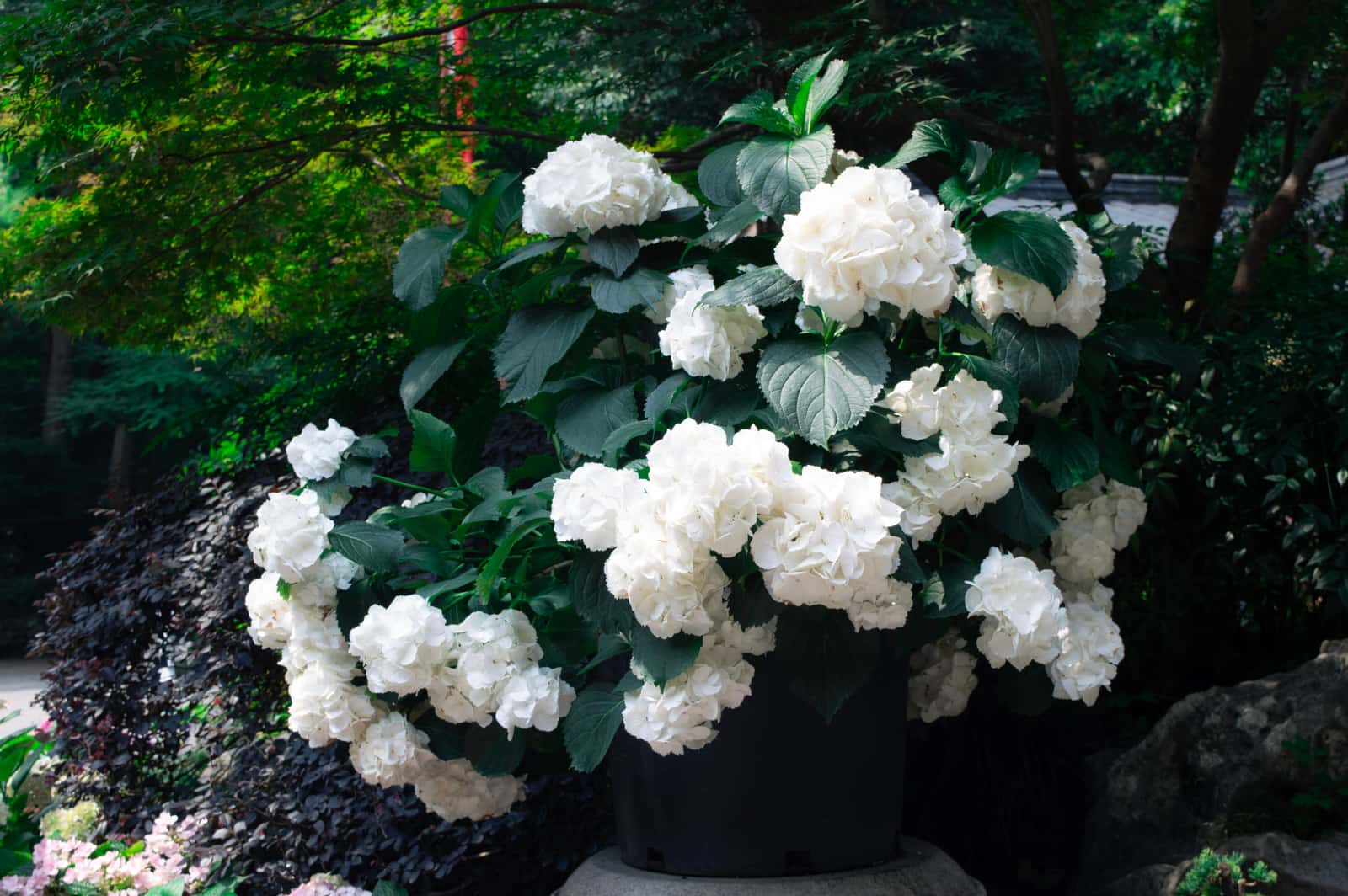
Net the shrub on a frame that holds the mesh clear of the foliage, or run a repellent on a strict schedule through the growing season and again in late winter. The critical window is winter and early spring, when deer take the buds that would have been this year's flowers.
Hydrangeas come up constantly in deer questions for a simple reason: they are a preferred browse plant, they are expensive, and they are usually planted somewhere prominent. Losing one is both a gardening problem and an aesthetic one.
The damage that actually matters
Summer browsing on leaves looks dramatic and the shrub usually shrugs it off. Winter and early-spring bud damage is the expensive one, because many hydrangeas flower on old wood — the buds formed the previous season. A deer that strips those buds has removed this year's flowers, and the shrub will leaf out looking healthy and simply not bloom.
That timing is the single most useful thing on this page. People protect hydrangeas in June, when they can see the plant and the damage, and leave them exposed in February when the loss that costs them a summer is happening.
| Season | What deer take | Cost | Priority |
|---|---|---|---|
| Late spring to summer | Leaves and soft shoots | Cosmetic; the shrub recovers | Moderate |
| Late winter to early spring | Buds on old wood | This year's flowers, entirely | Highest |
| Autumn | Some browse as other food declines | Sets back next season | Moderate |
Netting, held clear
The most reliable option, with one condition that decides whether it works at all: the mesh has to be held off the foliage. A deer browses straight through netting resting on leaves. Draped netting protects nothing; netting on a frame, or a cage over the shrub, protects everything under it.
Tenax publishes 7 ft x 100 ft polypropylene netting, which is enough to cage several shrubs. Two cautions carried over from garden netting: tension and pin every edge, because slack netting is an entanglement hazard for birds and small mammals, and check it after storms.
For a small shrub a rigid pop-up cage is easier than building a frame. ANC POP publishes 40 x 40 x 30 in, which suits a young or compact hydrangea and nothing larger.
Baffleworks is funded by affiliate commission. If you buy through a link on this page we may earn a commission at no extra cost to you, and it never decides a ranking. Full disclosure · how we pick.
Quick picks
Ranked, with the trade-off named. Tap a row for the full write-up; the price button goes straight to Amazon.
| # | Product | Best for | Price |
|---|---|---|---|
| 1 |  Tenax Deer Netting, 7 ft x 100 ftNetting rather than fence: lighter, easier to drape over a shrub or a bed, and not pretending to be a perimeter barrier. | Draping and small enclosures | $53.34 on Amazon |
| 2 |  Plantskydd Ready-to-Use Liquid, 1.3 galReady-to-use and covering the widest published species list here: deer, rabbits, elk, moose, voles, squirrels and chipmunks from one bottle. | No mixing, widest species list | $80.18 on Amazon |
| 3 |  Bobbex Concentrated Deer Repellent, 32 ozA concentrate rather than a ready-to-use bottle, which is the right format if you are going to spray often enough for a repellent to work at all. | Rotation partner, concentrate | $25.60 on Amazon |
| 4 |  ANC POP Pop-Up Mesh Plant Cover, 2-packANC POP's pop-up cage, sold as a pair. The single-unit listing is gone, so this is now the only way to buy this cage. | Two beds at once | $51.99 on Amazon |
#ad how we are funded · price as of October 24, 2026
The picks in full
Top pick Draping and small enclosures
Tenax Deer Netting, 7 ft x 100 ft
Netting rather than fence: lighter, easier to drape over a shrub or a bed, and not pretending to be a perimeter barrier.
Published specifications
- Height
- 7 ft (published)
- Length
- 100 ft
- Material
- Black polypropylene
- Structure
- Quadrangular mesh (published)
Trade-offs
- Light enough to throw over a shrub or a fruit cage without a post system
- Cheap enough per foot to protect a lot of individual plants
- Not a perimeter fence, and treating it as one is how people conclude that deer fencing does not work
- Loose netting can entangle wildlife if it is left slack and unpegged
Who it is forIndividual shrubs, small beds and winter protection on ornamentals, rather than a garden boundary.
Skip it ifYou want a perimeter. Buy the fence, set posts, and tension it — the height guide explains why the two are not interchangeable.
#ad how we are funded · price as of October 24, 2026
Where these specifications came from
No. 2 No mixing, widest species list
Plantskydd Ready-to-Use Liquid, 1.3 gal
Ready-to-use and covering the widest published species list here: deer, rabbits, elk, moose, voles, squirrels and chipmunks from one bottle.
Published specifications
- Size
- 1.3 gal ready-to-use (published)
- Targets
- Deer, rabbit, elk, moose, voles, squirrels, chipmunks
- Form
- Ready-to-use liquid
- Part number
- PS-5L
Trade-offs
- No mixing, so it is the one people actually reapply on schedule
- The species list covers the garden raiders as well as the browse animals
- 1.3 gal is enough to treat a real garden rather than a planter
- Ready-to-use costs considerably more per treated area than concentrate
- It is a blood-meal-based product and it smells like one for a day or so
Who it is forA mixed garden problem — deer on the shrubs, rabbits on the greens, chipmunks in the bulbs — where you want one bottle rather than three.
Skip it ifYou are treating a large area regularly. Buy the powder concentrate and mix it; the ready-to-use maths stops working quickly at scale.
#ad how we are funded · price as of October 24, 2026
Where these specifications came from
No. 3 Rotation partner, concentrate
Bobbex Concentrated Deer Repellent, 32 oz
A concentrate rather than a ready-to-use bottle, which is the right format if you are going to spray often enough for a repellent to work at all.
Published specifications
- Size
- 32 oz concentrate (published)
- Targets
- Deer, elk, moose
- Form
- Dilute and spray
- Part number
- B550100
Trade-offs
- Concentrate is far cheaper per treated square foot than ready-to-use
- A different active profile from Plantskydd, which is what makes rotation possible
- Repellents are a reapplication commitment: rain, new growth and habituation all reset them
- Mixing and spraying is a job, and the ones that stop working are usually the ones that stopped being sprayed
Who it is forOrnamental beds and shrubs where fencing is not acceptable, used on a schedule rather than in a panic.
Skip it ifYou want to solve this once. Extension services are consistent that a fence is the exclusion method and a repellent is a mitigation. Read what actually keeps deer out before you buy a spray instead of a fence.
#ad how we are funded · price as of October 24, 2026
Where these specifications came from
No. 4 Two beds at once
ANC POP Pop-Up Mesh Plant Cover, 2-pack
ANC POP's pop-up cage, sold as a pair. The single-unit listing is gone, so this is now the only way to buy this cage.
Published specifications
- Dimensions
- 40 x 40 x 30 in each (published)
- Quantity
- 2
- Stakes
- 8 ground stakes
- Assembly
- Pop-up, folds flat
Trade-offs
- Two beds covered from one purchase, which suits a plot where more than one bed is under pressure
- Identical footprint, so beds can be laid out to one dimension
- You are committed to the 40 in module whether or not your beds match it
- The published 30 in height caps what you can grow under it
Who it is forA vegetable plot with more than one bed under pressure, which is most vegetable plots by midsummer.
Skip it ifYou have one bed and do not want a spare. There is no single-unit listing for this cage any more, so the cheaper two-pack covers on this page are the alternative.
#ad how we are funded · price as of October 24, 2026
Where these specifications came from
Repellent, on a calendar
Repellents work on hydrangeas as well as on anything, with the standard limits: rain strips the coating, new growth is untreated, and a hungry deer will eat something it dislikes.
- Buy concentrate, not ready-to-use, if you are treating a border. Plantskydd's 2.2 lb powder publishes a yield of 2.5 gallons; cost per treated area is what determines whether you keep spraying.
- Spray in autumn, before the buds are at risk, and again in late winter. This is the application people miss.
- Reapply after heavy rain and after any significant flush of new growth.
- Rotate genuinely different products. Plantskydd is blood-meal based and Bobbex is a different formulation, so alternating them is a real rotation rather than a change of label.
A dormant shrub in February holds a coating well — there is no new growth diluting it and no flush of leaves to cover. Winter is when repellent on a hydrangea is at its most effective, which is convenient given that is also when it matters most.
What about the fence?
If the hydrangeas are inside a garden you can fence, fence it and stop thinking about this. Michigan State University Extension puts effective perimeters at 8 to 10 ft, with woven wire at 10 ft as the only sure barrier, and a fence is the only measure that does not decay. The height guide covers the terrain cases where a shorter mesh fence holds.
Most hydrangeas, though, are planted at the front of a house where a 10 ft fence is not happening. That is precisely why this page is about netting and repellent — they are what is left when exclusion is not socially available.
The free measure
If you are still choosing where to plant, put hydrangeas where they are not the first thing a deer meets. Boundary planting takes the pressure first, and moving a preferred species behind less-preferred ones changes what gets browsed. Deer-resistant plants covers how to use that properly — and is honest that nothing is deer-proof under enough pressure.
The repellent this page leans on is examined claim by claim in the Plantskydd review. And hostas are the other plant in Rutgers' D category, with a simpler answer because they are low — protecting hostas from deer covers the calendar and the cage.
Questions people actually ask
- Do deer eat hydrangeas?
- Yes, readily. They are a preferred browse plant, which is why they come up so often in deer questions. Leaves in summer, and buds in winter and early spring.
- When are hydrangeas most at risk from deer?
- Late winter to early spring. Many hydrangeas flower on old wood, so deer taking those buds removes this year's flowers entirely. The shrub leafs out looking fine and does not bloom.
- Does netting protect hydrangeas from deer?
- Only if it is held clear of the foliage on a frame or as a cage. A deer browses straight through mesh resting on leaves, so draped netting protects nothing.
- When should I spray repellent on hydrangeas?
- In autumn before the buds are at risk, again in late winter, and after heavy rain or a flush of new growth. A dormant shrub holds a coating well, so winter application is unusually effective.
- Will a short fence keep deer off my hydrangeas?
- Not reliably. Michigan State University Extension puts effective perimeters at 8 to 10 ft. A short decorative fence is a step-over; if you cannot fence properly, net the shrub instead.
Sources
Read next
- Deer-resistant plants
Resistant means less-preferred, not inedible. What planting actually buys, and where to get a list that applies to your region.
- The best deer repellents
Ranked on published yield and format, with an honest account of why repellents fail: reapplication, not chemistry.
- The best garden netting
Cheap protection by the square foot, and the mesh sizes and pinning that decide whether it works.
- How to keep deer out of the garden
Fence, repel, deter, replant — in that order, with the published height that decides step one.
- Deer Deterrence
Fencing at the height extension services publish, plus the repellents that fill the gaps around it.