Feeders / Budget
The best cheap squirrel-proof bird feeders
Spending less works in this category, but only if you spend it on the right thing. The cheapest setup that genuinely excludes squirrels is rarely the cheapest feeder with the words on the box.
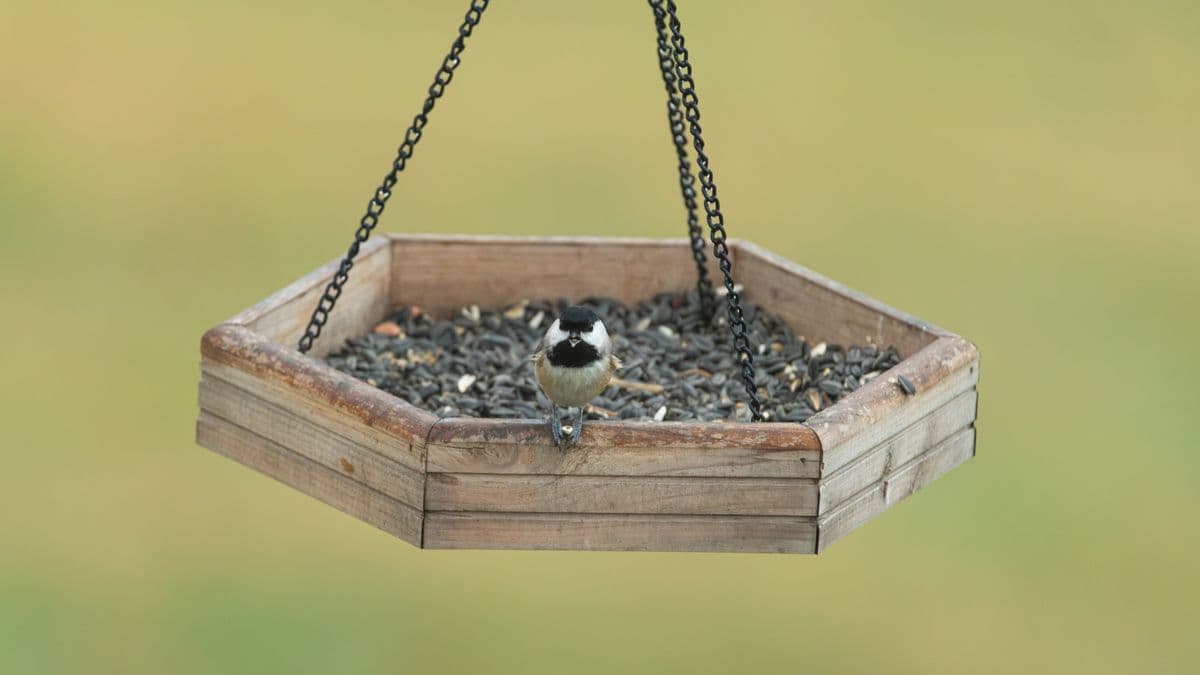
The cheapest setup that genuinely excludes squirrels is a plain feeder on a pole with a correctly placed baffle — not a cheap feeder labeled squirrel-proof. If you already own a pole, a baffle is the cheapest fix on this page. If you own nothing, a complete pole-and-baffle station costs less than most mid-range feeders on its own.
Every price on this page is pulled live from the retailer, so the ranking below is by capability rather than by a number we typed once and forgot. What follows is an order of operations, cheapest first, with what each saving actually costs you.
Start with the thing that costs nothing
This has to come first on a budget page, because it is free and it beats everything below it. A gray squirrel covers roughly eight feet horizontally and jumps about four feet vertically — figures the Alabama Cooperative Extension System publishes. Audubon's answer follows directly: baffle top four to five feet off the ground, feeder above it, and eight to ten feet of clear air from anything solid.
Moving a feeder pole three feet further from a fence costs nothing and does more than any product in this roundup. If your budget is genuinely zero, that is the whole article — the clearance spec has the sources and the arithmetic. Everything below assumes you have already done it, because nothing below works if you have not.
How we ranked the cheap end
Not by price. By cost per unit of exclusion — which of the three real mechanisms you get for the money, and what the low price took away.
| Mechanism | How it excludes | Budget version | What the saving costs |
|---|---|---|---|
| Cage | A fixed aperture. Weight is irrelevant, so chipmunks and red squirrels are excluded too | A small steel cage feeder | Capacity, and cardinals — the aperture cannot be adjusted |
| Baffle | Geometry. Nothing reaches the feeder because nothing can get past the disk | A 19 in plastic wrap-around | Steel. Plastic can be chewed and publishes no service life |
| Weight trigger | Mass. A shroud closes the ports under a squirrel | The smallest model in the range | Seed capacity, and any ability to tune the trigger |
A fourth thing is sold at this price point and is not a mechanism: a metal body described as chew-resistant. That protects the feeder, not the seed.
Read the last row of that note carefully, because it is where most budget money is wasted. Chew-resistant is not exclusion — it is a claim about how long the hardware survives while the squirrel eats.
Baffleworks is funded by affiliate commission. If you buy through a link on this page we may earn a commission at no extra cost to you, and it never decides a ranking. Full disclosure · how we pick.
Quick picks
Ranked, with the trade-off named. Tap a row for the full write-up; the price button goes straight to Amazon.
| # | Product | Best for | Price |
|---|---|---|---|
| 1 |  Girvenith Metal Caged Seed Feeder, 4 portA steel cage around an enclosed seed compartment, sized so finches and chickadees pass and larger birds do not. The cheapest honest cage on this page. | Small songbirds in a small space | $20.99 on Amazon |
| 2 |  Gtongoko 19 in Wrap-Around Squirrel BaffleThe value end of the baffle shelf: a wrap-around that publishes an actual pole range and ships adapter inserts, so it fits what you own instead of hoping. | The cheapest baffle that publishes a pole fit | $19.99 on Amazon |
| 3 | 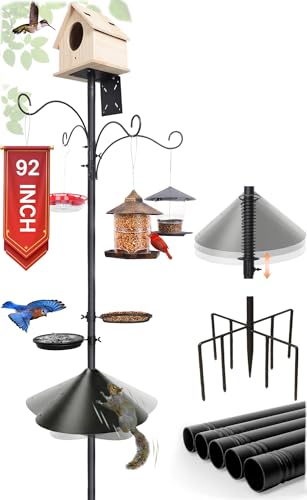 eWonLife 92 in Feeder Pole with Spring BaffleA whole feeding station for less than most bare baffles: pole, spring baffle, four hooks, a bath and a tray. The compromise is the anchor, and the spec rows say so. | The cheapest complete station | $37.99 on Amazon |
| 4 |  Erva SB6 Pole-Mount Disk Baffle, 22.5 inThe widest disk we found with a published diameter, which is the whole mechanism: a squirrel on the pole below has to reach past 22.5 inches of steel to get anything. | Round poles, maximum overhang | $39.99 on Amazon |
| 5 |  Caged Dual-Purpose Suet and Seed FeederSuet is the format squirrels raid hardest, and a caged suet holder with a seed tray solves both problems with the same steel. | Suet and seed in one cage | $45.88 on Amazon |
| 6 | 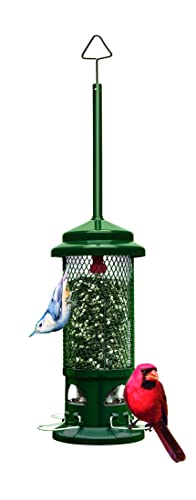 Brome Squirrel Buster StandardThe smallest Brome, with four metal perches and a 1.3 lb reservoir. The cheapest way into a mechanism that genuinely works on gray squirrels. | Small spaces and a low entry price | $57.51 on Amazon |
#ad how we are funded · price as of September 15, 2026
The picks in full
Top pick Small songbirds in a small space
Girvenith Metal Caged Seed Feeder, 4 port
A steel cage around an enclosed seed compartment, sized so finches and chickadees pass and larger birds do not. The cheapest honest cage on this page.
Published specifications
- Mechanism
- Fixed cage aperture
- Dimensions
- 6.25" L x 6.25" W x 10.25" H (published)
- Feeding ports
- 4 (published)
- Cage
- Durable steel exterior (published)
- Weather
- Rainproof cover; all-weather metal (published)
- Named birds
- Finches and chickadees welcomed, larger birds discouraged (published)
- Filling
- Wide-opening metal top (published)
Trade-offs
- Publishes its actual cage body dimensions, which is how you predict which birds get in
- A fixed aperture ignores weight, so it stops the chipmunk and red squirrel a weight trigger lets through
- All-metal with a rainproof cover — no plastic tube to chew or craze
- Small enough to hang almost anywhere, and cheap enough to try
- The listing publishes the cage body size but not the mesh opening, which is the number that would settle exactly which birds fit
- Excludes cardinals, jays and grosbeaks along with the squirrels — the trade, not a defect
- No published seed capacity, and a 10.25 in body will not hold much
- 'Squirrel proof' in the title is doing more work than the cage alone can — placement still matters
Who it is forA small yard with chipmunks or red squirrels, where finches and chickadees are the birds you actually want.
Skip it ifYou want cardinals. A 6.25 in cage body is the mechanism working as designed, and no setting changes it — see the cardinal page.
#ad how we are funded · price as of September 15, 2026
Where these specifications came from
No. 2 The cheapest baffle that publishes a pole fit
Gtongoko 19 in Wrap-Around Squirrel Baffle
The value end of the baffle shelf: a wrap-around that publishes an actual pole range and ships adapter inserts, so it fits what you own instead of hoping.
Fits: Round pole · Shepherd's hook
Published specifications
- Diameter
- 19 in (published)
- Pole fit
- 1/2" to 1-1/4" poles and shepherd hooks (published)
- Adapters
- Two adapter inserts included (published)
- Material
- PP, rust-proof, weather-resistant (published)
- Fitting
- Three-piece wrap-around; installs without removing pole or feeder (published)
- Action
- Smooth surface with a wobbling design (published)
Trade-offs
- Publishes a real pole-diameter range, which most baffles at this price will not
- Wrap-around, so an installed pole does not have to come out of the ground
- Two adapter inserts mean a thin pole still gets a tight fit — a loose baffle is a step, not a barrier
- Nothing to rust, which is more than can be said for cheap steel
- PP plastic, not steel. Steel collars cannot be chewed and this can be
- 19 in is narrower than the 22.5 in steel disks, so it overhangs less
- Publishes no thickness or UV rating, so how many summers it survives is unknown
- A three-piece wrap-around has seams, and a seam left loose is a foothold
Who it is forA first baffle on a pole you already own, where the budget is the binding constraint and the pole is within the published range.
Skip it ifSquirrels in your yard chew. Plastic is the wrong material for that, and a steel disk is the durable answer.
#ad how we are funded · price as of September 15, 2026
Where these specifications came from
No. 3 The cheapest complete station
eWonLife 92 in Feeder Pole with Spring Baffle
A whole feeding station for less than most bare baffles: pole, spring baffle, four hooks, a bath and a tray. The compromise is the anchor, and the spec rows say so.
Fits: Ground-set
Published specifications
- Height
- Adjustable 47" to 92", 6 sections (published)
- Pole diameter
- 1 in (published)
- Baffle
- 16.5 in with a built-in spring that sinks and wobbles (published)
- Base
- 9 reinforced steel prongs (published)
- Hooks
- 4 free-sliding shepherd hooks (published)
- Included
- Detachable bird bath and mesh food tray (published)
- Not included
- Feeders and bird houses (published)
Trade-offs
- A complete station — pole, baffle, hooks, bath and tray — for less than several bare baffles on this site
- A spring baffle rather than a fixed disk, which is an active mechanism at a passive price
- Free-sliding hooks mean the feeder height can be tuned to put the baffle top where it belongs
- Adjustable from 47 to 92 in, so the same pole suits a border or an open lawn
- A prong base, not an auger. In wet ground under four loaded hooks this is the part that lets go, and it is the main thing the price buys you out of
- Publishes no load rating, so 'heavy duty' is a word rather than a number
- 16.5 in is a small baffle by the standards of the steel disks here
- 'Defeats squirrels every time' is marketing — the geometry defeats squirrels, and this pole only makes the geometry possible
Who it is forSomebody starting from nothing who wants the pole, the baffle and the anchor in one cheap box.
Skip it ifYour soil is soft or the site is exposed. Pay for an auger anchor — a leaning pole is a closer pole.
#ad how we are funded · price as of September 15, 2026
Where these specifications came from
No. 4 Round poles, maximum overhang
Erva SB6 Pole-Mount Disk Baffle, 22.5 in
The widest disk we found with a published diameter, which is the whole mechanism: a squirrel on the pole below has to reach past 22.5 inches of steel to get anything.
Fits: Round pole
Published specifications
- Diameter
- 22.5 in (published)
- Type
- Disk, pole-mount
- Material
- Powder-coated galvanized steel, solid steel collars
- Origin
- Made in USA
Trade-offs
- 22.5 in is the largest published disk diameter in this set, so it gives the most overhang past the pole
- Steel collars rather than plastic clamps, which is what usually fails first on a baffle
- Powder coat over galvanized steel, so it is not a chew or corrosion target
- Pole-mount, so it has to come off the pole to install unless your feeder arm lifts clear
- A 22.5 in disk is visually large; on a small deck or patio it dominates
Who it is forA standard round feeder pole where you want the mechanism doing the work rather than luck. Mount the top of the disk at four to five feet and give it the clearance the geometry actually needs.
Skip it ifYour feeder is on a 4x4 wooden post — this is a round-pole fitting. Use the 4x4 post baffles instead.
#ad how we are funded · price as of September 15, 2026
Where these specifications came from
No. 5 Suet and seed in one cage
Caged Dual-Purpose Suet and Seed Feeder
Suet is the format squirrels raid hardest, and a caged suet holder with a seed tray solves both problems with the same steel.
Published specifications
- Capacity
- 2 suet cakes plus 1 lb seed (published)
- Cage
- Metal
- Tray
- Included
- Finish
- Copper
- Mount
- Hanging
Trade-offs
- Two cakes plus a pound of seed covers woodpeckers and songbirds from one hanger
- The cage is also the fix for starlings on suet, which is the second complaint after squirrels
- Tray catches the seed that would otherwise feed the animals under the feeder
- A seed tray under a suet cage collects wet shell and needs emptying
- Copper finish is a strong look that will not suit every setup
Who it is forAnyone feeding suet through the cold months who has watched a squirrel carry an entire cake away.
Skip it ifYou only feed seed. You are paying for a suet cage you will not fill, and a plain caged tube does the seed job for less.
#ad how we are funded · price as of September 15, 2026
Where these specifications came from
No. 6 Small spaces and a low entry price
Brome Squirrel Buster Standard
The smallest Brome, with four metal perches and a 1.3 lb reservoir. The cheapest way into a mechanism that genuinely works on gray squirrels.
Published specifications
- Perches
- 4 metal (published)
- Seed capacity
- 1.3 lb (published)
- Mechanism
- Weight-activated shroud
- Cardinal ring
- Not published for this model
Trade-offs
- Lowest price of entry to a weight mechanism from the brand that defined the category
- Metal perches even at the smallest size
- Light enough for a shepherd's hook that would bend under a large hopper
- 1.3 lb is a genuinely small reservoir and will need refilling often in a busy yard
- No cardinal ring published
- Smallest body in the range, so the least comfortable for a large bird
Who it is forA balcony, a small courtyard, or a first squirrel-proof feeder where the point is finding out whether the mechanism works for you.
Skip it ifCardinals are the target. This is the smallest feeder in the range with no cardinal provision published, which makes it the least likely of the six to satisfy them.
#ad how we are funded · price as of September 15, 2026
Where these specifications came from
What we would skip
Any cheap feeder sold as squirrel-proof with no published mechanism
This is the defining trap of the budget shelf. A listing that says squirrel-proof but names no weight trigger, no cage aperture and no baffle is selling the phrase, not the function. Chew-resistant metal is a claim about the housing, not about the seed. If you cannot find the mechanism in the listing, there is not one.
Buying a cheap feeder before you have moved the one you own
Eight to ten feet of clear air costs nothing and outperforms every purchase on this page. Buying first and measuring second is how people end up owning three feeders and still losing.
A cheap baffle on a pole outside its published fit range
A baffle that does not clamp tight is a step, not a barrier. The budget baffle here publishes 1/2 to 1-1/4 in and ships adapter inserts; plenty at the same price publish nothing. Measure the pole before ordering.
The cheapest real answer, depending on what you already own
The budget decision is not really which feeder. It is which gap you are filling.
- You own a pole and a feeder. Buy a baffle. It is the cheapest genuine fix available and it upgrades the setup you already paid for rather than replacing it. Check your pole against the baffle's published fit range first.
- You own a feeder but hang it from a hook or a branch. A hook cannot take a baffle at the published height, so the cheapest working answer is a pole — and a complete pole with a baffle included costs less than buying the two separately.
- You own nothing. The complete station is the value pick on this page by a distance: pole, baffle, hooks and trays in one box for less than several bare baffles here.
- Chipmunks or red squirrels, not grays. Skip the weight triggers entirely — they are calibrated for a gray squirrel's mass and a chipmunk walks straight under them. A cage is both the correct mechanism and the cheaper one.
Where spending a little more is worth it
Two places, and we would rather say so than pretend the cheapest option wins every time.
Steel over plastic, on a baffle. The budget baffle here is PP plastic. Erva's disk is powder-coated over fully galvanized steel with a solid steel collar that cannot be chewed, and it publishes a 22.5 in diameter against the budget option's 19 in. If squirrels in your yard chew — and you will know — that gap is the difference between an annual purchase and a permanent one.
An auger over prongs, on a pole. The cheap station anchors with nine steel prongs. The pole roundup covers systems with an auger that threads into the ground instead. Under four loaded hooks in a wet spring, the anchor is what fails, and a leaning pole is a closer pole — which puts the feeder back inside jumping range of whatever it was moved away from.
The one cheap feeder that publishes its aperture
Worth singling out, because it is rare. Cage feeders exclude by aperture, and almost no listing at any price states what that aperture is — a recurring complaint on the caged feeders page. The dual-purpose suet and seed cage here publishes an average opening of 1.28 x 1.68 in, along with two suet cakes and a stated seed capacity.
That single figure lets you predict which birds get in before you buy, which no amount of marketing copy does. When a cheap product publishes more than an expensive one, it deserves to be said out loud.
What a small budget cannot buy
- Raccoons. Nothing at this price is rated for them. A raccoon is heavier and reaches further, and the baffles that name raccoons cost several times the ones here — raccoon deterrents covers why.
- Capacity. Cheap feeders are small. The budget picks here hold a fraction of what a large hopper does, so the saving is partly repaid in refills.
- Cardinals through a cage. A fixed aperture sized for finches excludes cardinals and jays as well as squirrels. The cardinal page explains why a weight trigger is the mechanism to buy if big birds matter, and the cheapest one of those costs more than any cage here.
- A guarantee. Most budget listings publish no load rating, no gauge and no service life. We record that as unpublished rather than guessing, and it is a real part of what the price reflects.
The order we would actually buy in
- Move the feeder to eight to ten feet of clear air. Free, and it decides the outcome.
- If there is a pole, add a baffle with its top at four to five feet. Cheapest real purchase available.
- If there is no pole, buy the complete station rather than assembling one from parts.
- Only then consider the feeder itself, and buy the mechanism that matches your animal — a cage for chipmunks, a weight trigger for grays where big birds matter.
That order is the argument of this page. Almost every budget guide in this category inverts it, starts with the cheapest object labeled squirrel-proof, and skips the step that costs nothing and works.
How we picked
- We sorted by mechanism first: weight, cage or spin. Those three exclude different animals, and the choice between them is not a quality judgment.
- We used published figures only — seed capacity, port count, dimensions, mechanism. Where a maker publishes nothing, the spec row says so.
- We checked each mechanism against the animal it is calibrated for. A weight trigger tuned for a gray squirrel does not fire for a chipmunk, and we say so rather than implying it does.
- We named at least one product to skip on every page, with the reason.
- We have not tested any of these. How we pick sets out what that does and does not cover.
Everyone in this category says they tested twenty of these. We have not tested any, and we say so. What we did instead: read the manuals, compiled the published specifications, worked out the clearance geometry, and cited every source. The full method is published.
Questions people actually ask
- What is the cheapest way to stop squirrels on a bird feeder?
- Move it. Audubon publishes eight to ten feet of clear air from anything solid, and Cornell puts it at ten feet from jumping-off points. That costs nothing and outperforms every purchase. After that, a baffle on an existing pole is the cheapest genuine fix.
- Are cheap squirrel-proof bird feeders worth it?
- Only where the listing names a mechanism — a cage aperture, a weight trigger or a baffle. A cheap feeder described as squirrel-proof with no published mechanism is selling the phrase. Chew-resistant metal protects the feeder, not the seed.
- Is a cheap plastic baffle as good as a steel one?
- No, and the difference is chewing. The budget baffle here is PP plastic and publishes no service life; Erva's steel disk publishes a solid steel collar that cannot be chewed and a wider 22.5 in diameter. Plastic is fine where squirrels do not chew, and a repeat purchase where they do.
- What is the cheapest complete squirrel-proof setup?
- A pole system with the baffle included. The one on this page ships an adjustable 47 to 92 in pole, a 16.5 in spring baffle, four hooks, a bath and a tray for less than several bare baffles here. Its compromise is a prong base rather than an auger.
- Will a cheap weight-activated feeder stop chipmunks?
- No. Weight triggers are calibrated for a gray squirrel's mass and a chipmunk does not weigh enough to close them. A cage excludes by aperture regardless of weight, and the cage options here are cheaper than the weight-activated ones.
- How much should I expect to spend?
- We show live prices rather than quoting a bracket that goes stale. The useful rule is the order of operations: free placement first, then a baffle if you own a pole, then a complete station if you do not, and the feeder last.
Sources
Read next
- The best squirrel-proof bird feeders
Seven feeders ranked by mechanism and published capacity, and which animal each one actually excludes.
- Caged bird feeders
Exclusion by size rather than weight: the mechanism that beats chipmunks, red squirrels and starlings.
- How high should a squirrel baffle be?
Four to five feet high, eight to ten feet clear. The sourced numbers, the arithmetic, and the popular page that gets it wrong.
- The best squirrel-proof bird feeder poles
Pole systems ranked on baffle height, anchoring and the ten-foot setback one maker actually publishes.
- Squirrel-Proof Feeders
Weight-activated, caged and spinning feeders, sorted by which animal each mechanism actually keeps out.