Guides / Structure
Squirrel proofing your house
This page is about keeping squirrels out of a structure they have not got into yet. If something is already living in your roof, the answer is not on this page and not in a hardware aisle.
Seal entry points before anything gets in: roof and gable vents with a stainless exclusion screen, and gaps at soffits and fascia with hardware cloth. Ridge vents are the exception and we are explicit about it below — we cannot currently point you at a product for them. Never seal an entry that may be occupied — that traps the animal, and if there are young the outcome is worse. That is a licensed operator's job.
With that established: exclusion hardware is genuinely effective, it is the only permanent answer, and it is squarely within what this site covers — a barrier with a published specification, doing a job you can verify.
Where they actually get in
Squirrels are climbers with strong incisors. They rarely make a hole in sound material; they exploit a gap that already exists and enlarge it.
| Entry point | Why it is vulnerable | What closes it |
|---|---|---|
| Roof and gable vents | A louvered vent is an opening by design, and the factory screen behind it is usually thin insect mesh | A stainless steel exclusion guard over the outside |
| Ridge vents | A continuous opening the full length of the roof, often only shingle-covered | No verified product — roofer's job |
| Soffit and fascia gaps | Where the roof meets the wall; gaps open as timber moves | Hardware cloth, cut and fixed over the gap |
| Chimneys | An open flue is a direct route in | A chimney cap with mesh |
| Utility penetrations | Gaps around cables and pipes are rarely sealed tightly | Hardware cloth plus an appropriate sealant |
A rooftop solar array belongs on that list too, and is missing from most of them. It creates a sheltered cavity a few inches above the roof with the system's wiring running through it, and it is closed with perimeter mesh rather than a vent guard — squirrel proofing solar panels covers that job separately.
The hardware, and the spec that matters
HY-C publishes a range of VentGuards with a wildlife exclusion screen across hood-vent and roof sizes. The small universal guards publish 100% 304 stainless steel mesh and the size of vent they fit; the large roof guards publish a laser-cut, pre-drilled mounting frame at 16 by 16 inches. A published material and a published vent size, rather than general critter-proofing, is unusually specific for exclusion hardware.
Two practical notes. Measure the vent first, because the range exists in that many sizes for a reason and a guard that does not cover the opening achieves nothing. And stainless rather than galvanized on a roof, because a galvanized cage streaks rust down the shingles within a couple of seasons.
For soffit gaps and utility penetrations, the material is the same hardware cloth used for rabbit fencing — galvanized wire at a small aperture, cut and fixed over the gap.
Baffleworks is funded by affiliate commission. If you buy through a link on this page we may earn a commission at no extra cost to you, and it never decides a ranking. Full disclosure · how we pick.
Quick picks
Ranked, with the trade-off named. Tap a row for the full write-up; the price button goes straight to Amazon.
| # | Product | Best for | Price |
|---|---|---|---|
| 1 | 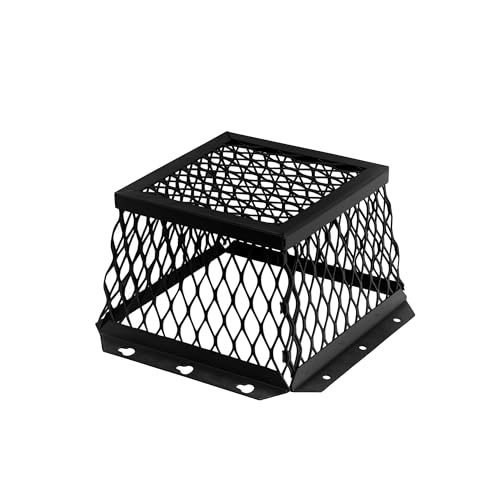 HY-C RVGDVGBL Stainless Steel Universal VentGuardThe small stainless guard: 304 stainless mesh over a dryer or bathroom hood vent, with a keyhole fitting so it comes off for the lint clean-out it will need. | Hood-style exhaust vents | $49.59 on Amazon |
| 2 |  HY-GUARD 16 x 16 in Galvanized Steel Roof VentGuardThe large roof guard: 16 by 16 inches over a roof louver, laser-cut mounting frame, made by the company that has built these since 1947. Galvanized rather than stainless, which is a real trade. | Large roof vents | $67.49 on Amazon |
| 3 |  HUNKA Hardware Cloth, 1/2 in mesh, 36 in x 50 ft, 19 gaugeRecommended by specification rather than by brand: 1/2 in mesh, 36 in tall, galvanized. This roll meets it — any roll matching the same three numbers does the same job. | A permanent rabbit barrier | $42.99 on Amazon |
#ad how we are funded · price as of October 24, 2026
The picks in full
Top pick Hood-style exhaust vents
HY-C RVGDVGBL Stainless Steel Universal VentGuard
The small stainless guard: 304 stainless mesh over a dryer or bathroom hood vent, with a keyhole fitting so it comes off for the lint clean-out it will need.
Published specifications
- Dimensions
- 7" L x 7" W x 5" H (published)
- Fits
- Most 3 in or 4 in hood-style exhaust vents (published)
- Mesh
- 100% 304 stainless steel, will not rust or corrode (published)
- Finish
- Black powder coat, paintable (published)
- Fitting
- Keyhole on/off attachment for maintenance (published)
Trade-offs
- 304 stainless rather than galvanized, so it will not streak rust down a wall or a roof
- Keyhole fitting means it comes off for cleaning — a dryer vent guard that cannot be removed becomes a fire risk
- Publishes the vent sizes it fits rather than claiming universal fit without a number
- Paintable finish, so it can disappear against siding
- This is a 7 in guard for hood vents — it is not the 11 x 11 roof vent guard it replaces, and it will not cover a large roof louver
- Publishes no mesh gauge, unlike the roof VentGuard line
- A vent guard must never be fitted over a vent something is already living behind
- Small guards are easy to fit badly; the keyhole mount has to be seated properly
Who it is forDryer, kitchen and bathroom hood vents on a wall — the low-level entries people forget while looking at the roof.
Skip it ifThe problem is a roof louver or a gable vent. Measure the opening and buy the 16 in roof guard instead.
#ad how we are funded · price as of October 24, 2026
Where these specifications came from
No. 2 Large roof vents
HY-GUARD 16 x 16 in Galvanized Steel Roof VentGuard
The large roof guard: 16 by 16 inches over a roof louver, laser-cut mounting frame, made by the company that has built these since 1947. Galvanized rather than stainless, which is a real trade.
Published specifications
- Dimensions
- 16" x 16" (published)
- Material
- Black galvanized steel (published)
- Mounting frame
- Laser cut with 1/4 in pre-drilled holes (published)
- Application
- Roof ventilation covers (published)
- Origin
- Made in USA since 1947 (published)
Trade-offs
- 16 by 16 covers a full roof louver, which the small hood-vent guards cannot
- Pre-drilled laser-cut frame, so fitting is marking and screwing rather than improvising
- Published as non-lethal exclusion rather than a trap, which is the right category of product
- A long-established maker with a published history in this specific product
- Galvanized, not stainless. On shingles this is the finish that eventually streaks rust, and we would pay more for stainless at this size if it were available
- Publishes no mesh gauge
- Roof work at the vent line is the real risk here, not the hardware
- Never fit it over a vent that may already be occupied — that traps the animal inside the roof
Who it is forA large roof louver that is a known entry point, on a roof somebody competent can work on safely.
Skip it ifAnything may be living behind the vent already, or the vent is a small hood-style one. The first is a licensed operator's job; the second needs the 7 in stainless guard.
#ad how we are funded · price as of October 24, 2026
Where these specifications came from
No. 3 A permanent rabbit barrier
HUNKA Hardware Cloth, 1/2 in mesh, 36 in x 50 ft, 19 gauge
Recommended by specification rather than by brand: 1/2 in mesh, 36 in tall, galvanized. This roll meets it — any roll matching the same three numbers does the same job.
Published specifications
- Mesh
- 1/2 in x 1/2 in (published); 1 in or smaller is the spec, 1/2 in excludes young rabbits
- Roll
- 36 in W x 50 ft L (published)
- Gauge
- 19, 0.91 mm wire diameter (published)
- Material
- Hot-dip galvanized over annealed wire (published)
- Height above ground
- At least 2 ft (Colorado State Extension)
- Buried depth
- 4 to 8 in (Colorado State Extension)
Trade-offs
- Extension services put chicken wire, hardware cloth or flexible netting at 2 ft high and buried 4 to 8 in as fairly effective against rabbits
- A permanent fix rather than a reapplication schedule
- Half-inch mesh also excludes young rabbits, which 2 in poultry netting does not
- Hot-dip galvanized after weaving, which is the coating that survives being buried
- Burying the bottom edge is the whole job, and it is real digging
- Galvanized wire is visible in a way black deer netting is not
- 36 in tall means you are burying roughly a third of what you paid for
- The listing warns of sharp edges at both ends — this is a gloves job, and nothing about this brand makes it better than any other roll at the same spec
Who it is forA vegetable plot or a border with a persistent rabbit problem, where you would rather dig once than spray for years.
Skip it ifDeer are the actual problem. Two feet of wire is a step-over for a deer; the height that matters there is 8 ft and up. See deer fencing.
#ad how we are funded · price as of October 24, 2026
Where these specifications came from
Cut off the route as well as the hole
Exclusion hardware closes the destination. Trimming closes the road, and it is free.
The Alabama Cooperative Extension System recommends keeping trees and overhanging branches at least 8 feet from buildings and feeders, and states gray squirrels jump up to 4 feet vertically and roughly twice that horizontally. That is the same arithmetic behind the clearance spec that governs feeders, applied to a roofline.
A branch within eight feet of the eaves is a bridge. Cutting it back does more than any single piece of hardware, and it does not need a ladder on the roof.
And the thing feeding the population
Spilled seed under a bird feeder sustains the local squirrel population, and a large local population is what makes your roofline interesting in the first place. A seed tray and a correctly placed baffle reduce structural pressure indirectly, at no extra cost.
Safety, honestly
- Roof work is the real risk on this page. Most of these fittings are at height on a sloped surface. If you would not otherwise go up there, do not go up there for this.
- Bats are legally protected in most states and seasonally restricted. Ridge and vent work where bats may be present is not a DIY job.
- Never seal an occupied entry. Repeating it because it is the mistake that turns a cheap job into an expensive one.
- If you are unsure whether something is inside, assume it is. A licensed operator can confirm and, where appropriate, fit a one-way exclusion device so the animal leaves and cannot return.
The Internet Center for Wildlife Damage Management is a better reference than any retailer for the biology and the legal side of structural work.
The material choice for sealing gaps is the same one that comes up all over the garden, and getting it wrong is the usual reason a repair fails. Hardware cloth vs chicken wire covers mesh size and gauge.
Questions people actually ask
- How do I stop squirrels getting into my roof?
- Close the entry points before anything gets in: a stainless exclusion guard over roof and gable vents, and hardware cloth over soffit gaps and utility penetrations. Trim branches back at least 8 ft from the building. Ridge vents are the exception - see below.
- Can I seal the hole if a squirrel is already inside?
- No. Sealing an occupied entry traps the animal in your structure, which is inhumane and far more expensive to resolve. If there are young the outcome is worse. Call a licensed wildlife control operator.
- What mesh keeps squirrels out of vents?
- HY-C publishes VentGuards in 304 stainless for hood-style vents and in galvanized steel at 16 by 16 in for roof louvers. Measure the vent before ordering, and prefer stainless where it is available in your size.
- How far should trees be from the house?
- The Alabama Cooperative Extension System recommends keeping trees and overhanging branches at least 8 feet from buildings. A gray squirrel covers roughly 8 ft horizontally, so a closer branch is a bridge.
- Should I use galvanized or stainless hardware on a roof?
- Stainless. A galvanized cage will streak rust down the shingles within a couple of seasons, which is a visible and permanent cosmetic problem.
- What about bats?
- Bat exclusion is legally protected and seasonally restricted in most states. If bats may be present in a ridge or vent, that is not a DIY job under any circumstances.
- What do I use on a ridge vent?
- Nothing we can currently verify. We previously recommended a ridge vent exclusion mesh here and that listing is gone. What is sold today under the same searches is ridge vent filter media - activated carbon or mesh rolls made to filter air and weather, not to resist a chewing animal - so we are not going to point you at one. A ridge vent that is a known entry point is roofing work, and if bats may be present it is legally restricted work on top of that.
Sources
Read next
- Squirrel proofing 101
The whole subject in one page: the two jump distances, the three barriers, and where to go for each fight.
- Squirrel damage around the yard
Gnawing is maintenance, not appetite, so taste repellents miss. Conduit for cable, covers for cushions, and the mains-voltage line to not cross.
- How high should a squirrel baffle be?
Four to five feet high, eight to ten feet clear. The sourced numbers, the arithmetic, and the popular page that gets it wrong.
- Raccoon deterrents
Food management first, then a baffle that actually names raccoons, then a sprinkler on the route.
- Active Deterrents
Motion sprinklers, seed treatments and per-animal answers for raccoons, opossums and skunks, judged on whether the mechanism is published or just claimed.