Guides / Garden
How to keep chipmunks out of the garden
Everything about the chipmunk problem comes from one fact: they are small. Too light to trip a mechanism, small enough to pass a mesh that stops everything else.
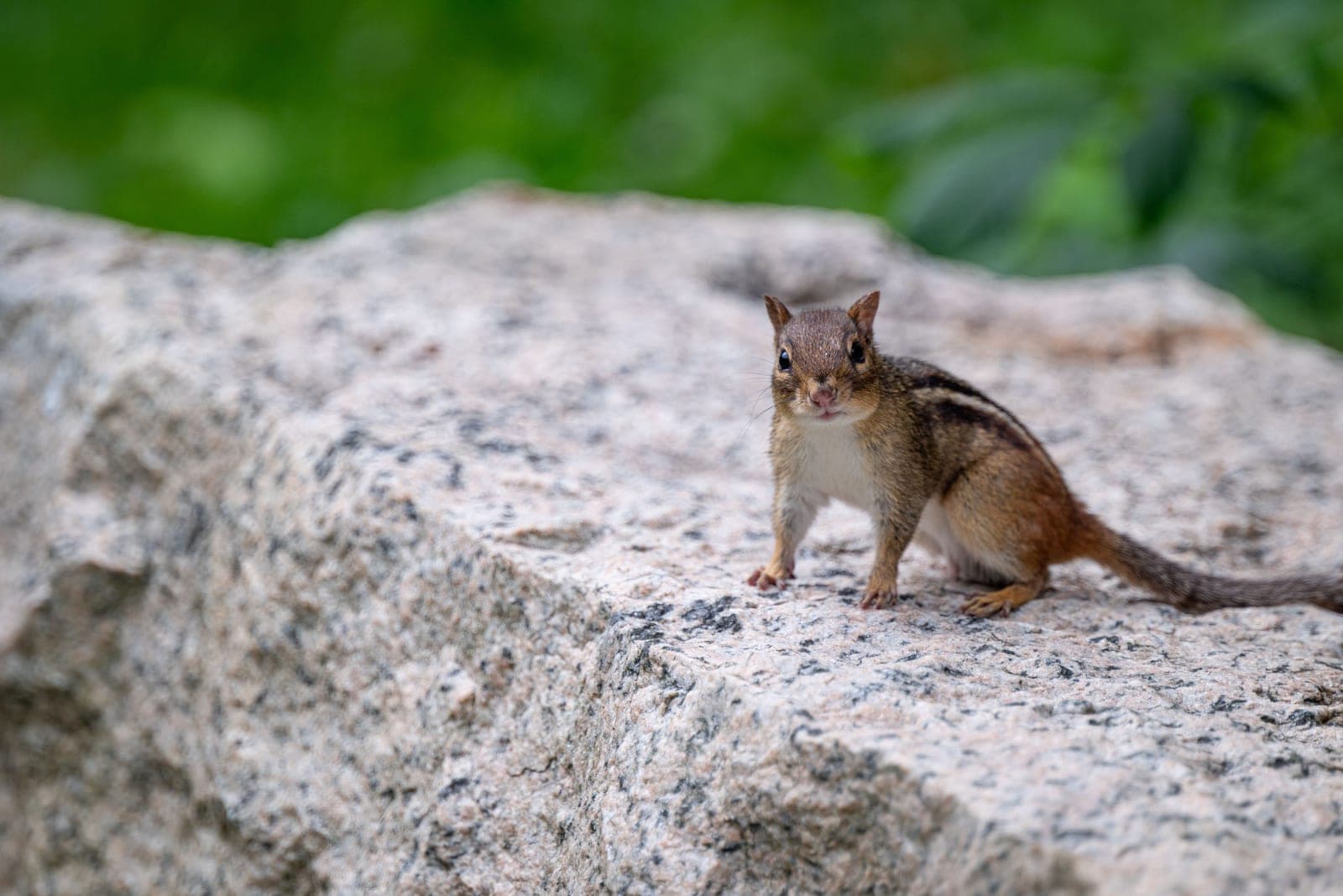
Use mesh of half an inch or smaller, because chipmunks pass apertures that stop rabbits and squirrels. At the feeder, use a caged feeder rather than a weight-activated one, since a chipmunk is far too light to trip a weight mechanism.
Why chipmunks defeat the standard answers
Every mechanism that works on gray squirrels is calibrated or sized for a gray squirrel, and a chipmunk is neither that heavy nor that large.
| Measure | Works on gray squirrels | Works on chipmunks | Why |
|---|---|---|---|
| Weight-activated feeder | Yes | No | Too light to trip the mechanism; feeds under the trigger point |
| Baffle on a pole | Yes | Partly | Blocks the climb, but chipmunks often arrive at ground level and eat spill |
| 2 in hex netting | Yes | No | Passes straight through the aperture |
| Caged feeder | Yes | Yes | Excludes by size, and the gaps are sized for small songbirds |
| 1/2 in hardware cloth | Yes | Yes | Small enough to exclude a chipmunk |
Mesh size is the whole answer
The University of Georgia Extension notes hex netting is sold with 1 in or 2 in openings and in 24, 36 and 48 in heights. For rabbits, 1 in is enough. For chipmunks, go smaller — half-inch hardware cloth is the standard specification and it excludes essentially everything above insect size.
If you are already fencing or caging for something else, choosing the smaller aperture costs very little extra and covers a species that would otherwise walk through your work.
Baffleworks is funded by affiliate commission. If you buy through a link on this page we may earn a commission at no extra cost to you, and it never decides a ranking. Full disclosure · how we pick.
Quick picks
Ranked, with the trade-off named. Tap a row for the full write-up; the price button goes straight to Amazon.
| # | Product | Best for | Price |
|---|---|---|---|
| 1 |  Woodlink WLCAGE2 Designer Caged 4-Port Tube FeederA cage around a tube, which excludes by aperture rather than by weight — so it stops the chipmunk and the red squirrel a weight trigger ignores, and stops the cardinal too. | Small songbirds only | $71.48 on Amazon |
| 2 |  HUNKA Hardware Cloth, 1/2 in mesh, 36 in x 50 ft, 19 gaugeRecommended by specification rather than by brand: 1/2 in mesh, 36 in tall, galvanized. This roll meets it — any roll matching the same three numbers does the same job. | A permanent rabbit barrier | $42.99 on Amazon |
| 3 |  ANC POP Pop-Up Mesh Plant Cover, 2-packANC POP's pop-up cage, sold as a pair. The single-unit listing is gone, so this is now the only way to buy this cage. | Two beds at once | $51.99 on Amazon |
| 4 |  Bobbex-R Rabbit, Squirrel and Chipmunk Repellent, 32 ozFormulated for the small raiders rather than for deer, which matters because the animal eating your bulbs is usually not the animal eating your hostas. | Rabbits and chipmunks specifically | $27.95 on Amazon |
#ad how we are funded · price as of October 24, 2026
The picks in full
Top pick Small songbirds only
Woodlink WLCAGE2 Designer Caged 4-Port Tube Feeder
A cage around a tube, which excludes by aperture rather than by weight — so it stops the chipmunk and the red squirrel a weight trigger ignores, and stops the cardinal too.
Published specifications
- Mechanism
- Fixed cage aperture
- Feeding ports
- 4 (published)
- Cage material
- Metal, bronze finish (published)
- Tube material
- Recycled plastic (published)
- Cleaning
- Published as easy to fill and clean
Trade-offs
- A fixed aperture does not care how heavy the animal is, so it excludes chipmunks and red squirrels as well as grays
- Metal cage rather than a coated wire basket
- The tube is recycled plastic, which is unusual honesty about material in this category
- Nothing to calibrate and nothing to wear out
- The cage excludes cardinals, jays and grosbeaks along with the squirrels — that is the trade, not a defect
- The listing publishes no cage aperture in inches, which is the one number that would let you predict exactly which birds get in
- No published seed capacity
- Plastic tube inside a metal cage: the cage protects it, but only while the cage is intact
Who it is forA yard where chipmunks or red squirrels are the problem and you are content with finches, chickadees and titmice.
Skip it ifYou want cardinals. A cage cannot be adjusted and this one publishes no aperture — the cardinal page covers why a weight trigger is the right mechanism instead.
#ad how we are funded · price as of October 24, 2026
Where these specifications came from
No. 2 A permanent rabbit barrier
HUNKA Hardware Cloth, 1/2 in mesh, 36 in x 50 ft, 19 gauge
Recommended by specification rather than by brand: 1/2 in mesh, 36 in tall, galvanized. This roll meets it — any roll matching the same three numbers does the same job.
Published specifications
- Mesh
- 1/2 in x 1/2 in (published); 1 in or smaller is the spec, 1/2 in excludes young rabbits
- Roll
- 36 in W x 50 ft L (published)
- Gauge
- 19, 0.91 mm wire diameter (published)
- Material
- Hot-dip galvanized over annealed wire (published)
- Height above ground
- At least 2 ft (Colorado State Extension)
- Buried depth
- 4 to 8 in (Colorado State Extension)
Trade-offs
- Extension services put chicken wire, hardware cloth or flexible netting at 2 ft high and buried 4 to 8 in as fairly effective against rabbits
- A permanent fix rather than a reapplication schedule
- Half-inch mesh also excludes young rabbits, which 2 in poultry netting does not
- Hot-dip galvanized after weaving, which is the coating that survives being buried
- Burying the bottom edge is the whole job, and it is real digging
- Galvanized wire is visible in a way black deer netting is not
- 36 in tall means you are burying roughly a third of what you paid for
- The listing warns of sharp edges at both ends — this is a gloves job, and nothing about this brand makes it better than any other roll at the same spec
Who it is forA vegetable plot or a border with a persistent rabbit problem, where you would rather dig once than spray for years.
Skip it ifDeer are the actual problem. Two feet of wire is a step-over for a deer; the height that matters there is 8 ft and up. See deer fencing.
#ad how we are funded · price as of October 24, 2026
Where these specifications came from
No. 3 Two beds at once
ANC POP Pop-Up Mesh Plant Cover, 2-pack
ANC POP's pop-up cage, sold as a pair. The single-unit listing is gone, so this is now the only way to buy this cage.
Published specifications
- Dimensions
- 40 x 40 x 30 in each (published)
- Quantity
- 2
- Stakes
- 8 ground stakes
- Assembly
- Pop-up, folds flat
Trade-offs
- Two beds covered from one purchase, which suits a plot where more than one bed is under pressure
- Identical footprint, so beds can be laid out to one dimension
- You are committed to the 40 in module whether or not your beds match it
- The published 30 in height caps what you can grow under it
Who it is forA vegetable plot with more than one bed under pressure, which is most vegetable plots by midsummer.
Skip it ifYou have one bed and do not want a spare. There is no single-unit listing for this cage any more, so the cheaper two-pack covers on this page are the alternative.
#ad how we are funded · price as of October 24, 2026
Where these specifications came from
No. 4 Rabbits and chipmunks specifically
Bobbex-R Rabbit, Squirrel and Chipmunk Repellent, 32 oz
Formulated for the small raiders rather than for deer, which matters because the animal eating your bulbs is usually not the animal eating your hostas.
Published specifications
- Size
- 32 oz concentrate (published)
- Targets
- Rabbit, squirrel, chipmunk
- Form
- Dilute and spray
- Part number
- B550120
Trade-offs
- Targets the species that deer repellents are not formulated for
- Concentrate, so a season of reapplication is affordable
- Same reapplication burden as every other repellent
- It will not fix a rabbit problem that a 2 ft buried fence would fix permanently
Who it is forBulbs, seedlings and container plants that rabbits, chipmunks or squirrels are working through, where a cage would be impractical.
Skip it ifThe damage is at ground level along a boundary. Colorado State Extension is specific: two feet of wire buried 4 to 8 inches is fairly effective against rabbits, and that is a permanent fix a spray is not. See rabbit fencing.
#ad how we are funded · price as of October 24, 2026
At the feeder
A caged feeder is the answer, and it is not a compromise choice — a cage excludes by geometry, so the animal's weight is irrelevant. Woodlink's caged tube publishes four ports; the Girvenith publishes 10.25 x 6.25 x 6.25 in.
A weight-activated feeder is the wrong purchase here regardless of brand or price, because the mechanism is mass and a chipmunk has too little of it. That is not a product failure and buying a more expensive one will not change it.
Ground-level pressure is the other half
Chipmunks are ground animals in a way squirrels are not. They live in burrows, they forage at ground level, and spilled seed under a feeder is a more attractive resource to them than the feeder itself.
- Fit a seed tray on the feeder. It removes the ground buffet that draws them in.
- Rake underneath regularly, especially in wet weather when seed germinates and rots.
- Store seed in sealed containers, not in an open bag in a shed. A chipmunk will find an open bag.
- Clear fallen fruit and nuts, which are the same attractant by another name.
Beds and bulbs
The same measures as for squirrels in the garden apply, with the mesh sized down. A rigid cage over the bed works if the mesh is fine enough; a wire layer over freshly planted bulbs, covered with soil, blocks the digging window.
Plants squirrels avoid covers the bulb side of this, which applies to chipmunks caching in autumn as much as to squirrels.
Bobbex-R is formulated for rabbits, squirrels and chipmunks and is the repellent to use where a cage is impractical — a container, a specimen plant, a border you will not cover.
On burrows, briefly
Chipmunk burrow entrances are small, neat holes with no soil mound, often at the edge of a wall, patio or foundation. They rarely cause structural problems in a garden, and the practical response is to reduce food and cover rather than to attempt removal.
If burrowing is undermining a wall, a step or a foundation, that is a structural matter and the Internet Center for Wildlife Damage Management is a better reference than any retailer. Trapping and relocation is regulated differently in every state and we do not recommend it.
Two places chipmunks show up that fabric covers do not handle: a raised bed, where the raised bed cover roundup separates the mesh that stops birds from the wire that stops a digger; and a strawberry patch, where the strawberry netting page covers why the berries vanish one at a time and what holds them.
A much larger burrower needs a much larger fence. How to keep groundhogs out of the garden covers the one garden mammal that both climbs a fence and digs under it, and the 3 ft wire, outward apron and deliberately floppy top published for it.
Chipmunks are the clearest case for choosing the finer mesh: they pass through chicken wire without touching it. Hardware cloth vs chicken wire covers the published mesh sizes by animal.
If the culprit is smaller, plainer and you only ever see the runways rather than the animal, it is more likely a vole. Vole control covers how to tell the damage apart and what the published fix is.
Questions people actually ask
- What mesh size keeps chipmunks out?
- Half an inch or smaller. The University of Georgia Extension notes hex netting comes in 1 in and 2 in openings; 1 in stops rabbits but a chipmunk needs a finer aperture.
- Why do chipmunks get into my squirrel-proof feeder?
- Because it is weight-activated and they are too light to trip it. That is a calibration limit rather than a defect. A caged feeder excludes by size and works on chipmunks.
- How do I stop chipmunks eating spilled birdseed?
- Fit a seed tray to catch the spill and rake underneath regularly. Ground-level seed is a bigger attractant to a chipmunk than the feeder itself.
- Do chipmunk repellents work?
- Plant repellents formulated for chipmunks, such as Bobbex-R, reduce damage while they are on the plant, with the usual reapplication burden. Barriers with fine enough mesh are the permanent answer.
- Are chipmunk burrows a problem?
- Rarely in a garden — the entrances are small and there is no soil mound. If burrowing is undermining a wall or foundation, treat it as a structural matter and consult a licensed operator.
Sources
Read next
- How to keep squirrels out of the garden
Squirrels work a garden rather than browse it, which is why a cage holds and a drape does not.
- Caged bird feeders
Exclusion by size rather than weight: the mechanism that beats chipmunks, red squirrels and starlings.
- The best plant cages and cloches
Pop-up cages and cloches ranked by published dimensions and how well the skirt actually pins down.
- Rabbit fencing
Two feet high, buried four to eight inches, one inch mesh. The one garden problem with a published answer.
- Garden Protection
Cages, cloches, netting and rabbit fencing, sized to the animal doing the damage rather than to the bed.